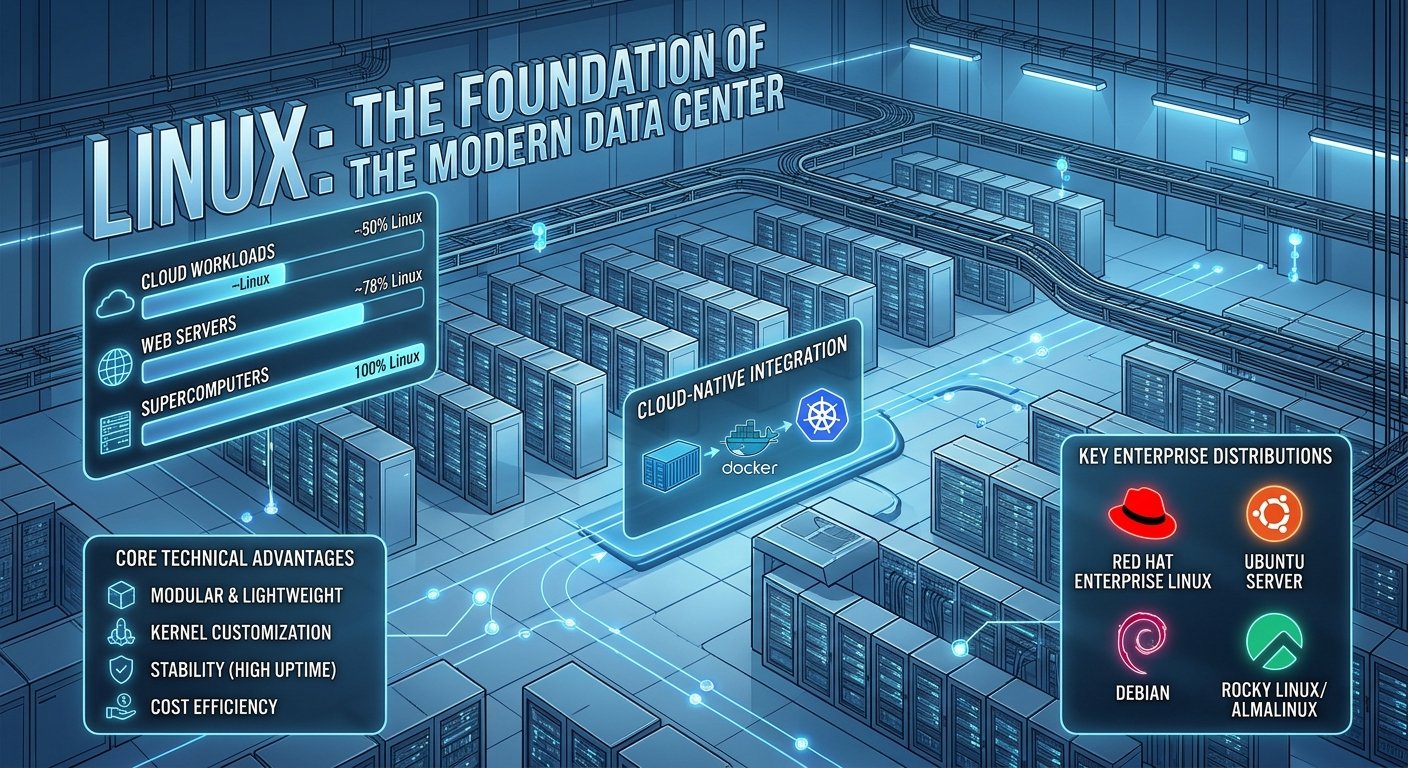
Modern data centers are the invisible backbone of the digital age, powering everything from global financial transactions and streaming services to enterprise cloud computing and massive artificial intelligence workloads. At the heart of this infrastructure lies an overwhelming technological preference: the Linux operating system. While consumer desktop computing remains heavily split, enterprise data centers rely almost universally on Linux to orchestrate trillions of daily operations.
The Evolution and Dominance of Linux in Enterprise Infrastructure
Historically, enterprise server environments were dominated by proprietary Unix variations and Microsoft Windows Server. However, as web traffic scaled exponentially in the late 1990s and 2000s, organizations required an operating system that offered robust performance, granular source-code control, and freedom from prohibitive licensing fees. Linux emerged as the ideal solution.
Today, Linux commands the vast majority of server and cloud workloads. According to industry data, Linux powers nearly half of all global cloud workloads, roughly 78% of web-facing servers, and 100% of the TOP500 most powerful supercomputers globally. Major hyper-scale cloud providers—such as Amazon Web Services (AWS), Microsoft Azure, and Google Cloud Platform—rely heavily on customized Linux kernels to manage millions of virtual machines and physical servers efficiently.
Core Technical Advantages Driving Linux Adoption
Data center operators choose Linux for several fundamental architectural and economic reasons:
- Performance and Low Overhead: Linux is modular and lightweight. Unlike operating systems burdened with graphical user interfaces and unnecessary background processes, a server-optimized Linux installation can be stripped down to consume minimal CPU and memory resources. This ensures maximum hardware utilization for actual applications.
- Kernel Customization: The open-source nature of the Linux kernel allows system architects to recompile or tune the operating system for specialized workloads. Whether optimizing TCP/IP networking stacks for low-latency high-frequency trading or tweaking memory management pages for massive database clusters, engineers have complete control.
- Stability and Uptime: Linux servers are renowned for their rock-solid reliability. Critical security patches and even major kernel updates can often be applied without requiring a full system reboot, ensuring uninterrupted service-level agreements (SLAs).
- Cost Efficiency: Licensing fees for proprietary operating systems can scale into millions of dollars across thousands of physical servers. Linux eliminates per-core or per-socket software licensing costs, allowing companies to redirect capital toward hardware infrastructure and engineering talent.
Popular Linux Distributions in the Data Center
While the core Linux kernel remains consistent, different enterprises utilize distinct distributions (distros) tailored to their specific operational priorities:
- Ubuntu Server: Developed by Canonical, Ubuntu is widely regarded as a dominant force in cloud-native deployments and DevOps environments. Its extensive documentation, rapid hardware compatibility, and deep integration with container platforms make it a favorite for modern web applications.
- Red Hat Enterprise Linux (RHEL): RHEL is the enterprise standard for mission-critical banking, government, and corporate systems. Organizations choose RHEL for its rigorous security features (such as SELinux), long-term support cycles, and comprehensive 24/7 commercial support.
- Rocky Linux and AlmaLinux: Following changes to the CentOS project, these community-driven distributions stepped in to provide a 1:1 binary-compatible alternative to RHEL, giving organizations enterprise-grade stability without corporate licensing fees.
- Debian: Celebrated for its strict conservative stability philosophy, Debian serves as the underlying foundation for numerous other distributions and is chosen for core networking or database infrastructure where absolute reliability is paramount.
Linux as the Engine of Cloud-Native and Container Ecosystems
The modern data center extends far beyond traditional bare-metal servers. The explosive growth of containerization and orchestration frameworks—most notably Docker and Kubernetes—is inextricably linked to Linux.
Technologies like Linux cgroups (control groups) and namespaces form the underlying security and isolation primitives that allow containers to run efficiently on shared hardware. Because the vast majority of container base images (such as Alpine Linux or Debian slim) are Linux-based, the modern DevOps toolchain speaks fluent Linux. From automated CI/CD pipelines to massive hyperscale Kubernetes clusters, Linux provides the consistent operating layer that makes cloud elasticity possible.
Source List
- Command Linux: Linux Data Center Market Statistics
- Fortune Business Insights: Linux Operating System Market Size, Share & Growth Forecast
- TechnologyChecker: Linux Market Share Analysis
- NovoServe: Top Linux Distros for Bare Metal Dedicated Servers
- EasyDataHost: Most Used Linux Distributions for Servers
- Conclusive Tech: Top Linux Distros for Professionals