Categories
Fedora Internet Websites

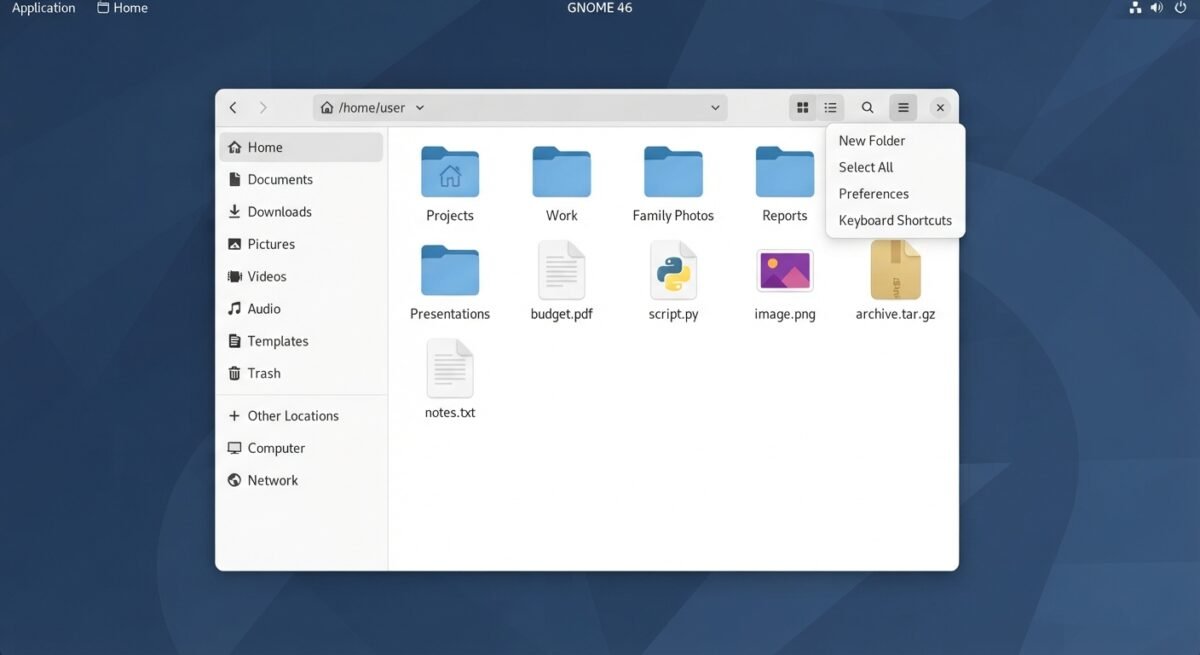
Navigating the Linux Desktop: A Study of the Nautilus File Manager and Its Role in Fedora

In the graphical world of Linux, a file manager is far more than a visual wrapper around filesystem commands—it is the primary spatial bridge between a user’s personal data, system storage, network shares, and installed applications. On the GNOME desktop environment and throughout the default workstation edition of Fedora Linux, that bridge is GNOME Files, widely known by its original and internal codename, Nautilus. Balancing clean minimalist design with deep desktop integration, Nautilus exemplifies how open-source software evolves across decades of shifting interface paradigms, toolkit migrations, and Linux distributions.
Categories
Fedora Networking

Streamlining Virtualization: Running Fedora Server on Fedora Workstation via GNOME Boxes

The Linux operating system has long been celebrated for its robustness, flexibility, and power as a hosting environment. Among its many strengths, native support for kernel-based virtualization transforms a standard Linux desktop into a comprehensive hypervisor. Setting up and managing virtual machines (VMs) has historically been associated with complex configurations, tedious command-line switches, and dense networking parameters. However, modern Linux distributions have radically simplified this landscape. By leveraging tools built directly on Kernel-based Virtual Machine (KVM) technology, users can effortlessly spin up virtual environments.

A prime example of this seamless capability is running Fedora Server inside Fedora Workstation using GNOME Boxes. This combination demonstrates how accessible enterprise-grade virtualization has become for everyday users, developers, and system administrators alike.

Categories
Fedora Internet

Reclaiming Digital Sovereignty: Why Users Are Rejecting Windows 11 and Finding Refuge in Fedora Linux

The personal computer once represented a sanctuary of individual ownership. Your hardware was yours, your files stayed local, and the operating system served strictly as a quiet tool to execute your commands. Today, navigating modern operating systems—most notably Microsoft’s Windows 11—feels less like owning a tool and more like renting a digital billboard. Driven by aggressive telemetry, forced cloud integrations, intrusive artificial intelligence push, and a default state engineered for corporate surveillance, Windows 11 has alienated a massive wave of power users, privacy advocates, and everyday consumers.

For those looking to escape this ecosystem of control, the open-source community provides a robust, ethical alternative. Chief among them is Fedora Linux—an operating system that puts user agency back where it belongs.

Categories
Fedora Internet Websites

The Architecture and Role of Fedora Server in Web Hosting

Fedora Server is a community-driven, open-source Linux distribution developed by the Fedora Project and sponsored by Red Hat. Positioned as the upstream proving ground for Red Hat Enterprise Linux (RHEL), Fedora Server bridges the gap between bleeding-edge open-source innovation and enterprise-grade architectural standards. Unlike traditional long-term support distributions that freeze software versions for years, Fedora operates on a rapid six-month release cycle with an approximate 12-month maintenance window per release, giving system administrators immediate access to modern Linux kernels, updated system libraries, and current server daemons.

Categories
Command Line Fedora

The Linux Ecosystem: Navigating Distributions and Packaging Systems

Linux is a powerful, open-source operating system kernel created by Linus Torvalds in 1991. Because the core operating system is freely distributed under the GNU General Public License, anyone can take the kernel, combine it with system utilities, window managers, and application software, and assemble a complete operating system. These custom-tailored collections are known as distributions, or distros.

With hundreds of active operating systems available, navigating the Linux ecosystem can feel overwhelming. However, almost every major Linux distribution can be classified into distinct families based on its underlying package management system. Package managers handle software installation, updates, dependency resolution, and system integrity.