Categories
Internet Networking

Demystifying Computer Networking: Protocols, Addressing, and Subnets

At its core, computer networking is the invisible infrastructure that allows billions of devices worldwide to communicate, share data, and access information. Whether you are loading a webpage, sending an instant message, or streaming a video, a complex suite of rules and mathematical structures works behind the scenes to deliver data accurately.

To understand how this digital ecosystem functions, we need to examine the foundational layers of networking: how data is transmitted using TCP/IP, why IPv4 addresses are structured the way they are, and how netmasks and network classes organize global traffic.

Categories
Command Line Programming

The Bourne Again Shell (Bash): The Engine of Linux Productivity

The command line is often described as the beating heart of the Unix and Linux operating systems. At the center of this interactive universe sits the Bourne Again Shell, universally known as Bash. Developed as a free software replacement for the original Bourne shell (sh), Bash has served as the default command interpreter for the vast majority of Linux distributions for decades. Its enduring dominance stems from a unique balance of rigorous POSIX compliance, powerful scripting constructs, and an intuitive interactive environment that empowers users ranging from casual hobbyists to seasoned systems administrators.

Categories
Internet

The Evolution of an Open-Source Titan: A Brief History of the Linux Operating System

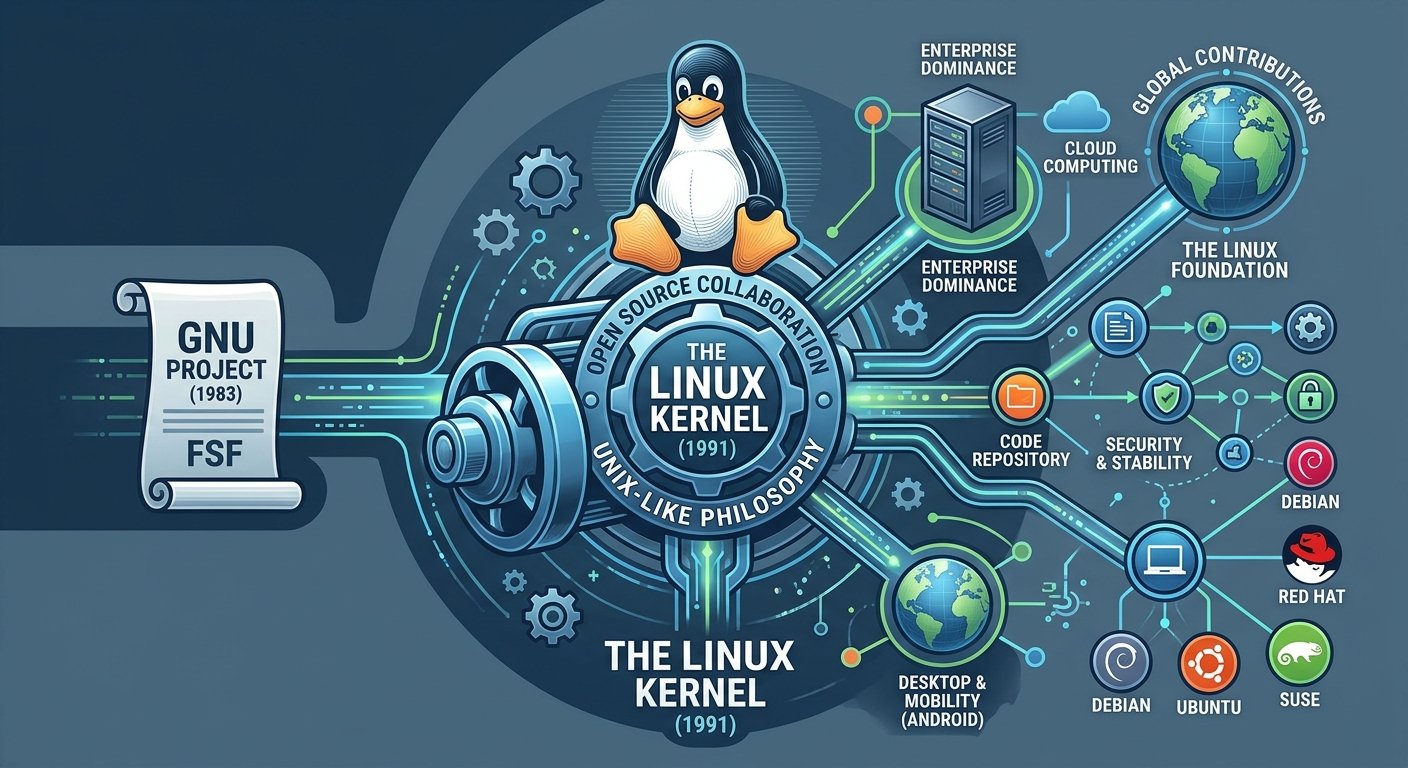
Few technologies have reshaped the digital landscape as profoundly as Linux. What began in 1991 as a personal experiment by a university student has grown into the invisible engine driving the modern world. From smartphones running Android and cloud-computing infrastructure to the world’s fastest supercomputers, Linux is everywhere. Understanding its history is a journey through collaboration, philosophy, and the power of open-source software.

Categories
Command Line

Mastering File Security: A Guide to the Linux chmod Command

In the landscape of Unix and Linux operating systems, security and multi-user access control are foundational. Every file and directory is bound to a specific owner and group, governed by strict access permissions. Managing these access rights is essential for maintaining system integrity and safeguarding sensitive data. At the heart of this privilege management system lies the chmod command, short for “change mode”. Whether you are a system administrator locking down a server or a developer making a shell script executable, understanding how to use chmod is a vital skill.

Categories
Internet

The Economical Elegance of GNOME: Why the Default Linux Desktop Wins

Choosing a graphical user interface (GUI) in the Linux ecosystem can often feel overwhelming, given the sheer variety of window managers and desktop environments available. However, among all options, the GNOME Desktop Environment stands out as the premier choice for modern computing. Far from being just another interface, GNOME represents a cohesive design philosophy centered around human efficiency, cognitive clarity, and ruthless minimalism.