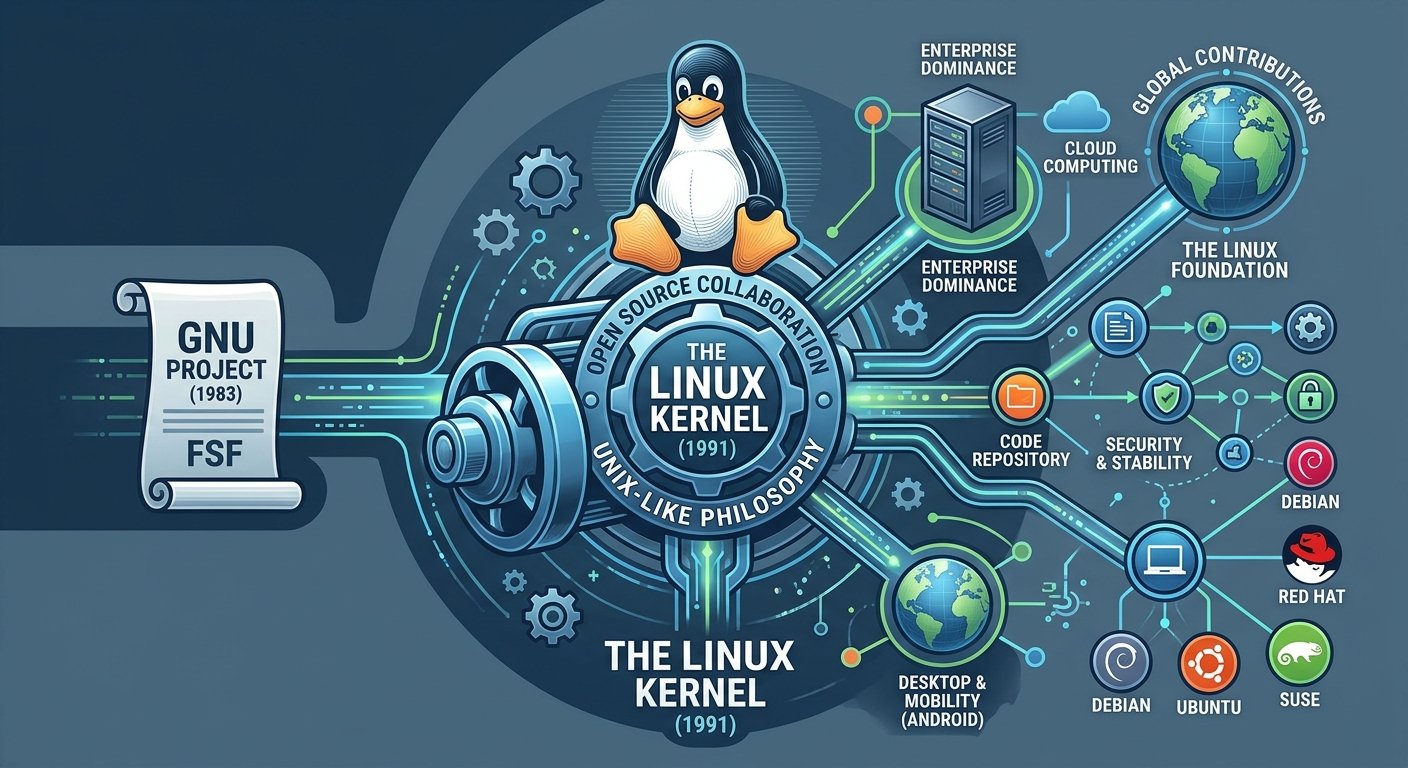
Few technologies have reshaped the digital landscape as profoundly as Linux. What began in 1991 as a personal experiment by a university student has grown into the invisible engine driving the modern world. From smartphones running Android and cloud-computing infrastructure to the world’s fastest supercomputers, Linux is everywhere. Understanding its history is a journey through collaboration, philosophy, and the power of open-source software.
1. The Precursors: Unix and the GNU Project
To understand Linux, one must first look at its predecessors. In the late 1960s and 1970s, Unix was developed at AT&T Bell Labs. While revolutionary, Unix was heavily proprietary and expensive, making it largely inaccessible to students and independent hobbyists.
By September 1983, computer scientist Richard Stallman launched the GNU Project with a bold mission: to create a complete, free Unix-like operating system. Stallman also established the Free Software Foundation (FSF) and authored the GNU General Public License (GPL), establishing a legal framework that guaranteed users the freedom to run, study, share, and modify software. By 1990, the GNU Project had built or gathered nearly all the components needed for a full operating system—except for one crucial element: the kernel.
2. Linus Torvalds and the 1991 Breakthrough
The missing puzzle piece arrived in 1991. Linus Torvalds, an undergraduate student at the University of Helsinki, became frustrated by the licensing restrictions and limitations of MINIX—a small Unix-like system used for academic instruction. Seeking a free alternative that could run on inexpensive Intel 386 hardware, Torvalds began writing his own kernel.
- The First Announcement: In August 1991, Torvalds famously posted a message to the
comp.os.minixUsenet newsgroup, describing his project as a “hobby, won’t be big and professional like gnu”. - The Name: Originally leaning toward the name Freax (a mix of “free,” “freak,” and “X” for Unix), the project was soon dubbed Linux by an FTP server administrator.
- Joining with GNU: While Torvalds built the kernel, it lacked user-space tools. By pairing the Linux kernel with utilities, compilers (like GCC), and shells from the GNU Project, a fully functional, free operating system came to life—frequently referred to as GNU/Linux. In 1992, Torvalds licensed the kernel under the GNU GPL, cementing its open-source trajectory.
3. The Rise of Distributions and Community Expansion
As the kernel matured, developers worldwide began contributing code via the internet. Because raw source code was difficult for average users to compile and install, Linux distributions (“distros”) emerged to bundle the kernel, system utilities, and application software into cohesive, ready-to-install packages.
- Early Distros: Softlanding Linux System (SLS) paved the way, quickly followed in 1993 by Slackware (created by Patrick Volkerding, making it the oldest actively maintained distro) and Debian (founded by Ian Murdock).
- Commercialization: In 1995, Red Hat Linux launched, providing enterprise-grade support that made open-source software viable for corporate IT departments.
- The Mascot: Around 1996, Tux the Penguin was officially adopted as the playful mascot of Linux, chosen after a contest won by Larry Ewing.
4. Corporate Adoption and Modern Dominance
Throughout the late 1990s and early 2000s, tech giants like IBM, Intel, and Oracle recognized the stability, security, and cost-effectiveness of Linux, pouring billions into its development.
To protect and standardize the ecosystem, The Linux Foundation was established in 2000. Today, Linux development is a global collaborative effort involving thousands of independent developers and major technology corporations alike. Its principles of openness and peer review have not only defined the modern software industry but have also proven that global, decentralized collaboration can outpace traditional proprietary development models.