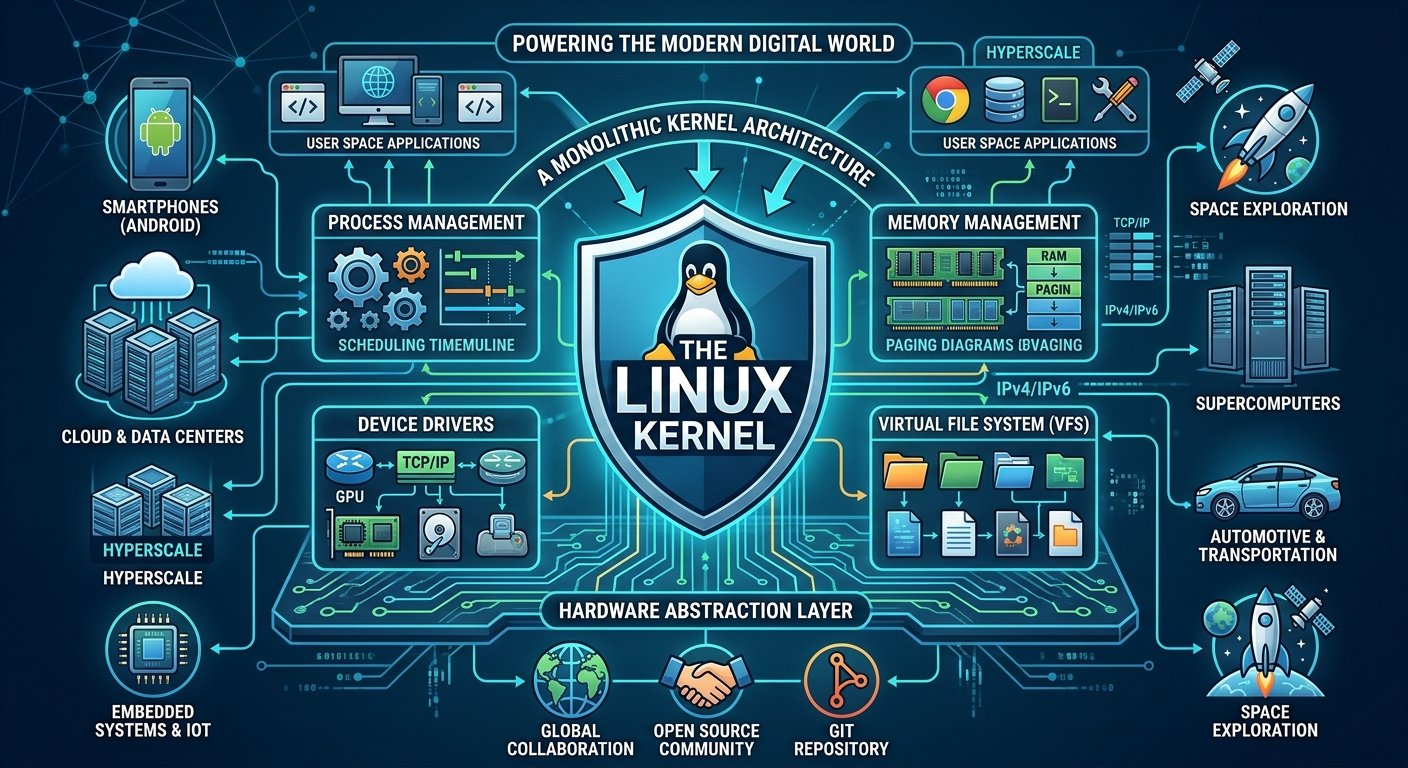
The Linux kernel stands as one of the most remarkable collaborative engineering achievements in human history. Serving as the foundational core of the GNU/Linux operating system, it bridges physical computer hardware and user-space applications. From humble beginnings as a hobbyist project in the early 1990s, it has grown into a ubiquitous software force powering everything from embedded microcontrollers and Android smartphones to hyperscale cloud infrastructures, supercomputers, and space exploration equipment.
1. Core Architectural Principles
At an architectural level, the Linux kernel is classified as a monolithic kernel. Unlike microkernels—which keep core services like file systems and process coordination in separate user-space servers—Linux executes all core operating system services (such as process management, memory management, networking stacks, and device drivers) within a single high-privileged address space known as kernel space.
This monolithic design delivers exceptionally high performance and low execution overhead because subsystems can communicate directly via internal function calls rather than expensive message passing. To maintain modularity and avoid bloat, Linux utilizes dynamically loadable kernel modules, allowing administrators to insert or remove drivers and features on demand without requiring a full system reboot.
Primary Subsystems
- Process Management: Manages task execution, thread scheduling, and multi-processing via advanced schedulers designed to balance workloads fairly and efficiently across single or multiple CPU cores.
- Memory Management: Oversees physical RAM, virtual memory mappings, paging structures, and caching mechanisms to optimize resource utilization and isolate application environments.
- Virtual File System (VFS): Provides a generalized abstraction layer that allows the operating system to support dozens of distinct physical and network file systems (such as Ext4, XFS, Btrfs, and NFS) through a uniform API.
- Networking Stack: Implements comprehensive protocols ranging from raw Ethernet and IPv4/IPv6 networking to advanced packet filtering, routing, and firewall capabilities via
netfilterandnftables. - Device Drivers: Acts as the critical mediator, exposing unified interfaces so that user applications can interact seamlessly with diverse physical hardware components.
2. Historical Evolution and Development Scale
The kernel’s story began in August 1991, when a University of Helsinki student named Linus Torvalds announced a free operating system kernel as a personal hobby project inspired by Andrew Tanenbaum’s educational MINIX system. Initially distributed under a restrictive custom license, Torvalds relicensed the kernel under the GNU General Public License Version 2 (GPLv2) in 1992, aligning it with Richard Stallman’s Free Software Foundation ecosystem and the broader GNU Project.
Over the decades, the codebase expanded dramatically alongside the global open-source community. Managed using Git—a version control system custom-built by Linus Torvalds precisely to handle the immense scale of Linux development—the source tree crossed major milestones. By early 2025, the kernel surpassed 40 million lines of code, drawing contributions from thousands of individual developers and major technology enterprises worldwide. Recent versions have also introduced modern memory-safe languages like Rust alongside traditional C code to enhance security and driver reliability.
3. The Development Community and Upstream Process
Kernel development is governed by an open, meritocratic, and highly organized community workflow coordinated primarily through the Kernel.org infrastructure and the Linux Foundation.
Developers contribute modifications via patches submitted to specialized subsystem mailing lists (archived extensively on platforms like LWN.net). Maintainers review these patches for architectural consistency, performance, and adherence to strict coding standards before pushing them upstream into mainline release candidates. Comprehensive technical documentation for developers and system administrators is continuously maintained and published through the Linux Kernel Documentation Project, providing deep insights into internal APIs, locking primitives, and debugging tools.
Source List
- The Linux Kernel Archives – Official source code releases, cryptographic signatures, and development portals.
- The Linux Kernel Documentation – Comprehensive guides for kernel developers, driver implementers, and system administrators.
- Wikipedia: Linux Kernel – Historical timeline, licensing details, and version statistics.
- Red Hat: What is the Linux kernel? – Conceptual overviews of kernel responsibilities, user space, and kernel space.
- IBM Developer: Anatomy of the Linux kernel – Technical breakdowns of core subsystems, memory management, and process scheduling.
- LWN.net (Linux Weekly News) – In-depth historical articles and continuous journalistic coverage of kernel development.
- The GNU Project – Information regarding GNU utilities, compilers, and the philosophical foundations of free software.
- The Linux Foundation – Umbrella organization supporting collaborative open-source technological innovation.