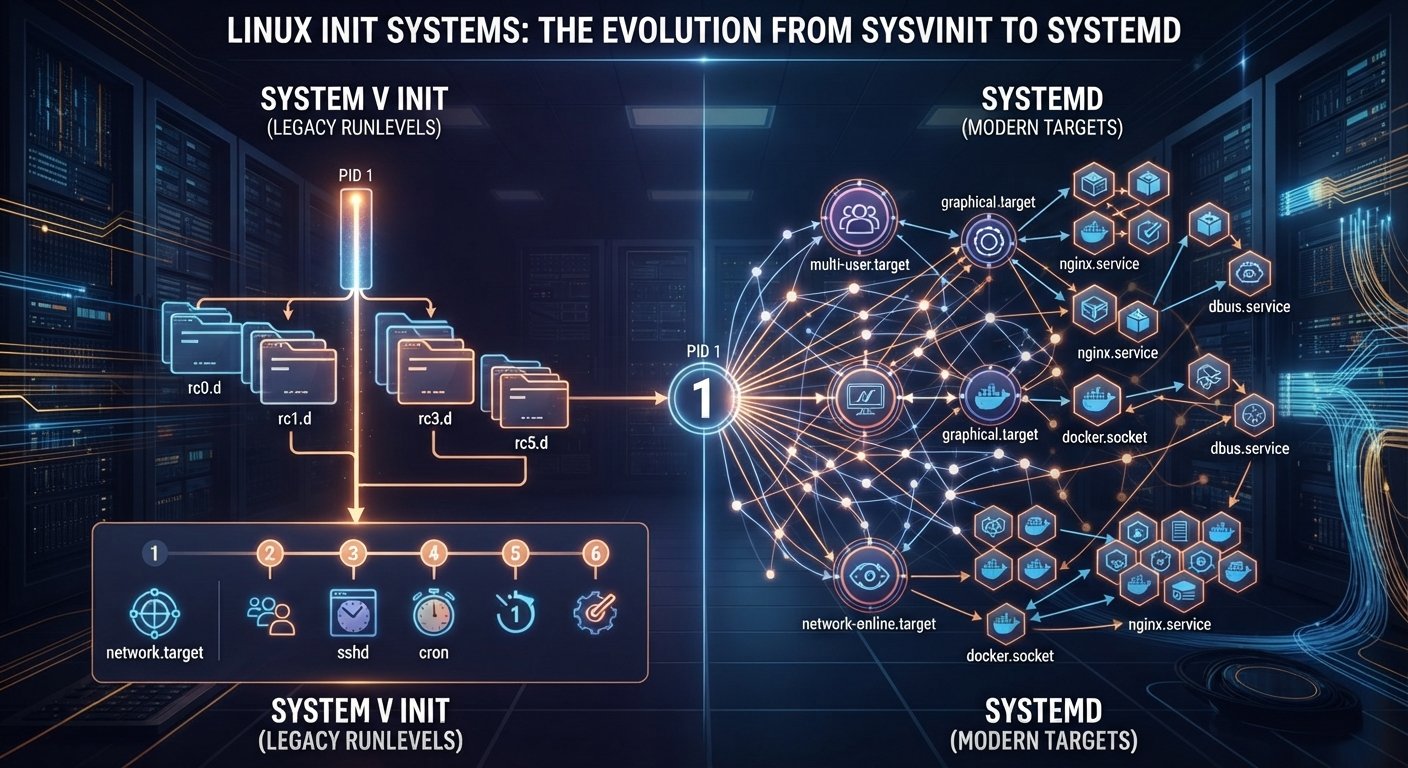
The initialization system is the literal foundation of a running Linux operating system. As the very first process spawned by the kernel (Process ID 1, or PID 1), the init system is responsible for bringing up hardware daemons, mounting filesystems, and setting the operating environment into a usable state. For decades, the Linux ecosystem relied heavily on System V init (SysVinit) and its paradigm of runlevels. However, as hardware evolved and server architecture scaled into complex cloud environments, systemic limitations sparked a massive paradigm shift. This led to the widespread adoption of systemd, a modern suite that completely redefined how Linux initializes and manages services.
1. The Era of System V (SysV) Init and Runlevels
Derived from historical Unix System V releases, SysVinit governed the Linux boot sequence and system state lifecycle for generations. Its core operational concept centered around runlevels—distinct, predefined operating states that dictated which system services and daemons should run.
Understanding Runlevels
A typical SysV-based Linux system recognized a standard set of runlevels, usually numbered 0 through 6:
- Runlevel 0: Halt / Shutdown
- Runlevel 1 (or S/s): Single-user mode (used for administrative repair and recovery)
- Runlevel 2: Multi-user mode without network services (or user-definable depending on the distribution)
- Runlevel 3: Full multi-user mode with networking (standard for text-only servers)
- Runlevel 4: Unused / User-definable
- Runlevel 5: Full multi-user graphical mode (boots into a display manager / desktop environment)
- Runlevel 6: Reboot
Administrators could check the active runlevel using commands like runlevel or who -r, and transition between states dynamically using the init or telinit commands.
How SysV Initialization Worked Under the Hood
The configuration of SysV init was anchored in the /etc/inittab file, which defined the default system runlevel. Upon booting, the init program parsed this file and looked into structured directories under /etc/rc.d/ (such as /etc/rc3.d/ for runlevel 3).
These directories contained symbolic links pointing back to master shell scripts stored in /etc/init.d/. The links were prefixed with specific naming conventions:
Sscripts: Followed by a two-digit sequence number, indicating services to Start upon entering that runlevel.Kscripts: Followed by a sequence number, indicating services to Kill when leaving or entering a state.
Strengths and Limitations of SysV
SysVinit was deeply celebrated for its simplicity, transparency, and predictability. Because services were managed via standard Bourne shell scripts (/etc/init.d/*), debugging a failing service was as straightforward as reading a bash script or running it manually with verbose output.
However, as computer hardware scaled, SysVinit began displaying critical architectural bottlenecks:
- Sequential Booting: SysVinit executed startup scripts strictly one-by-one in numerical order. If a single script hung waiting for a disk timeout or network response, the entire boot sequence completely froze.
- Poor Dependency Tracking: Shell scripts had rudimentary mechanisms for tracking true service dependencies, often leading to race conditions where a daemon started before its required network interface or database backend was actually ready.
- Lack of Post-Boot Supervision: Once init handed off processes and launched scripts, it essentially washed its hands of active monitoring. If a daemon crashed silently in the background, SysVinit did not automatically restart it.
2. The Rise of systemd and Target-Based Initialization
To address the performance constraints and monitoring shortcomings of legacy init schemes, Lennart Poettering and Kay Sievers introduced systemd in 2010. Initially met with heated debate across the open-source community regarding the Unix philosophy (“do one thing and do it well”), systemd quickly became the default standard for nearly all major Linux distributions (including Fedora, Red Hat Enterprise Linux, Ubuntu, Debian, and openSUSE).
What is systemd?
systemd is far more than a simple replacement for PID 1; it is an integrated system and service management suite. It coordinates core system components, including centralized logging (journald), device management (udevd), login session tracking, network time synchronization, and automated socket activation.
Unit Files and Parallelization
Instead of relying on sprawling shell scripts, systemd organizes system resources using declarative unit files (e.g., .service, .target, .socket, .mount). These configuration files explicitly outline dependencies (After=, Requires=, Wants=) in a structured format.
This architecture enables parallel startup: rather than waiting for services to boot sequentially, systemd builds a comprehensive dependency tree and fires up independent services concurrently as soon as their prerequisites are met, drastically reducing overall boot times. Furthermore, systemd actively supervises daemons via Linux Control Groups (cgroups), ensuring that crashed services are automatically restarted or isolated safely.
From Runlevels to Targets
To maintain backwards compatibility while modernizing system states, systemd replaced numerical runlevels with targets. Targets are simply specialized unit files (ending in .target) that group multiple units together.
Common systemd targets map directly to traditional SysV runlevels:
poweroff.target➔ Equivalent to Runlevel 0 (Shutdown)rescue.target➔ Equivalent to Runlevel 1 (Single-user / Maintenance mode)multi-user.target➔ Equivalent to Runlevel 3 (Multi-user CLI environment)graphical.target➔ Equivalent to Runlevel 5 (Multi-user GUI environment)reboot.target➔ Equivalent to Runlevel 6 (Reboot)
Administrators interact with systemd using the systemctl utility. For instance, checking the default operational state is handled via systemctl get-default, and shifting operational modes on the fly is managed using systemctl isolate graphical.target.
3. Conclusion
The transition from System V runlevels to systemd represents one of the most profound structural shifts in Linux history. While SysVinit championed script-based simplicity and transparency, it could not keep pace with the demands of modern multi-core hardware, cloud scalability, and rapid system initialization. systemd replaced rigid numerical modes with flexible, dependency-driven targets and parallelized service execution. Understanding both frameworks remains a vital competency for Linux system administrators navigating legacy infrastructure and modern enterprise environments alike.
Source Bibliography
- Red Hat Enterprise Linux Reference Guide. “1.4. SysV Init Runlevels.” Available via the Red Hat Documentation portal: RHEL 4 Reference Guide – SysV Init Runlevels.
- Wikipedia Contributors. “Runlevel.” Wikimedia Foundation, Encyclopedia entry covering multi-distribution runlevel implementations and POSIX standards: Wikipedia Runlevel Entry.
- LinuxSecurity Feature Articles. Gomez, Brian. “Optimize System Security with Linux Services and Runlevels.” Published September 2022: LinuxSecurity Runlevels Guide.
- Linux Journal. “Runlevels and the Boot Process in Linux.” Published November 2023: Linux Journal Boot Process & Targets.
- CentOS Documentation Vault. “1.4. SysV Init Runlevels.” Historical archival documentation for CentOS / Red Hat Enterprise Linux architecture: CentOS Vault RHEL 3 Guide.
- Medium / Technical Deep Dives. MKGS, Janani. “Traditional Init vs systemd — A Deep Dive into Linux Boot Evolution.” Published March 2026: Medium Traditional Init vs systemd Analysis.