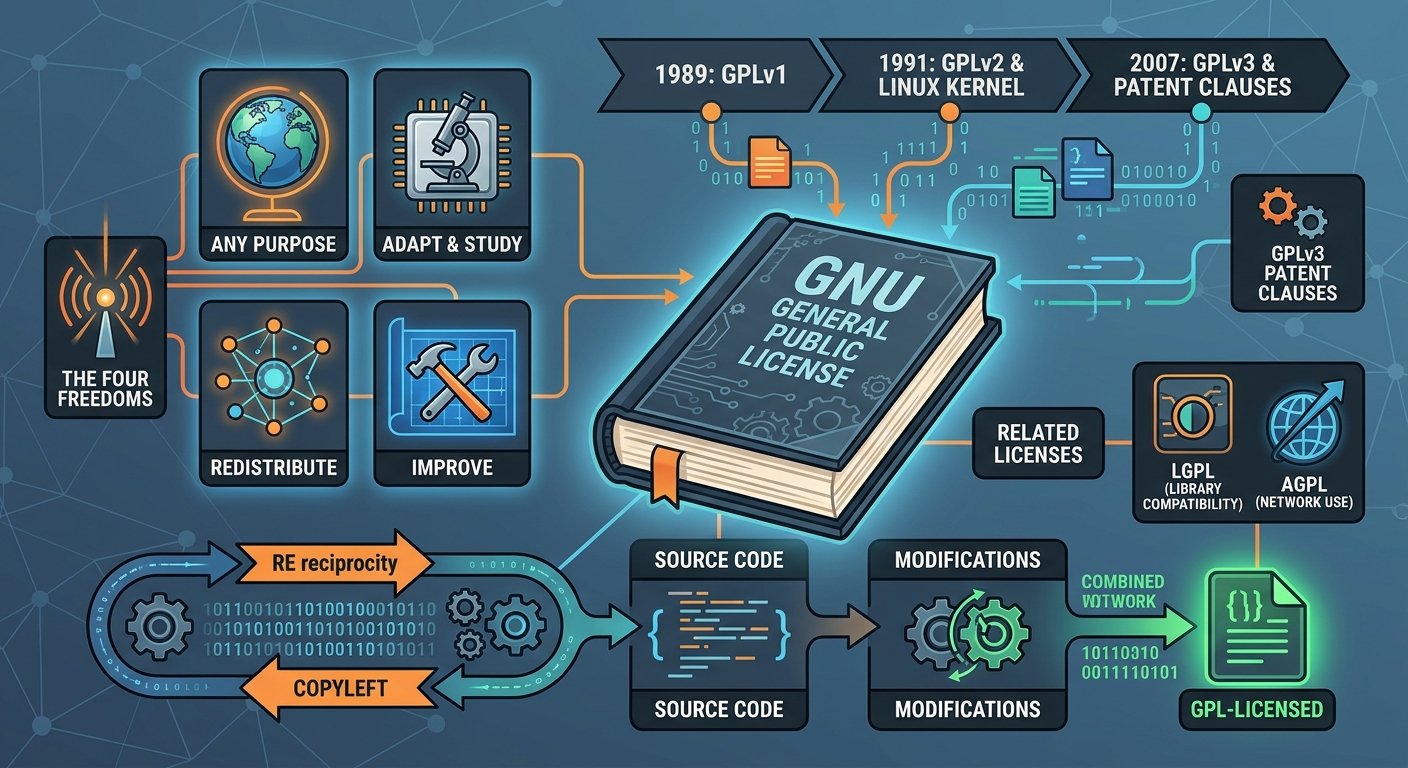
The GNU General Public License (GPL) is the foundational pillar of the free and open-source software movement. Formulated by Richard Stallman and the Free Software Foundation (FSF), the GPL redefined how software intellectual property is treated by utilizing copyright law to grant and protect end-user rights rather than restricting them.
What is the GNU GPL?
At its core, the GPL is a strong copyleft software license. Unlike permissive licenses—such as the MIT License or the Apache License 2.0—which allow developers to take open code and embed it into closed, proprietary commercial applications, the GPL demands reciprocity.
The license guarantees four core freedoms defined by the Free Software Foundation:
- Freedom 0: The freedom to run the program for any purpose.
- Freedom 1: The freedom to study how the program works and adapt it to your needs.
- Freedom 2: The freedom to redistribute copies so you can help others.
- Freedom 3: The freedom to improve the program and release your improvements to the public.
Under the GPL, anyone who modifies or redistributes GPL-licensed software must make the source code available under the exact same terms. This mechanism ensures that software released under the GPL remains permanently free for all downstream users.
Historical Context and Development
The story of the GPL begins in the early 1980s at the Massachusetts Institute of Technology (MIT). Programmer Richard Stallman observed a shift in the computer industry toward proprietary software, where source code was kept secret and users were barred from fixing bugs or sharing programs.
 timeline
 1983 : Richard Stallman announces the GNU Project
 1985 : Founding of the Free Software Foundation (FSF)
 1989 : Release of GNU GPL Version 1 (GPLv1)
 1991 : Release of GNU GPL Version 2 (GPLv2) & adoption by the Linux Kernel
 2007 : Release of GNU GPL Version 3 (GPLv3)
- GPLv1 (1989): Released on February 25, 1989, version 1 sought to stop two main practices: the distribution of binary-only files without source code, and the addition of extra contractual restrictions by distributors.
- GPLv2 (1991): Version 2 introduced the famous “Liberty or Death” clause (Section 7). If legal restrictions prevent a distributor from satisfying both the GPL’s copyleft terms and other legal obligations (such as patent lawsuits), they cannot distribute the software at all. In late 1991, Linus Torvalds chose GPLv2 for the Linux Kernel, establishing the license as a central foundation of modern computing infrastructure.
- GPLv3 (2007): After 15 years of evolving digital landscapes, GPLv3 addressed new technical realities. It included explicit patent licenses, anti-tivoization clauses (preventing hardware devices from locking out user-modified software binaries), and explicit compatibility terms with the Apache License.
Practical Application: How the GPL Works
Applying and abiding by the GPL requires specific technical and legal obligations during distribution:
| Concept | Requirement / Mechanism |
| Applying the License | Authors attach copyright notices and a copy of the GNU GPL Text alongside their source files. |
| Distribution Obligation | Distributing binaries requires providing the complete corresponding source code or a valid written offer for the source code. |
| Commercial Sale | Selling GPL-licensed software is explicitly permitted. Sellers cannot, however, prevent buyers from redistributing the source code. |
| Linking and Derivatives | Statically or dynamically linking GPL-licensed libraries usually forces the combined work to be released under the GPL. For weaker obligations, authors use the GNU LGPL. |
Related Licenses in the GNU Family
To address specific use cases, the FSF developed complementary copyleft variants:
- GNU Lesser General Public License (LGPL): Designed primarily for software libraries, allowing proprietary applications to link to the library without requiring the whole application to be open-sourced.
- GNU Affero General Public License (AGPL): Closes the “SaaS loophole” by requiring developers who run modified software over a network to share their source code with remote users.
Bibliography
- Free Software Foundation. GNU General Public License, Version 3.0 Text. GNU Project, 2007.
- Free Software Foundation. What is Free Software?. GNU Project, 2021.
- Wikipedia Contributors. GNU General Public License. Wikipedia, The Free Encyclopedia, 2026.
- Safeguard Research. GNU General Public License: Versions and Obligations. Safeguard, 2026.
- Sbomify Guide. GPL License Explained: GNU General Public License Guide. Sbomify, 2025.