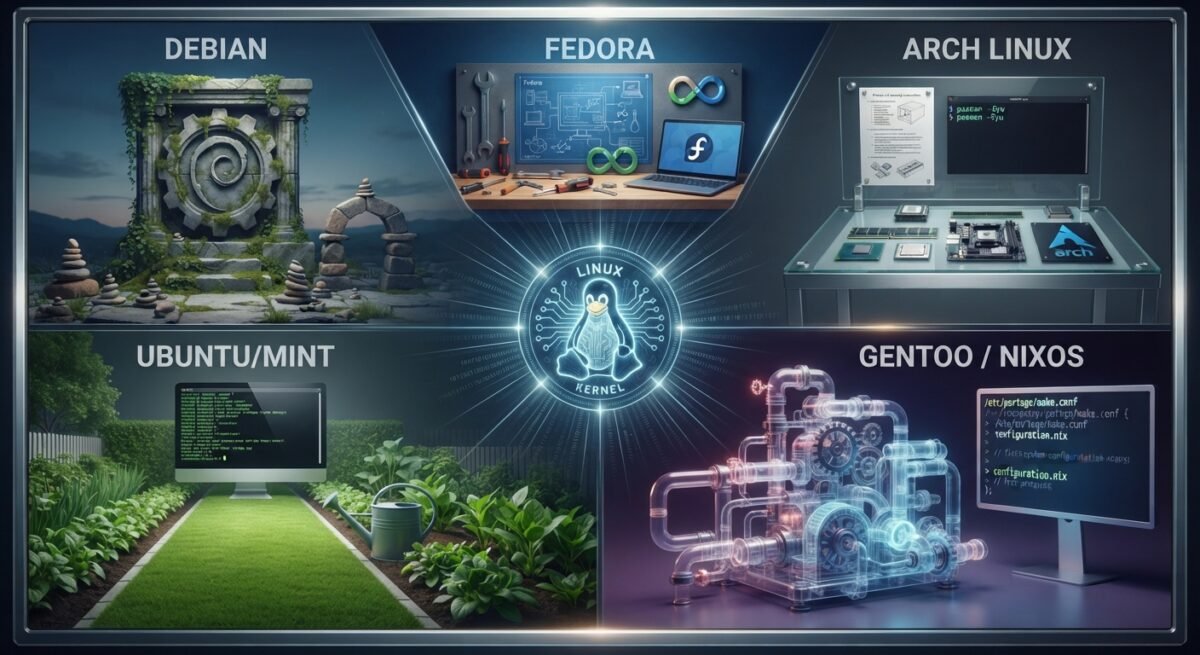
Choosing an operating system is rarely just a technical decision; it is often a quiet negotiation between convenience, control, friction, and identity. For mainstream computer users, an operating system functions much like an automatic transmission—something that gets you from point A to point B with minimal effort and minimal awareness of what happens beneath the hood. Linux flips that arrangement on its head. By exposing configuration files, package managers, init systems, and kernel parameters, Linux invites users to examine the machinery itself. Over the decades, observers in forums like Reddit’s r/linux community and developer publications such as daily.dev’s distro personality breakdown have noted that the way people choose and maintain a Linux distribution often mirrors how they tolerate ambiguity, seek autonomy, and manage cognitive load.
Autonomy, Friction, and the Appeal of Linux
Psychologically, adopting Linux often correlates with a high need for autonomy and epistemic control—the desire to understand how a system works rather than simply trusting a black box. Commercial operating systems prioritize frictionless defaults, standardized interfaces, and centralized vendor decisions. While that design reduces cognitive overhead for everyday tasks, it can feel confining to people who dislike opaque automation or who want their tools to bend to specific workflows.
At the same time, Linux carries an inherent friction tax. Drivers may require reading documentation, updates may demand attention, and a single misconfigured file can leave a system unbootable. Why do people willingly accept friction when smoother alternatives exist? In behavioral terms, desirable difficulty and hands-on mastery can turn troubleshooting into a form of constructive problem-solving rather than pure frustration. For analytical minds, diagnosing why a service failed or why a display server behaved oddly provides a clear cause-and-effect loop—a welcome contrast to real-world problems whose causes are messy and slow to resolve.
What Different Distributions Signal About Mental Makeup
Because Linux is a kernel surrounded by radically different philosophies of packaging, release cadence, and system assembly, different distributions tend to attract—and reinforce—distinct temperaments. Treating these patterns as strict psychological diagnoses would be a mistake, since people switch distributions for practical reasons all the time, yet each ecosystem rewards a recognizable mindset.
Debian: Stoic Patience and Long-Horizon Stability
Debian is the quintessential exercise in delayed gratification and conservative risk management. By prioritizing thorough testing and rock-solid stability over shiny new features, Debian appeals to people who value predictability, long-term maintainability, and systems that do not move the goalposts mid-project. Mentally, a Debian inclination often favors endurance over novelty: you trade cutting-edge software today for fewer surprises eighteen months from now.
Ubuntu and Linux Mint: Pragmatism and Friction Reduction
Ubuntu and Linux Mint lean toward instrumental pragmatism. Users in this camp generally view the computer as a means to an end—writing, browsing, coding, media, or daily productivity—rather than a perpetual hobby project. Linux Mint, in particular, often resonates with people who appreciate familiarity, gentle transitions, and sensible defaults that preserve control without demanding constant terminal gymnastics. There is nothing less “real” about pragmatism; often, it reflects healthy boundaries around where one’s time and attention actually belong.
Fedora: Measured Curiosity at the Leading Edge
Fedora occupies an interesting middle ground between static conservatism and raw bleeding-edge churn. Because it integrates upstream improvements quickly while maintaining clear release cycles and sensible polish, it often appeals to curious builders who still respect structure. It suits minds that enjoy modern tooling and steady evolution without wanting to rebuild basic system plumbing from scratch every week.
Arch Linux: DIY Mastery, Minimalism, and Identity
Arch Linux is famous both for its documentation and for the cultural jokes surrounding it, such as community discussions on why Arch users get teased in Linux spaces. Psychologically, Arch’s “KISS” (keep it simple, stupid) philosophy—meaning structurally straightforward and transparent rather than feature-bloated—appeals to high-agency tinkerers who want only what they explicitly installed. A rolling release demands ongoing vigilance: you read release notes, stay engaged, and accept responsibility for maintenance. The downside of high-agency ecosystems can be status signaling or gatekeeping when competence becomes tied to ego, though many Arch users simply enjoy clean systems and comprehensive reference manuals.
Gentoo and NixOS: First-Principles Optimization and Declarative Order
At the more specialized end of the spectrum, Gentoo and NixOS speak to two distinct forms of deep systems thinking. Gentoo—where packages can be compiled from source with tailored USE flags—attracts perfectionists and first-principles explorers who want granular control over build options and hardware alignment. NixOS, built around declarative configuration and reproducible system states, appeals to architects and systems thinkers who hate “configuration drift” and want an entire machine state defined cleanly in code so it can be reproduced or rolled back reliably.
Community Culture and the Shadow Side of “Distro Identity”
Online Linux spaces—from mailing lists and wikis to threads comparing Arch and Gentoo community dynamics—reveal a recurring tension between shared craft and tribal identity. At their best, Linux communities embody an ethos of open inquiry, self-reliance, and generous technical problem-solving. At their worst, attachment to a distribution can harden into conformity in reverse: trading corporate lock-in for ideological rigidity, elitism, or endless bikeshedding over tools that all ultimately run the same kernel.
Ultimately, the psychology of Linux is less about proving superiority and more about how a person relates to complexity. Some people find peace in a curated, predictable environment; others find clarity in stripping away abstractions until every piece of the stack makes sense. The healthiest relationship with any operating system is remembering that the tool serves the human—not the other way around.
Source Bibliography
- Daily.dev. What Your Linux Distro Says About You. https://daily.dev/posts/what-your-linux-distro-says-about-you-rwqtpyoj8
- Daily.dev. What Your Linux Distro Says About You (2026 edition). https://daily.dev/posts/what-your-linux-distro-says-about-you-dwjjawuun
- Reddit (
r/linux). What is the psychology of a person who uses linux? https://www.reddit.com/r/linux/comments/9o5syy/what_is_the_psychology_of_a_person_who_uses_linux/ - Reddit (
r/linux). Correlating personality with Linux distribution. https://www.reddit.com/r/linux/comments/3j5uu5/correlating_personality_with_linux_distribution/ - Reddit (
r/archlinux). Why are Arch users joked about so much in the linux community? https://www.reddit.com/r/archlinux/comments/19615g4/why_are_arch_users_joked_about_so_much_in_the/ - Reddit (
r/Gentoo). The arch community is absolutely depressing compared to gentoo. https://www.reddit.com/r/Gentoo/comments/1xfshhh/the_arch_community_is_absolutely_depressing/
What Your Linux Distro Says About YOU!
This video explores the humorous stereotypes and community habits tied to different Linux distributions discussed in the essay.