
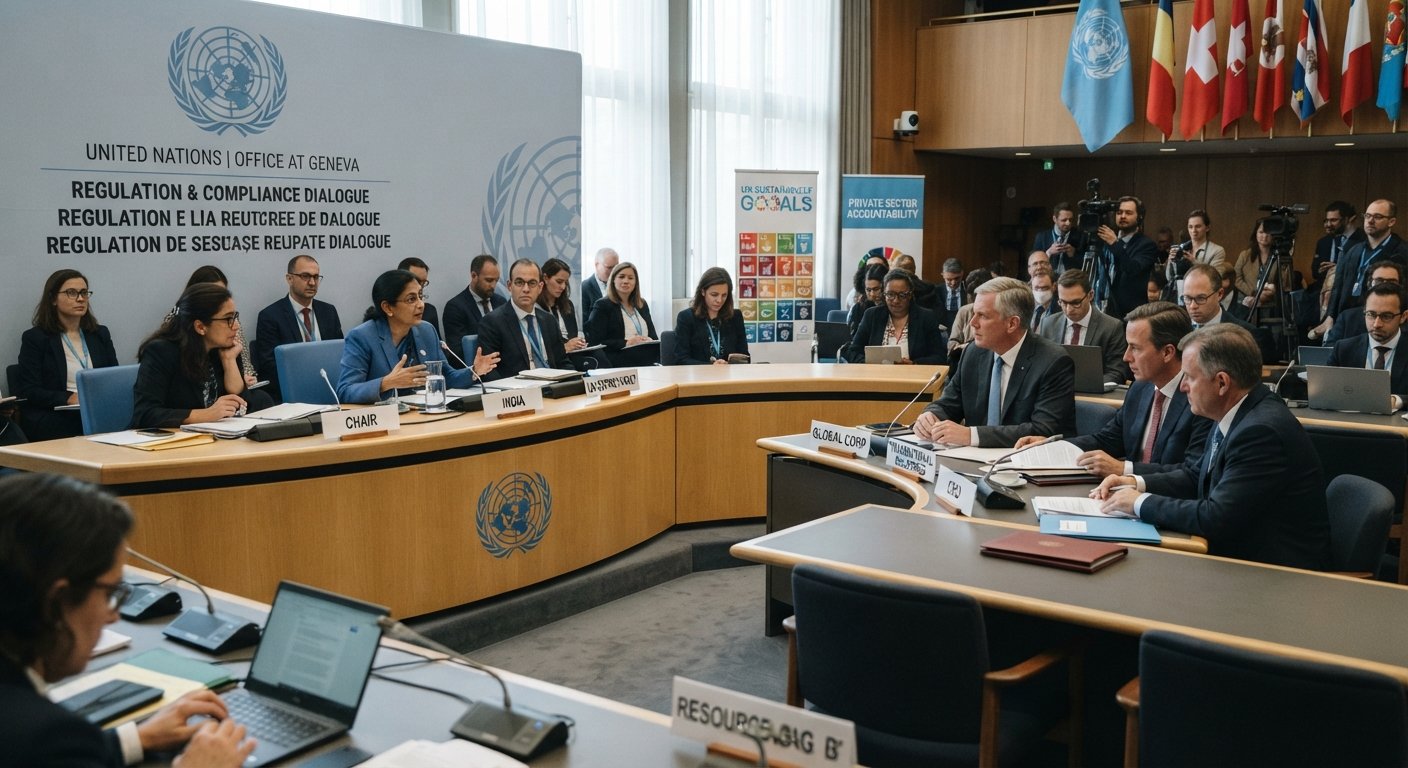
Standing Tiny Before the Global Common Good: The Imperative for a Strong United Nations Regulatory Commission
Capitalism, in its purest and most unbridled form, is driven by a singular, relentless imperative: the accumulation of capital. While this engine of private enterprise has generated unprecedented technological innovation and material wealth over the past few centuries, leaving it entirely unchecked and unregulated produces systemic crises that threaten the very fabric of human society and the natural world. In an era of globalization, where corporate entities transcend national borders with ease, the traditional nation-state often finds itself outmatched, captured, or coerced by transnational capital. To protect humanity from the perils of corporate hegemony, environmental collapse, and extreme inequality, we must envision a paradigm shift: a strengthened United Nations endowed with the authority to regulate international corporations for the collective good, redistribute wealth and income, and act as an ecological guardian. Within this new order, corporate giants—no matter how vast their market capitalization or global reach—must stand tiny and small before the regulatory commissions of the United Nations.
The Pathologies of Unchecked Capitalism
When capital operates without moral or regulatory boundaries, its inherent tendencies manifest as profound social harms. Unchecked capitalism treats labor not as human beings with intrinsic dignity, but as a mere factor of production to be optimized and minimized. This dynamic suppresses wages, erodes labor standards, and fosters a race to the bottom as corporations scour the globe for the weakest regulatory environments.
Furthermore, the concentration of market power under deregulated capitalism inexorably leads to vast disparities in wealth and income. As wealth accumulates at the very top, the democratic process is subverted; economic power translates directly into political influence, allowing corporations to write the rules of the global economy in their own favor. Most critically, the market views the environment as an infinite resource sink and a free dumping ground. The existential crisis of climate change is, at its core, a market failure—the ultimate consequence of allowing private enterprises to privatize profits while externalizing the ecological costs onto the public.
The Global Reach of Transnational Power
National governments, constrained by geographic borders and fearful of capital flight, are increasingly incapable of curbing these global pathologies. If a single nation attempts to impose stringent environmental standards or fair taxation on a multinational corporation, that entity can simply threaten to relocate its operations, capital, and supply chains to a more compliant jurisdiction.
This regulatory arbitrage leaves individual states powerless. Capital has successfully globalized, yet governance remains stubbornly parochial. To counter a globalized corporate elite, humanity requires an institution with an equally global mandate.
The Vision of a Strong United Nations Regulatory Authority
The United Nations, founded on the principles of universal human rights, peace, and collective security, is uniquely positioned to evolve into the supreme regulatory body for the global economy. A strengthened UN—equipped with binding enforcement mechanisms, international courts of trade, and specialized regulatory commissions—could finally establish a rule of law that places human well-being above corporate profit.
To achieve this, the UN must wield the authority to enforce global labor standards, mandate living wages, and dismantle monopolistic cartels. By doing so, it can actively facilitate the redistribution of wealth and income on a planetary scale. A global tax framework imposed by the UN could eliminate tax havens, ensure that multinational corporations pay their fair share where value is extracted and labor is performed, and channel those revenues into global public goods: education, healthcare, and poverty alleviation.
Moreover, a empowered UN regulatory commission must serve as an uncompromising protector of the global environment. Carbon emissions, biodiversity loss, and ocean pollution do not respect national boundaries; thus, they cannot be managed by fragmented local policies. The UN must possess the legal authority to cap resource extraction, penalize ecological destruction, and hold corporate boards criminally liable for environmental degradation, ensuring that the planetary commons is preserved for future generations.
Standing Tiny and Small: The Reversal of Corporate Sovereignty
To realize this vision, we must radically alter the psychological and political posture of the multinational corporation. For decades, corporations have loomed like colossi over governments, dictating trade agreements, demanding bailouts, and treating sovereign states as mere subsidiaries of their commercial empires.
Under a reformed and empowered United Nations, this dynamic must be fundamentally inverted. Corporations must stand tiny and small before the UN regulatory commissions.
- Subservience to the Law: Just as an individual citizen stands small before the domestic courts of a constitutional republic, subject to laws designed to protect the public order, a multinational conglomerate must stand small before global regulatory bodies, stripped of its ability to bully governments or bypass international standards.
- Accountability and Transparency: In this framework, corporate boards would no longer answer solely to shareholders seeking short-term returns; they would be legally accountable to global oversight panels representing the people of the earth.
- Proportionality of Power: To stand tiny and small means that no corporate entity is “too big to fail” or too powerful to sanction. If a corporation violates human rights, exploits labor, or poisons the biosphere, the UN regulatory commission must have the unmitigated power to fine, restructure, or dissolve it, regardless of its economic footprint.
Conclusion
The unchecked march of global capitalism has brought humanity to a critical juncture. The crises of extreme inequality, social alienation, and ecological breakdown are the direct results of allowing private profit to reign supreme over public welfare. National solutions are no longer sufficient to rein in entities that operate across borders with impunity. By building a strong, authoritative United Nations capable of regulating international corporations, redistributing wealth, and defending the environment, we can restore balance to the world. In this new architecture, the corporate titan is reduced to its proper scale—standing tiny and small before the collective will of humanity, embodied in global law and dedicated to the common good.