The Vanishing Worker: How the Global Education Gap threatens Social Stability

A Tale of Two Realities: Tom and Lisa

In a sunlit corporate headquarters, two worlds exist within the exact same space.

Tom works as a janitor. Having dropped out of high school, his daily routine revolves around emptying wastebaskets, scrubbing floorboards, and pushing a mop across polished tiles.

Lisa, on the other hand, is the company’s Chief Executive Officer. Armed with advanced degrees—a Master’s in Business Administration and another in Computer Science and Programming—she commands the room with effortless authority.

To Tom, Lisa and her team of highly educated colleagues appear as literal “giants”. As they stride past his workstation discussing algorithmic models and market expansion, they take little notice of him. He feels entirely invisible.

Continue reading “The Vanishing Worker: How the Global Education Gap threatens Social Stability”


Shrinking Imperative: Why Reducing Our Ecological Footprint Is Essential for Survival

The Tale of Helen’s Uncompromising Reduction

In a high-tech laboratory filled with glowing chemical retorts and precision glass, Dr. Helen looked down at the palm of her hand. Standing in her open palm was Carl, her formerly six-foot-tall laboratory assistant, now reduced to a mere five inches.

Carl stared up in panic at the towering scientist, his tiny voice barely audible over the hum of the ventilation hoods. Helen, impeccably dressed in her blue suit, smiled down with serene, ruthless authority. She had perfected a device capable of shrinking human physical matter to a fraction of its original scale. Her goal was not wealth or world conquest in the traditional sense; it was ecological preservation.

Continue reading “Shrinking Imperative: Why Reducing Our Ecological Footprint Is Essential for Survival”

The Shadow of Progress: Automation, Global Competition, and the Imperative for International Trade Regulation

The rapid evolution of modern manufacturing has ushered in a chillingly futuristic paradigm: the “dark factory”. As explored in the CNN report, “China’s factories run in the dark. Can the rest of the world keep up?”, these fully automated, lights-out facilities operate 24 hours a day with rows of robotic arms and artificial intelligence systems functioning entirely without human presence or intervention. While this technological marvel is framed as a triumph of efficiency and a leap toward competitive dominance, it simultaneously exposes a profound crisis at the heart of the global economy. Unchecked industrial competition is no longer just a race between nations; it has transformed into a race to the bottom that threatens the livelihoods of workers and the poor worldwide. To prevent technological progress from exacerbating human misery, international institutions like the United Nations must step forward to regulate global trade and ensure that productivity serves the collective benefit of humanity rather than punishing the vulnerable.

Continue reading “The Shadow of Progress: Automation, Global Competition, and the Imperative for International Trade Regulation”

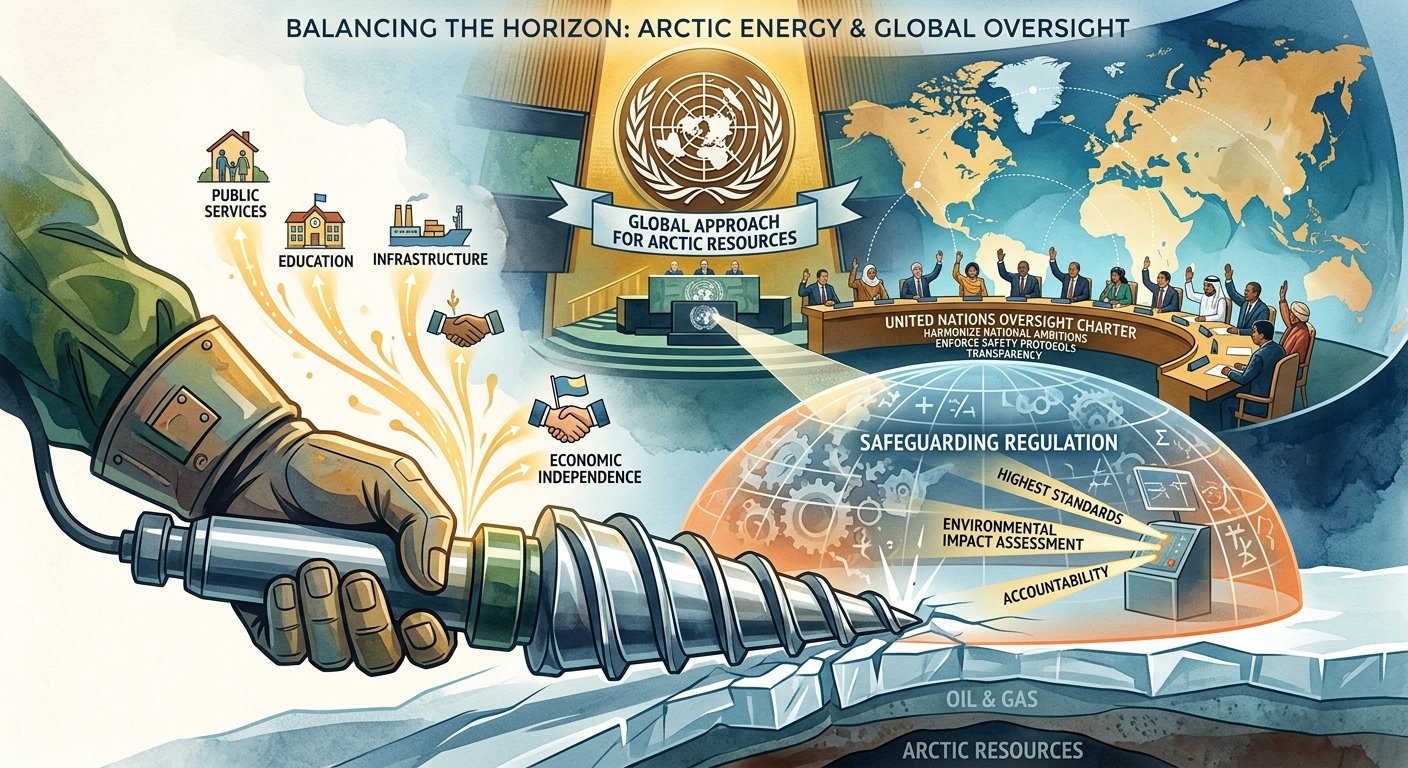
Balancing the Horizon: Arctic Energy, Regulation, and the Case for a Global United Nations Approach

Recent headlines highlighting statements from Washington regarding “massive” oil, gas, and mineral exploration in Greenland have reignited a fierce global debate. The prospect of tapping into the untouched energy reserves of the Arctic carries profound implications for geopolitics, economic security, and environmental stewardship. While the immediate reaction from purist environmental corners is often outright condemnation, a more nuanced perspective reveals that Arctic resource extraction can be a positive and necessary endeavor—provided it is tightly constrained by rigorous regulation. However, given the borderless nature of our climate and oceans, managing this new frontier cannot be left to individual superpowers or corporate interests alone; it demands a comprehensive, global approach spearheaded by the United Nations.

Continue reading “Balancing the Horizon: Arctic Energy, Regulation, and the Case for a Global United Nations Approach”

The Concrete Foundations of Tomorrow: Data Centers, Deregulation, and the Global Fight for AI Supremacy

The global race for technological supremacy has shifted from abstract software algorithms to heavy, physical reality. As highlighted in reporting by outlets like CNN regarding the fierce domestic battles over data centers in the U.S. versus China’s rapid, state-backed expansion, the future of artificial intelligence is being anchored in concrete, steel, and electrical grids. This infrastructure race is about far more than computational capacity; it is the ultimate determinant of global hegemony. In response to China’s aggressive scaling, a powerful political and corporate consensus has emerged favoring the deregulation of AI, driven by the belief that slowing down for safety or local oversight will hand global control to Beijing.

Continue reading “The Concrete Foundations of Tomorrow: Data Centers, Deregulation, and the Global Fight for AI Supremacy”