
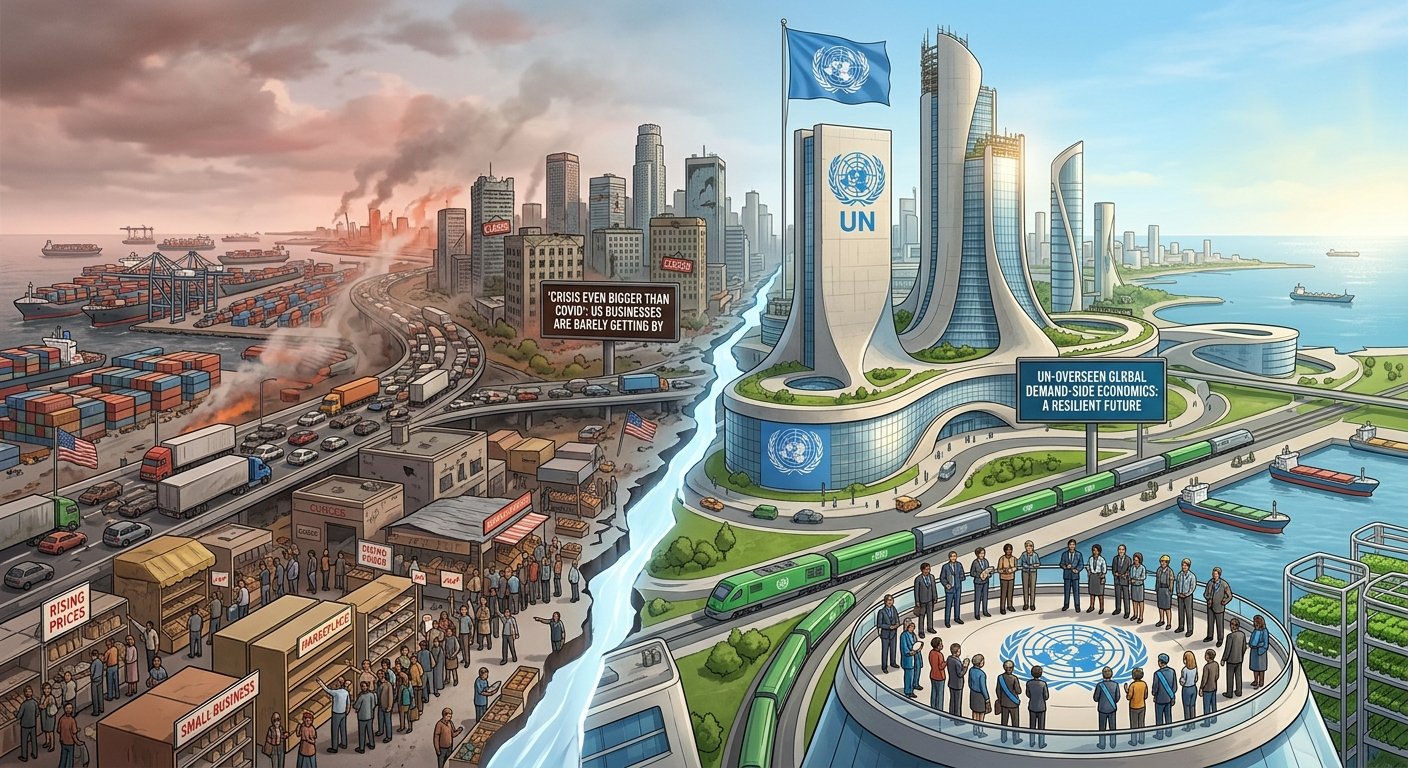
In the article titled “‘Crisis even bigger than Covid’: US businesses are barely getting by,” CNN paints a grim picture of the contemporary economic landscape.Business leaders, logistical experts, and supply-chain strategists highlight a unsettling reality: the compounding disruptions of systemic energy crises, climate-induced natural disasters, severe shipping bottlenecks, and persistent geopolitical conflict have created an environment far more volatile than the targeted, transitory shock of the 2020 pandemic.During COVID-19, global supply chains effectively froze, but once health measures eased, commerce resumed predictable patterns.Today’s crisis, by contrast, is characterized by persistent friction, uncontrollable cost surges, and erratic supply patterns that leave domestic enterprises incapable of long-term planning.
The underlying thesis of the article exposes a fundamental flaw in the classical framework of market-driven capitalism: localized supply-side interventions and monetary policy tightening are structurally incapable of resolving systemic, planet-wide supply shocks. When domestic businesses face compounding global crises—from climate events altering ocean transit to regional warfare driving up energy and logistical costs—no single nation’s interest-rate adjustments or domestic tax cuts can stabilize the market. To survive this era of ongoing systemic volatility, world governance must shift toward a framework of global demand-side economics overseen by the United Nations.
The Limits of Domestic Supply-Side and Monetary Solutions
For decades, mainstream economic policy has relied on supply-side incentives (such as deregulation and corporate tax breaks) alongside central bank monetary policy (adjusting interest rates) to regulate economic expansion and contraction. However, as the CNN article demonstrates, these instruments fail when confronted with multi-faceted global disruptions.
- Monetary Misalignment: Raising domestic interest rates destroys localized demand to curb inflation, but it does nothing to clear maritime choke points, lower global fertilizer prices, or repair weather-damaged agricultural output. It punishes small and medium-sized enterprises by raising borrowing costs precisely when their operational costs are surging due to external forces.
- Fragmented Supply Chains: When national governments attempt to solve global supply-chain friction unilaterally through protectionism or subsidies, they exacerbate resource hoarding and increase international trade friction.
The current crisis proves that production and distribution networks are fundamentally global, yet the policy mechanisms attempting to manage them remain fiercely nationalized.
The Case for Global Demand-Side Economics
Traditional demand-side economics (Keynesianism) posits that economic stability requires managing aggregate demand to maintain purchasing power, secure employment, and prevent catastrophic market collapses. In a hyper-connected, volatile global economy, demand-side management can no longer stop at national borders; it must operate on a global scale.
A global demand-side model focuses on maintaining stable, predictable baseline demand across nations while insulating end-consumers and foundational supply chains from acute inflationary spikes. Key components of this model include:
- Global Purchasing Power Stabilization: Ensuring that baseline consumer demand remains stable without triggering hyper-inflationary bidding wars for scarce resources.
- Coordinated Resource Allocation: Directing global demand toward resilient, sustainable supply channels rather than allowing panic-buying and corporate speculative bidding to destabilize essential commodities (such as fuel, grain, and key components).
- Equitable Distribution Frameworks: Guaranteeing that smaller businesses and developing economies are not priced out of vital global resources by conglomerate monopolies during supply bottlenecks.
Why the United Nations Must Oversee the Framework
If economic stability requires a coordinated global strategy, the governing body executing or overseeing this mandate must possess international legitimacy, multilateral infrastructure, and a focus on human welfare over pure profit maximization. The United Nations (UN) is uniquely situated to fulfill this institutional role.
1. Neutralizing Multilateral Choke Points
The CNN report notes that ongoing conflicts and regional instability directly drive shipping reroutes and energy price shocks. A UN-led economic mandate—leveraging institutions like the UN Conference on Trade and Development (UNCTAD), the International Maritime Organization (IMO), and the Food and Agriculture Organization (FAO)—could establish guaranteed transit corridors, standardized global logistics protocols, and unified commodity stabilization funds.
2. Managing Climate and Resource Vulnerabilities
Because severe climate events (“Super El Niño,” extreme weather, port shutdowns) now act as perpetual economic disruptors, market forces alone tend to gouge prices rather than adapt infrastructure. UN-supervised demand management can coordinate international investments in climate-resilient trade corridors and pool risk across member nations, ensuring supply chains do not disintegrate during local environmental shocks.
3. Balancing Global Consumption
Unregulated market demand during periods of scarcity inevitably leads to acute inequality: wealthy nations or dominant conglomerates absorb available supply, leaving smaller businesses and vulnerable populations facing price exclusion. Through multilateral treaties and UN-monitored economic frameworks, global demand can be systematically smoothed. By setting global standards for sustainable consumption, strategic inventory reserves, and emergency demand-smoothing protocols, the UN can mitigate severe inflationary shocks before they cascade into small-business bankruptcies.
Conclusion
The admission by business owners that today’s economic environment presents a “crisis even bigger than Covid” is a structural alarm bell. It demonstrates that the modern globalized economy has outgrown the capacity of nation-state central banks and localized market mechanisms. Isolated monetary tightening cannot fix sea-lane disruptions, climate-driven agricultural shortfalls, or systemic energy volatility.
To break this cycle of unpredictable cost spikes and systemic exhaustion, the international community must move beyond fragmented market responses. The ultimate implication of this ongoing crisis is clear: stabilizing the modern economy requires a coordinated, global demand-side economic framework overseen by the United Nations. Only through supranational coordination, unified resource management, and demand-stabilization policies can the world economy achieve the predictability and resilience that businesses need to survive.