
Education is increasingly treated as a privilege determined by zip code, wealth, and national policy rather than a universal human right. Across the globe—from developing nations struggling with resource shortages to world powers facing systemic inequality—secondary education is in crisis.
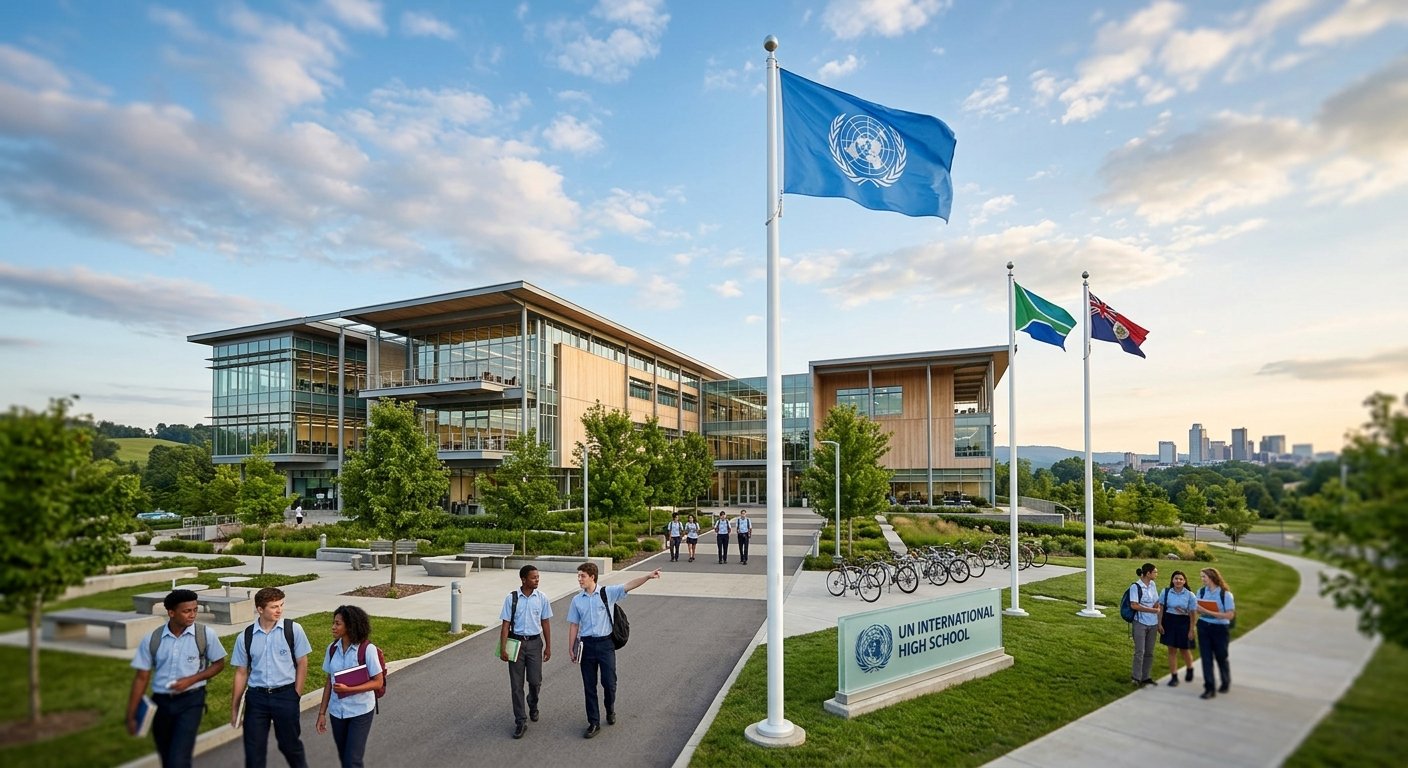
To bridge these gaps, the United Nations should step into public secondary education directly by launching a global network of UN International High Schools (UNIHS). Funded internationally, tuition-free, and open to all through equitable lottery systems, these schools would address educational crises worldwide—including in developed nations like the United States—while promoting a democratic socialist, globally minded worldview centered on solidarity, equality, and human rights.
1. Addressing Systemic Crises: A Direct Intervention
In many parts of the world, secondary education is plagued by underfunding, political polarization, privatization, and stark inequity. In the United States, for instance, public education relies heavily on local property taxes, creating vast disparities between wealthy suburban districts and under-resourced urban or rural schools. High-stakes standardized testing, teacher burnout, and ideological battles over curricula further compound the crisis.
By establishing tuition-free high schools directly in under-resourced regions and struggling urban centers—including in American cities—the UN could provide an immediate alternative. A UN-operated public high school system would serve as a stabilizing force, providing high-quality, free education regardless of a community’s tax base or local political volatility.
2. A Core Curriculum Rooted in Democratic Socialism and Global Citizenship
The curriculum of the UN International High School system would explicitly challenge hyper-capitalist and hyper-nationalist models of education. Instead, it would foster a democratic socialist perspective, emphasizing:
- Social and Economic Rights: Framing healthcare, housing, clean environments, and dignified work as fundamental human rights rather than market commodities.
- Global Solidarity Over Competition: Teaching history, economics, and environmental science from a international perspective that highlights global interdependence and collective action over national supremacy.
- Democratic Governance and Youth Agency: Organizing schools as democratic workplace communities where students, staff, and teachers collectively participate in decision-making processes.
This framework builds on the original spirit of early international education movements, such as Marie-Thérèse Maurette’s 1948 UNESCO framework Educational Techniques for Peace, which argued that lasting peace requires an education rooted in internationalism and mutual respect.
3. Modeling Proven Educational Success: The Nordic and Global Frameworks
Rather than reinventing the wheel, UN high schools should adapt best practices from nations with world-leading educational outcomes:
The Finnish Model: Equity and Professional Trust
Finland consistently ranks at the top of global education metrics while spending less per student than nations like the United States. The Finnish model succeeds by prioritizing equity over competition:
- No High-Stakes Standardized Testing:Assessment is formative and individualized, freeing teachers to focus on deep understanding rather than test preparation.
- Highly Respected Educators:All teachers hold advanced degrees and are treated as trusted professionals.
- Holistic Wellbeing:Free meals, mental health care, and balanced school hours are built into the school day.
As Finnish educator Pasi Sahlberg notes:
“We prepare children to learn how to learn, not how to take a test… Education should be an instrument to balance out social inequality.”
Comparative Global Insights
Leading comparative education scholars, such as Dr. Linda Darling-Hammond (Stanford University) and Dr. Andy Hargreaves (Boston College), have long pointed out that top-performing systems—from Finland to Singapore and Canada—share key traits: high investment in teacher preparation, socio-economic integration, and funding targeted directly to students with the greatest need.
4. Institutional Precedents: From the IB to the UN System
The idea of UN-affiliated education is not unprecedented. The International Baccalaureate (IB) program was originally created in Geneva in 1968 to foster intercultural understanding, working in close consultation with UNESCO.Similarly, the United Nations International School (UNIS) in New York demonstrated how a multinational curriculum could bring young people together.
However, existing international schools are often private or accessible primarily to diplomatic corps and affluent families. A UN high school initiative would take the rigor and global outlook of frameworks like the IB and democratize them—making high-caliber, globally focused education available as a public good to working-class students worldwide.
Summary of Proposed School Features
| Feature | Standard Market-Driven Model | Proposed UN International High School |
| Funding Structure | Local property taxes / Private tuition | International UN education fund |
| Admission | Zip code / Merit / Ability to pay | Equitable open lottery |
| Evaluation | High-stakes standardized tests | Project-based, formative assessment |
| Core Ethos | Individual competition & market readiness | Democratic socialism & global cooperation |
| Teacher Role | Scripted curricula & evaluation by test scores | High professional autonomy & advanced training |
Conclusion: A Global Public Good
If the United Nations is committed to its Sustainable Development Goals—specifically Goal 4: Quality Education—it must go beyond issuing guidelines and benchmarks. By founding tuition-free UN International High Schools in regions facing systemic educational crises, the UN can provide a living model of democratic, equitable, and world-class education. In doing so, it would help raise a new generation of global citizens equipped to address climate change, inequality, and conflict through international solidarity.