
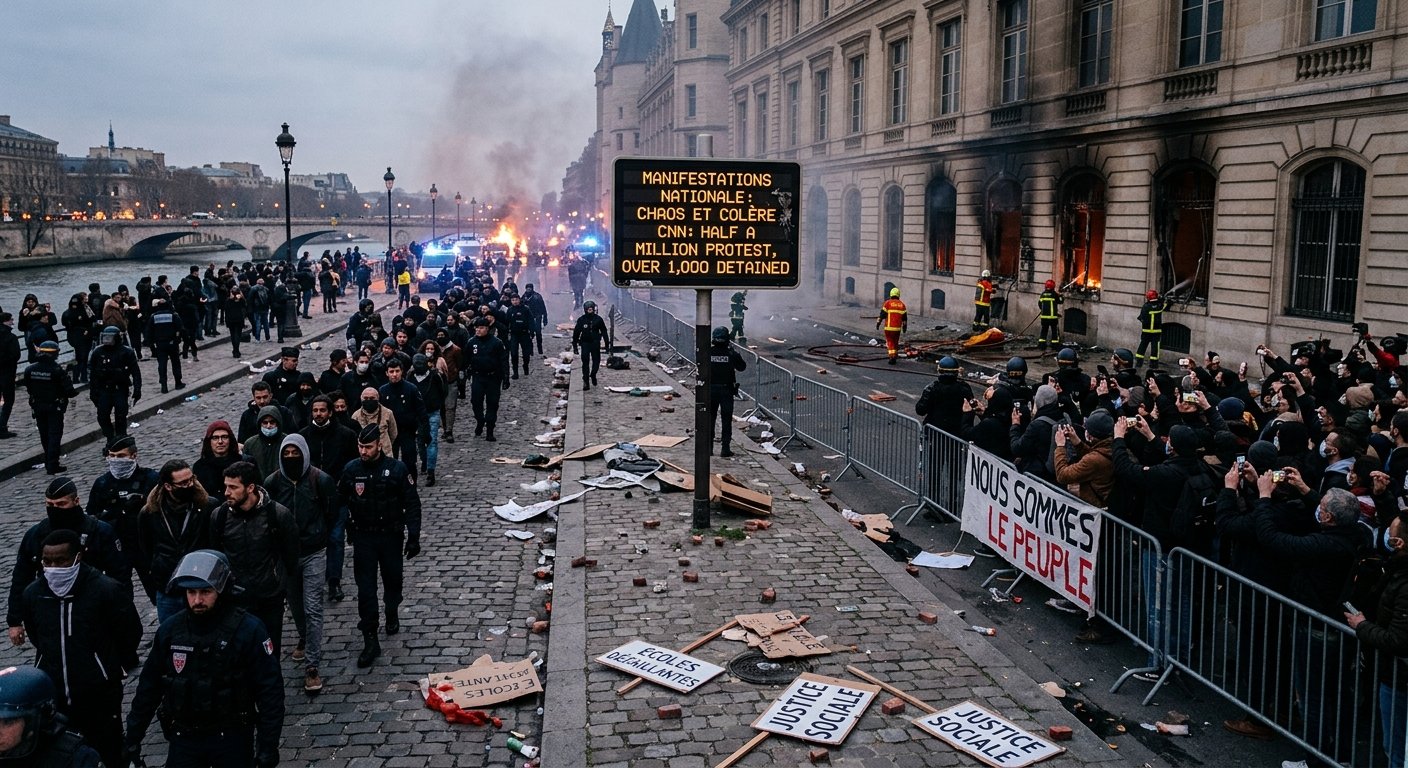
Recent events in Europe have once again laid bare the volatile intersection of civil dissent and state power. As reported in the CNN.com article, “Buildings torched and over 1,000 detained after half a million protesters sweep France,” major French cities became the epicenter of intense riots, featuring torched government buildings and mass detentions following widespread demonstrations.What began as localized student-led rallies over underfunded schools, crumbling infrastructure, and economic anxiety rapidly evolved into a broader national crisis.The subsequent escalation—marked by both destructive urban riots and controversial heavy-handed police tactics—highlights a profound societal fracture. To prevent these cycles of domestic violence and institutional breakdown, the global community must look toward robust international structures that balance the imperatives of law and order with the legitimate demands of social justice.
The Law and Order Perspective: Preserving Stability and the Rule of Law
From a traditional law and order perspective, the immediate priority during widespread civil unrest is the preservation of public safety, the protection of infrastructure, and the defense of democratic institutions against mob rule. When protests cross the line into arson, looting, and physical clashes with law enforcement, the state faces an existential challenge to its monopoly on legitimate force. Proponents of this view argue that without strict adherence to legal norms and a firm police response, society risks descending into lawlessness.
In the context of the French demonstrations, the torching of public buildings and injuries sustained by security personnel signal a breakdown in civic contract. From this standpoint, detaining over a thousand individuals is framed as a necessary measure to restore order and deter further criminality. Law and order advocates contend that grievances—no matter how valid—must be channeled exclusively through institutional and legal frameworks rather than violent street confrontations. Without order, civil liberties, economic stability, and the democratic process itself cannot function.
The Social Justice Perspective: Addressing Systemic Roots of Grievance
Conversely, the social justice perspective insists that focusing solely on the symptoms of unrest ignores the legitimate systemic failures that ignite these crises in the first place. The demonstrations in France did not materialize in a vacuum; they grew out of deep-seated frustrations regarding deteriorating school conditions, soaring costs of living, inequality, and perceived government indifference. Furthermore, critics from this viewpoint point to heavy-handed police tactics and the severe injuries inflicted on young protesters as evidence of state overreach that exacerbates rather than mitigates tension.
From the social justice framework, public demonstrations are a vital democratic safety valve for populations experiencing systemic neglect. When marginalized or economically strained citizens feel ignored by domestic policy channels, mass mobilization becomes a crucial tool for accountability. Ignoring the root causes—such as underfunded public services or economic disenfranchisement—while deploying aggressive policing measures only deepens societal alienation and guarantees future, more violent eruptions.
The Bridge: Why International Structure is Essential
The friction between these two paradigms reveals a dangerous governance gap. Domestic institutions alone are frequently too polarized, politically compromised, or strained to mediate deep-seated civil strife fairly. This is where international structures must play a vital, overarching role.
An effective international framework does not mean foreign interference in domestic policing; rather, it involves adherence to globally recognized standards of human rights, independent international oversight on law enforcement tactics, and cooperative economic structures that cushion communities against global inflation and systemic inequality. International human rights bodies can objectively evaluate whether state responses respect proportionality, while global economic benchmarks can help nations address wealth disparity before it boils over into civil conflict.
By synthesizing both perspectives, international frameworks can enforce a dual mandate: upholding accountability and the rule of law while simultaneously compelling governments to honor fundamental socioeconomic rights. Only through such a balanced, globally supported approach can nations like France—and the broader international community—move away from the destructive cycle of fires and detentions toward sustainable peace and justice.
Source List
- CNN – Buildings torched and over 1,000 detained after half a million protesters sweep France (Profile/Context Reference)
- Keyt – Half a million protesters sweep France in major show of youth unrest
- Reddit Discussion – Buildings torched and over 1,000 detained after half a million protesters sweep France
- CNN Video – French police tactics under scrutiny after teenagers seriously injured during protests
- CNN World News – France News and Updates Hub
Flames Scorch Historic Streets and Buildings as French Protests Erupt
This video provides visual context and ground-level footage of the intense urban clashes and demonstrations that swept across French cities during the unrest.