
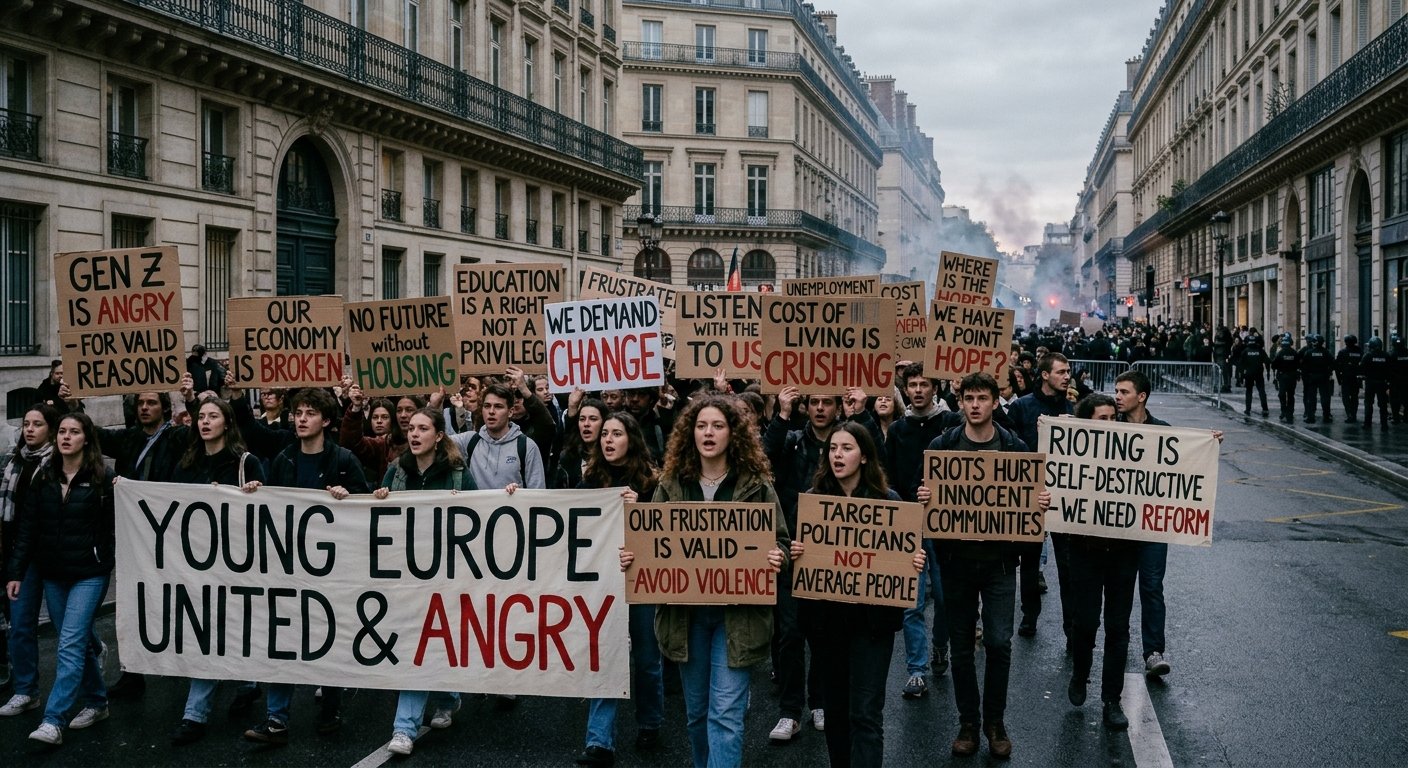
A wave of youth-led unrest has swept across major European cities, from Paris and Milan to Athens, Brussels, and Madrid. In its article, “Gen Z are leading the European protests. Here’s why they’re angry,” CNN highlights how younger generations are taking to the streets to demand systemic change. The core grievances driving Gen Z—skyrocketing housing costs, underfunded education systems, economic stagnation, and an uncertain job market—are undeniably valid. However, as peaceful rallies degenerate into violent clashes, burned-out vehicles, and destroyed storefronts, a critical line is crossed. While young people have every right to be furious with political leaders who have failed them, targeting average working-class citizens and local businesses through rioting is both counterproductive and unjust.
A Broken Social Contract: The Validity of Gen Z’s Anger
Gen Z is confronting a vastly different economic reality than previous generations. As documented by CNN, the fundamental promise of liberal democracy—that each generation will enjoy a better standard of living than the last—has broken down. Across Southern and Western Europe, national debt burdens and severe cost-of-living pressures have strained public infrastructure.
The frustration centers on tangible, structural failures:
- Housing Unaffordability: According to reporting from The Guardian, rent and property prices have skyrocketed across European capitals. In Portugal, housing costs surged over 120% in less than a decade, while Spanish renters face steep price hikes and displacement.
- Deteriorating Education: Students in France, Italy, and Greece are protesting overcrowded classrooms, crumbling infrastructure, and severe underfunding in public universities.
- Economic Insecurity: Entry-level job markets are increasingly volatile, compounded by technological disruption from artificial intelligence and wage stagnation relative to inflation.
These problems are real, urgent, and structural. Gen Z is not reacting out of entitlement; they are demanding basic economic stability and a future where homeownership, dignified work, and quality public services are attainable.
The Misdirection of Violence: Why Rioting Fails
While the anger driving these demonstrations is justified, the escalation into street violence and property destruction is not. Coverage from Fast Company details how protests in cities like Paris, Brussels, and Milan have led to smashed storefronts, looted shops, and widespread public damage.
Rioting fails as a tactic for three primary reasons:
- It Harms the Wrong People: The small-business owners whose storefronts are destroyed, or the working-class commuters whose cars are torched, are not the architects of austerity, inflation, or housing policy. Vandalizing local neighborhoods inflicts direct financial and emotional harm on everyday citizens who are often struggling under the exact same economic pressures.
- It Obscures the Core Message: Violence shifts the public conversation from substantive policy issues—like housing caps and education budgets—to law enforcement, public safety, and curfews. Political leaders can easily dismiss a legitimate social movement when it becomes associated primarily with property destruction.
- It Alienates Potential Allies: Real political reform requires building broad coalitions across age groups and socio-economic backgrounds. Unrest and property destruction alienate older generations and working families who might otherwise support the protesters’ economic demands.
Aiming Anger at the Decision-Makers
To achieve meaningful reform, young activists must channel their discontent constructively toward those holding actual power: elected politicians, policy makers, and institutional leaders. Government institutions control public spending, housing legislation, tax policies, and educational funding.
Civic pressure is far more potent when targeted through organized, sustained, and non-violent means—such as organized strikes, coalition-building, voter mobilization, and targeted peaceful demonstrations outside legislative bodies. Disrupting parliamentary sessions or voting out unresponsive officials creates accountability; burning down community infrastructure does not.
Gen Z has proven its ability to mobilize across borders and highlight critical societal flaws. By rejecting violence and keeping public pressure focused firmly on political decision-makers, young people can turn their anger into lasting, constructive political change.
Source List
- CNN: Gen Z are leading the European protests. Here’s why they’re angry
- Fast Company: Gen Z in France, Spain, Belgium, and Portugal are mad as hell: What’s at the root of Europe’s violent unrest
- CIVICUS Lens: France’s student protests: a new generation demands respect
- School of Foreign Service, Georgetown University: Six questions on the protests erupting across France and Spain
- Wikipedia: Gen Z Protests & Global Youth Movements Overview