
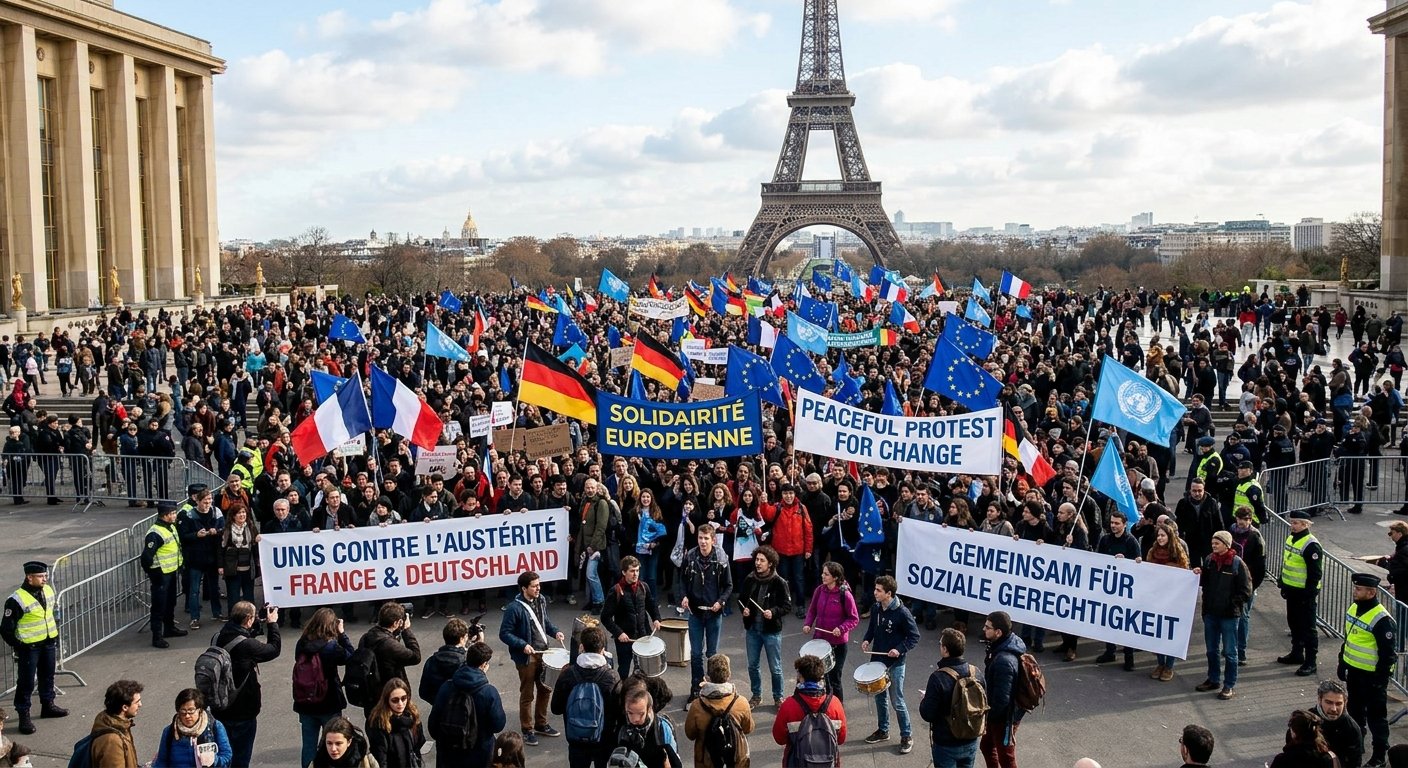
As cost-of-living pressures, education budget cuts, and public sector austerity continue to strain European societies, widespread civil unrest has spilled beyond national borders. What began as mass demonstrations across French urban centers has officially crossed the Rhine into Germany, where hundreds of thousands of citizens, workers, and youth groups are taking to the streets. According to initial reporting from CNN, this expansion reflects a deep-seated economic and social anxiety that spans multiple generations. While the core grievances driving these movements are undeniably valid, the path forward requires tactical nonviolence by the marchers and strategic institutional engagement by international bodies like the European Union and the United Nations.
Valid Grievances and the Case for Nonviolent Resistance
The economic foundations of the current movement are well-grounded. Citizens across France and Germany are facing real wage stagnation, deteriorating public infrastructure, underfunded schools, and rising utility and housing costs. Organized collective action remains one of the most effective historical tools for working-class and youth populations to demand democratic accountability. As detailed in analysis by The Guardian, initiatives led by youth coalitions such as Gen Z regelt in Germany emphasize systemic neglect in education, social safety nets, and healthcare.
However, for these movements to achieve structural policy changes rather than political attrition, nonviolence is an imperative strategy. Outbreaks of property destruction or clashes with security forces provide state authorities with quick justification to militarize their response, impose curfews, and criminalize legitimate dissent. Furthermore, violence shifts public focus away from fundamental socioeconomic demands toward debates over order and public safety. Historically, nonviolent mass movements retain higher participation rates and broader societal support, creating sustained political pressure that governments cannot simply ignore or suppress.
Strategic Leverage for the EU and UN
This cross-border wave of unrest presents a crucial opportunity for supranational bodies to reassert international authority and democratic coordination. National governments often struggle to resolve structural economic crises in isolation due to fiscal constraints and competing domestic interests.
- European Union Institutional Intervention: The EU has a direct mandate to protect social cohesion and fundamental rights across its member states. By stepping in to establish binding social protection benchmarks, coordinate fiscal flexibility within the Eurozone, and monitor police responses, the EU can demonstrate the functional value of regional governance. Reports on transnational stability from platforms like Alliance4Europe highlight how economic grievances in one member state quickly ripple across borders, requiring a unified continental policy response rather than fragmented national security measures.
- United Nations Normative Frameworks: The UN, through its Human Rights Council and economic agencies, can utilize international charters to mediate between state governments and civil society groups. Establishing international oversight on civil rights protections and public spending floors reinforces the premise that economic stability and peaceful assembly are fundamental human rights.
The Risk of Escalation and Foreign Exploitation
A key challenge facing these demonstrations is the risk of external manipulation and opportunistic escalation. Disinformation monitoring and investigative reports hosted on platforms like Albeu indicate that state-aligned network campaigns frequently seek to hijack real domestic grievances, amplifying inflammatory narratives to polarize democratic societies. Maintaining strict commitment to peaceful assembly serves as an internal defense mechanism against such sabotage, keeping the focus entirely on genuine democratic reform.
Ultimately, the spreading marches across France and Germany represent an urgent demand for economic fairness. If organizers remain committed to disciplined, peaceful tactics, and if institutions like the EU and UN exercise proactive leadership to address systemic inequalities, this period of unrest can serve as a catalyst for meaningful structural progress rather than prolonged instability.
Sources
- CNN / KESQ: Protests spread to Germany as hundreds of thousands march again in France
- The Guardian: Cost of living protests to spread to Germany and reignite in France
- The Guardian Live: Protests under way in Germany and France as minister warns against use of masks
- Alliance4Europe: EU Unrest Report: How France’s Protests Were Manipulated and Retold Abroad
- Albeu English: EU examines whether foreign actors are exploiting unrest in France for disinformation campaigns
Watching video coverage provides visual context for the scale of the rallies and the peaceful turnout across major European cities.
This video report gives a direct view of the recent street demonstrations in Germany and France, illustrating how organizers are advocating for peaceful assembly while voicing economic concerns.