
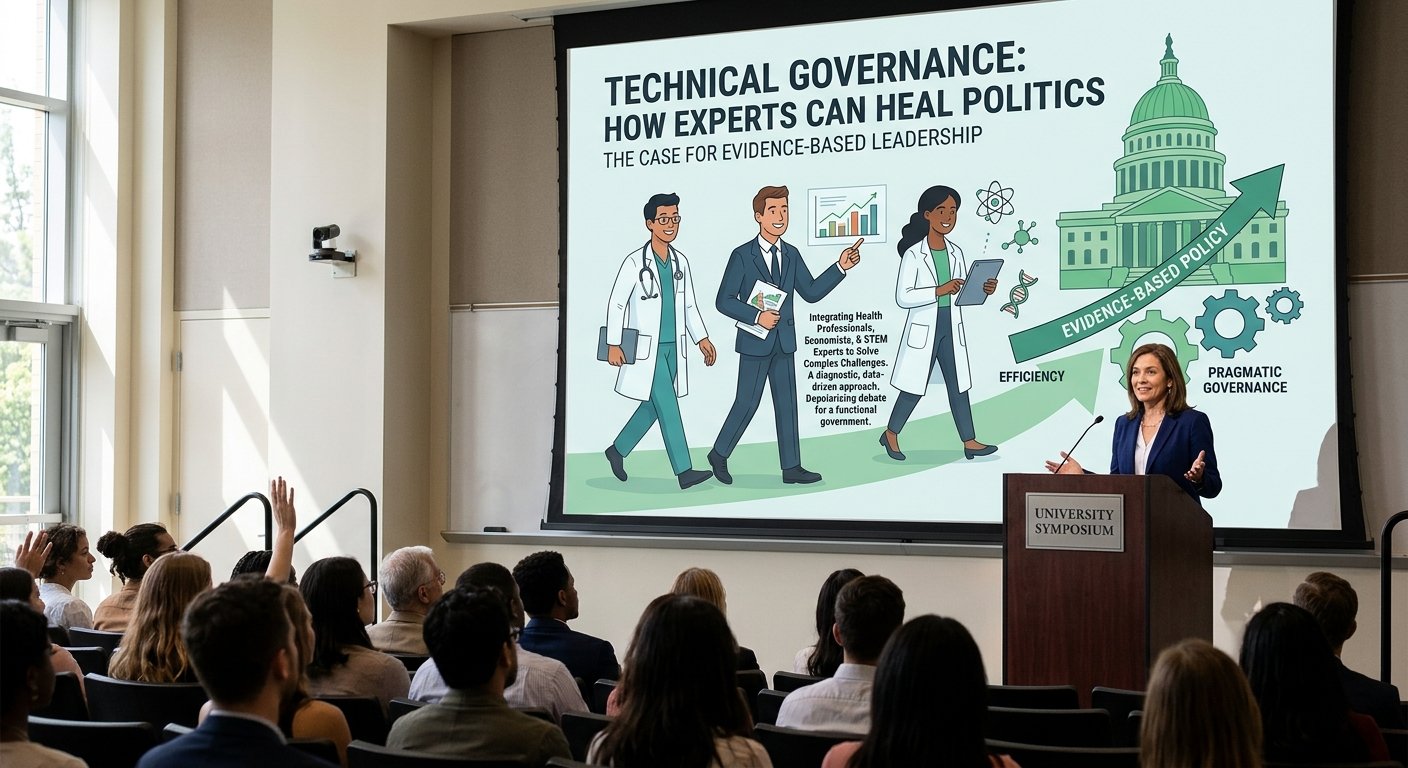
In an era defined by extreme political polarization, ideological gridlock, and legislative inertia, American governance frequently prioritizes rhetorical posturing over evidence-based decision-making. The CNN piece titled “A record number of health professionals are running for office. Could they help heal US politics?” examines a notable shift: medical practitioners stepping out of clinics and into legislative chambers. This trend represents a vital evolutionary step for democratic governance. Integrating technical experts—including doctors, economists, and scientists—into public office can streamline government efficiency, restore empirical rigor, and improve legislative outcomes.
The Case for Evidence-Based Leadership
Legislators are tasked with solving complex problems spanning public health, fiscal stability, digital privacy, and climate resiliency. However, Congress has historically been dominated by career politicians and legal backgrounds. While legal expertise is valuable for drafting statutes, it does not guarantee an understanding of empirical methodology, quantitative risk assessment, or scientific consensus.
When medical professionals run for office, they bring a diagnostic mindset to public policy. Physicians are trained to evaluate symptoms, run diagnostic tests, isolate root causes, and apply peer-reviewed solutions regardless of personal preference. Applying this pragmatic diagnostic process to public policy yields distinct structural advantages:
- Data-Driven Problem Solving: Scientists and quantitative experts evaluate legislative proposals using empirical metrics, statistical significance, and controlled testing rather than partisan dogma.
- Fiscal Efficiency: Economists understand resource allocation, opportunity costs, and market dynamics, preventing costly fiscal missteps before policies pass.
- Depolarized Debate: Technical subjects centered on measurable outcomes displace partisan narratives with verifiable facts, encouraging consensus on objective baselines.
- Focus on Preventive Solutions: Just as preventative medicine reduces healthcare expenditures, domain experts prioritize early interventions over reactive emergency measures.
Beyond Healthcare: The Need for Scientists and Economists
Expanding technical expertise beyond healthcare into fields like economics and STEM disciplines strengthens governance across every cabinet level and legislative committee.
| Expert Role | Primary Domain | Governance Impact |
| Medical Professionals | Public Health & Social Infrastructure | Optimizes healthcare delivery, emergency response, and community well-being. |
| Economists | Fiscal & Economic Policy | Mitigates inflationary pressures, designs efficient taxation, and evaluates budget trade-offs. |
| Scientists & Engineers | Energy, AI & Technology Regulation | Drafts technical standards for emerging technologies, defense, and environmental resilience. |
For instance, an economist in office evaluates policy through cost-benefit analysis and unintended consequences. They reduce redundant government spending and streamline bureaucratic procedures. Similarly, scientists bring rigorous peer-review habits to policy evaluation, verifying that public expenditures deliver measurable real-world outcomes.
Healing Polarization Through Shared Realities
A primary cause of political gridlock in the United States is the lack of a shared factual baseline. Ideological debate often replaces objective reality. Science, medicine, and economics offer common analytical frameworks that transcend partisan lines.
A physician treating a patient does not select treatments based on political alignment; they select what works according to empirical data. When domain experts enter the legislative arena, they introduce this objective standard to public debate. Bipartisan collaboration becomes achievable when discussions focus on verifiable metrics rather than partisan identity.
Structural Efficiency in Public Administration
Technical expertise in legislature improves government operations by minimizing policy failure rates. Unenforceable regulations, poorly targeted economic packages, and reactive crisis responses often stems from lawmaking uninformed by technical reality.
Integrating technical professionals builds an efficient government framework capable of managing 21st-century challenges. Increasing the representation of doctors, economists, and scientists in public office grounds policy in empirical fact, steering American politics toward functional governance.
Sources & Further Reading
- CNN Politics – ‘A record number of health professionals are running for office. Could they help heal US politics?’
- 314 Action – Electing Scientists, Engineers, and STEM Professionals to Public Office
- The Guardian – Doctors running for office to rebuild healthcare policy
- Institute for New Economic Thinking – Can We Really Save American Democracy?
- Wikipedia – Paul Krugman & Economic Advice in Government