
The Symphony of the Mind: Why Classical Music Education Belongs in Our Schools
In an era defined by rapid technological shifts and hyper-accelerated media, school curricula are under constant pressure to prioritize immediate, practical utility. Subjects like coding, data analysis, and vocational training often take center stage. Yet, amidst this push for modernization, one of the most powerful tools for intellectual and personal development is frequently sidelined: classical music education. Integrating classical music into school curricula—both through active performance and structured listening—is not merely an artistic enrichment activity; it is a rigorous academic catalyst that enhances cognitive function, fosters discipline, and enriches the emotional development of young people.
Cognitive Enhancement and Academic Achievement
The study and appreciation of classical music engage nearly every region of the brain simultaneously, creating dense neural pathways that support broader academic learning. Structurally, classical compositions are built upon complex mathematical foundations—rhythm relies on precise fractional divisions, polyphony requires spatial-temporal reasoning, and formal designs like sonata-allegro form mirror the logical structuring found in advanced composition and computer programming.
Research consistently demonstrates a strong correlation between music education and academic performance. Students trained in instrumental music often exhibit superior spatial-temporal reasoning skills, which directly translate to higher proficiency in geometry, advanced algebra, and physics. Furthermore, active listening and playing demand intense, sustained concentration. Classical works—with their intricate themes, dynamic shifts, and extended movements—train young minds to sustain focus over long durations. This heightened attention span directly benefits students across all academic disciplines, improving reading comprehension, critical analysis, and problem-solving capabilities.
Linguistic and Auditory Processing
Beyond mathematics, classical music profoundly influences language acquisition and verbal intelligence. Music and language share overlapping neural processing centers in the human brain. The ability to discern subtle shifts in pitch, timbre, and rhythm in a symphonic work mirrors the phonological processing required to master foreign languages and native vocabulary. Students engaged in musical training develop heightened auditory discrimination, allowing them to better parse speech in noisy environments, detect nuances in verbal instruction, and refine their own expressive writing and speaking skills.
Cultivating Discipline, Patience, and Resilience
In an age of instant gratification, classical music offers a counter-cultural lesson in delayed reward. Mastering an instrument or deeply understanding a complex orchestral piece cannot be rushed through shortcuts; it requires rigorous daily practice, meticulous attention to detail, and persistent resilience in the face of difficulty.
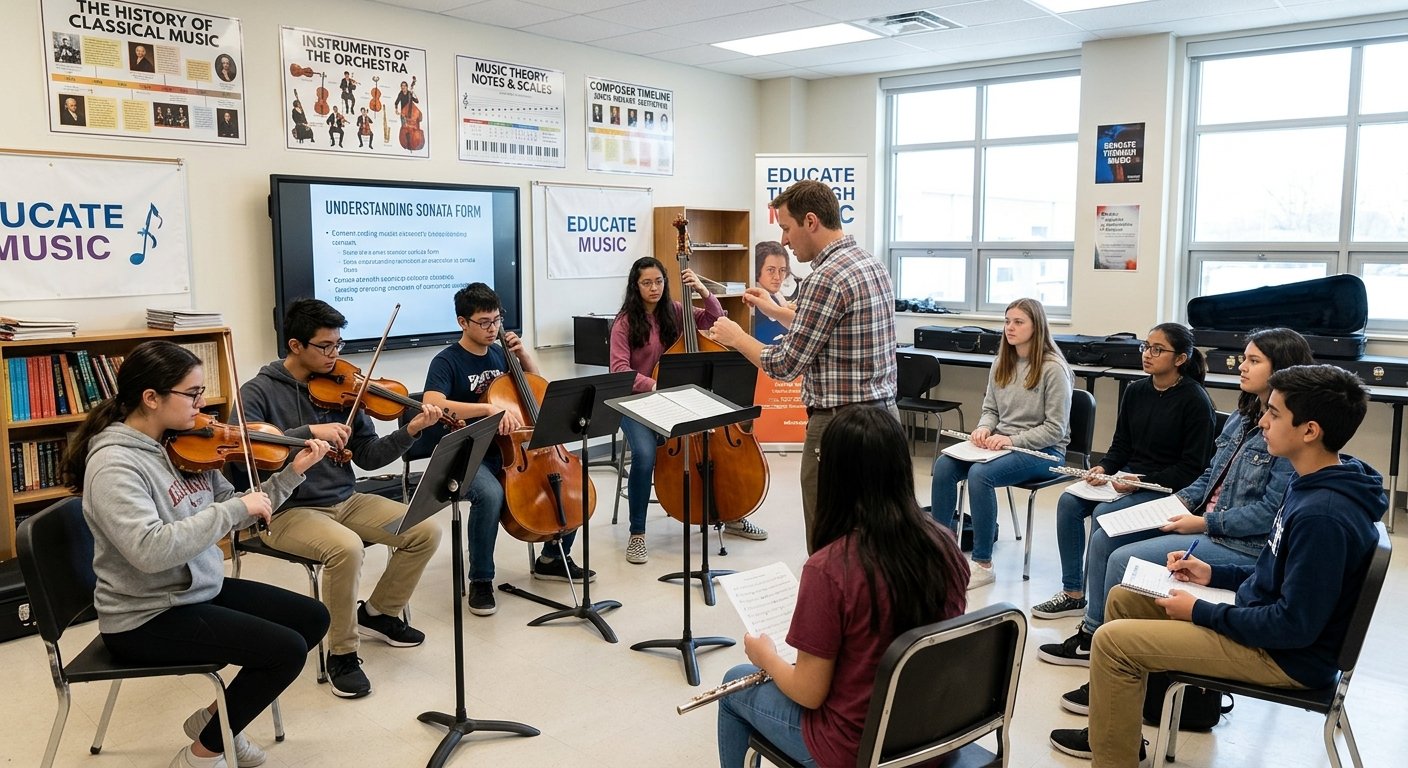
When young people practice an instrument, they learn the value of incremental progress. They discover that complex goals are achieved through systematic breakdown, slow repetition, and careful self-correction. This process instills a profound sense of self-discipline and accountability. Moreover, ensemble playing teaches vital collaborative skills. To produce a cohesive orchestral sound, students must listen actively to their peers, synchronize their timing, and subordinate individual impulses to a collective artistic vision. This fosters empathy, teamwork, and mutual respect.
Emotional Regulation and Cultural Literacy
Beyond its strict academic and cognitive utility, classical music provides a unique medium for emotional literacy. Unlike lyric-driven popular music, instrumental classical music communicates complex human emotions—grief, triumph, serenity, and turmoil—purely through abstract sound. Engaging with these works allows young people to explore and articulate their own inner emotional landscapes in a healthy, constructive manner.
Furthermore, classical music represents centuries of human cultural heritage. By studying masterworks from the Baroque, Classical, Romantic, and Modern eras, students gain a historical window into the philosophical and social movements that shaped the modern world. They learn to view contemporary culture within a broader, historically grounded perspective.
Conclusion
Classical music education is far more than an elective luxury or a relic of the past; it is an essential pillar of a comprehensive, high-quality education. By sharpening cognitive faculties, boosting academic performance in STEM and humanities fields, cultivating deep discipline, and expanding emotional intelligence, classical music equips young people with the intellectual agility and character needed to navigate a complex world. Schools have a responsibility to foster not just functional workers, but deeply cultivated, balanced thinkers. Restoring and prioritizing classical music in our classrooms is a vital step toward achieving that goal.