

The Cybernetic Commons: Steering Artificial Intelligence via Democratic Socialist Internationalism

As artificial intelligence rapidly accelerates past national boundaries, it presents humanity with a profound governance paradox. Left to the competitive impulses of corporate monopolies and hyper-nationalist rivalries, AI threatens to deepen inequality, destabilize labor markets, and trigger catastrophic technological arms races.

Addressing this trajectory requires a paradigm shift: the future of AI must be regulated for the common good, with authority increasingly vested in a reformed United Nations. By leveraging AI to centralize and democratize global coordination, the international community can foster a non-authoritarian, democratic socialist model of planetary governance.

Continue reading “The Cybernetic Commons: Steering Artificial Intelligence via Democratic Socialist Internationalism”


The Iron Arteries of Progress: The Imperative for Investing in Public Transportation, Trains, and Rails

Modern civilization is built on movement. From the earliest trade routes to the asphalt webs spanning contemporary continents, how we move defines our economies, our environments, and our daily quality of life. Yet, for decades, infrastructure planning across many parts of the developed world has been tethered to a single paradigm: the private automobile. This car-centric focus has yielded congested highways, sprawling suburbs disconnected from essential services, and a heavy carbon footprint. To build a resilient, sustainable, and equitable future, governments must fundamentally pivot their transportation priorities. Investing heavily in public transit—with a special emphasis on trains, heavy rail, and intercity corridors—is no longer merely an option; it is an absolute necessity.

Continue reading “The Iron Arteries of Progress: The Imperative for Investing in Public Transportation, Trains, and Rails”

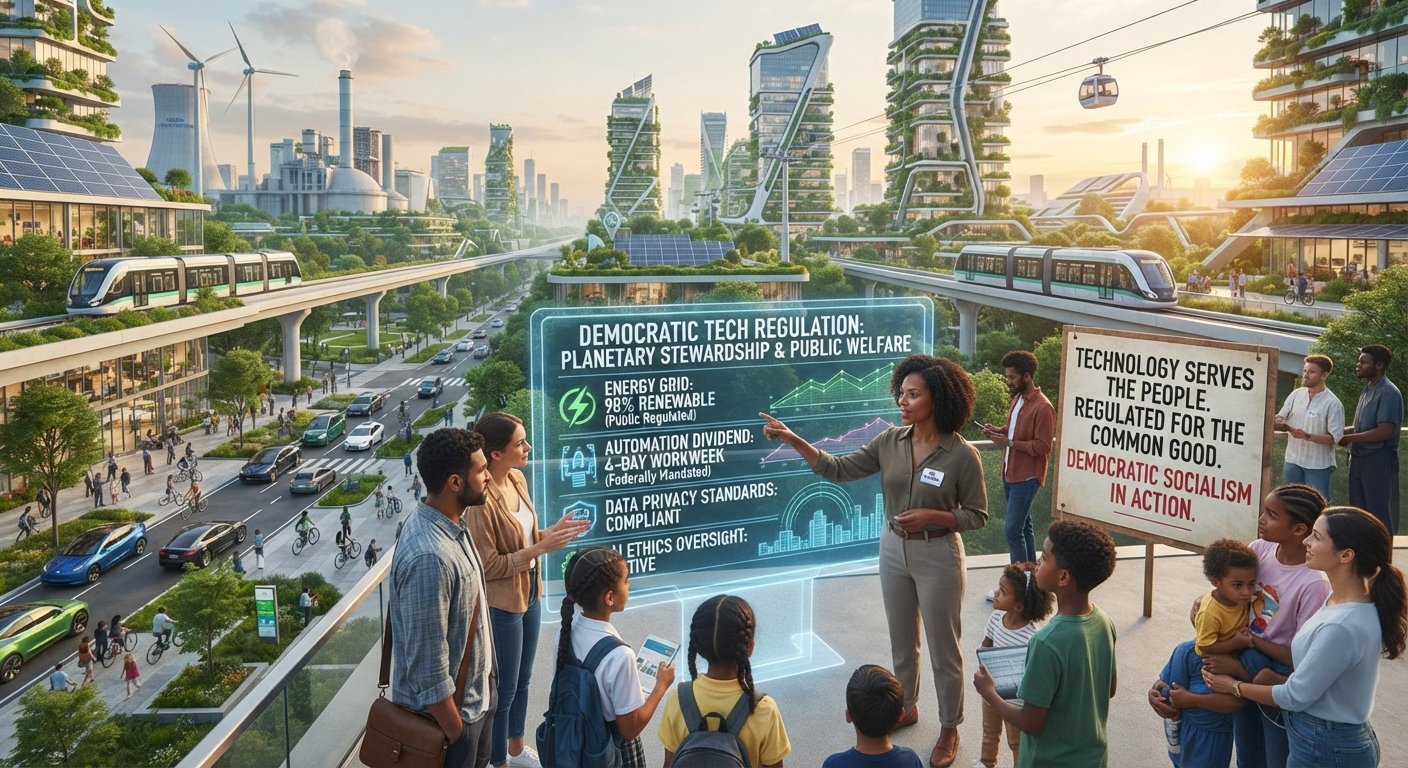
Beyond the Woods: Why Democratic Socialism and Heavy State Regulation Offer Our Best Path Forward

The romanticized longing for a return to a pre-industrial, “back-to-nature” existence is a powerful siren song. In an era marked by climate anxiety, algorithmic alienation, and corporate surveillance, the impulse to strip away modern machinery and retreat to the woods is entirely understandable. However, this primitivist philosophy fundamentally misdiagnoses our civilizational crisis. Technology itself is not the enemy of humanity or the earth; rather, it is a neutral tool whose current destructiveness stems from the profit-driven motives of unregulated capitalism. To abandon technology is to abandon billions to preventable suffering. Instead of retreating backward into the woods, our best path forward lies in embracing technological acceleration, guided, constrained, and directed by heavy government regulation through a democratic socialist framework.

Continue reading “Beyond the Woods: Why Democratic Socialism and Heavy State Regulation Offer Our Best Path Forward”

Driving Forward: The Environmental, Economic, and Independent Evolution of the Electric Vehicle

The conversation surrounding modern transportation is inextricably linked to the future of electric vehicles (EVs). Among the pioneers of this shift, Tesla has played a foundational role in dragging the automotive industry out of a century-long reliance on the internal combustion engine. To secure a sustainable future, the continuous development of Tesla’s vehicle technology remains a vital endeavor. Supporting this evolution is not merely a preference for modern engineering; it is an environmental necessity and, increasingly, an economic one. Crucially, evaluating this technology requires a clear separation between the machinery itself and the polarizing political persona of its chief executive officer.

Continue reading “Driving Forward: The Environmental, Economic, and Independent Evolution of the Electric Vehicle”