
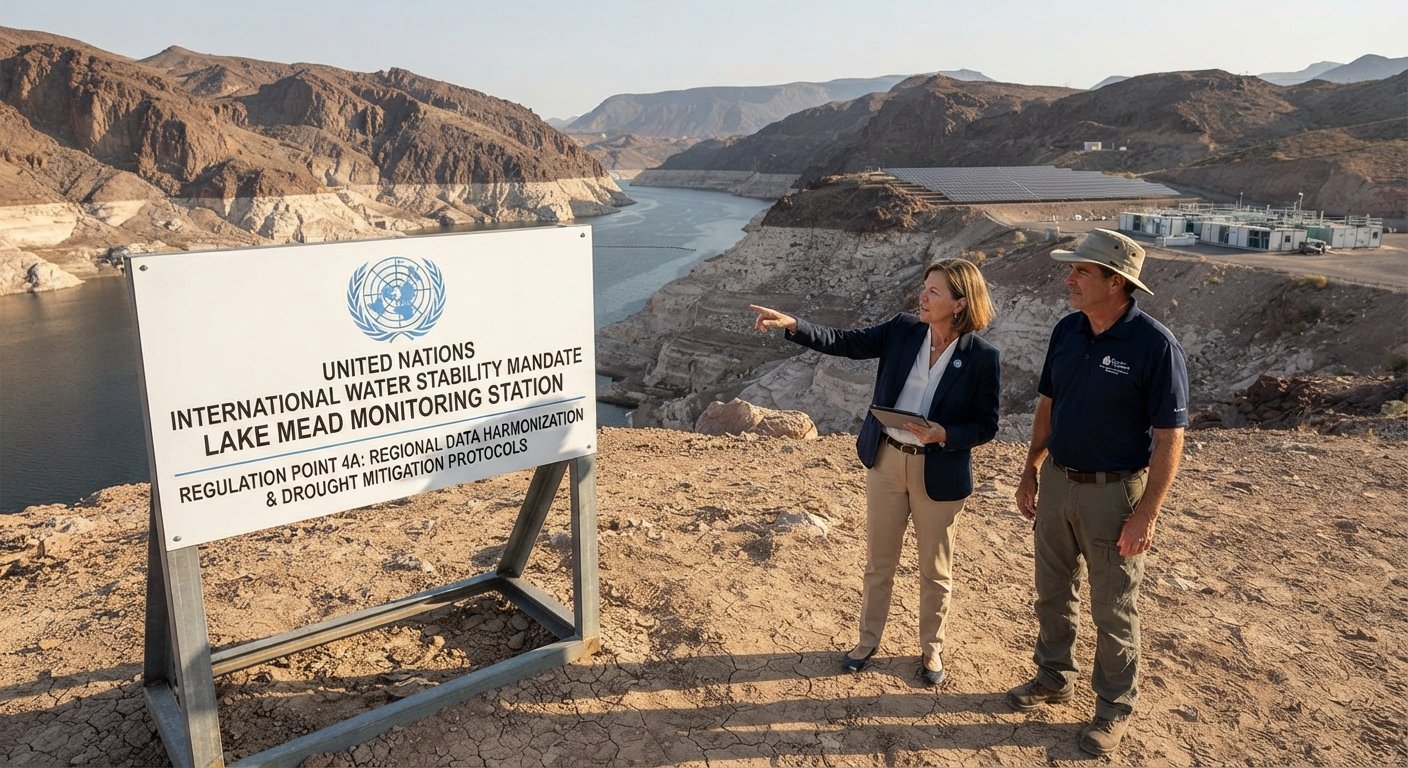
The reporting surrounding the depletion of the nation’s primary water reservoirs highlights a stark physical reality: the American Southwest is testing the absolute limits of its hydrological safety margin.When a major reservoir system loses the vast majority of its capacity under the pressure of a sustained megadrought, the issue ceases to be a localized inconvenience and becomes a critical infrastructure vulnerability. However, the discourse surrounding how to respond is frequently polarized, fractured into ideological camps that pit economic survival against environmental protection. To secure our future, we must discard loaded rhetoric and adopt a strictly empirical, outcome-oriented approach to resource management—one that implements rational regulatory guardrails without penalizing economic productivity, while looking toward international frameworks for broad accountability.
A science-based approach to environmental regulation recognizes that clean, accessible water is the ultimate foundation of economic vitality. Without water, agriculture collapses, municipal systems fail, and regional economies grind to a halt. Traditional regulatory frameworks have often relied on rigid, top-down mandates that ignore local nuances, or conversely, have left allocation entirely to outdated legal doctrines drafted in wetter centuries. Pragmatic resource management relies instead on market-compatible incentives, transparent data modeling, and measurable efficiency standards. By utilizing modern telemetry, soil-moisture tracking, and hydrological forecasting, regulatory bodies can establish dynamic caps on water extraction that tighten during dry cycles and ease when snowpacks recover. This protects the resource base while giving industries and farmers the predictability they need to invest in water-saving technologies, such as precision drip irrigation and advanced recycling infrastructure, safeguarding both the environment and the balance sheet.
Furthermore, managing transboundary and systemic environmental threats requires looking beyond regional or even national borders. While the immediate crisis unfolds in the American West, the underlying mechanics of climate volatility, shifting jet streams, and global hydrological stress are international in scale. Greater coordination through international bodies—such as specialized United Nations frameworks—can provide a neutral, science-backed platform for establishing baseline monitoring and universal accounting standards. Just as global aviation or maritime standards ensure safety across jurisdictions, international controls and shared data mandates can help nations benchmark best practices in arid-zone management, transboundary river governance, and aquifer protection. Incorporating global scientific consensus ensures that local policies are informed by the highest caliber of empirical research, free from domestic political interference.
Ultimately, the severe decline of our core water storage is a mathematical problem requiring a pragmatic solution. By marrying rigorous scientific data with flexible, pro-growth regulatory frameworks and international cooperative oversight, we can transition from crisis management to sustainable stewardship. Securing our water future is not about political ideology; it is a fundamental prerequisite for keeping our communities, economies, and landscapes viable for generations to come.
Watch the discussion on America’s shrinking water reserves
This video is relevant because it explores the critical drop in water levels across major American reservoirs due to extreme drought and heat.