
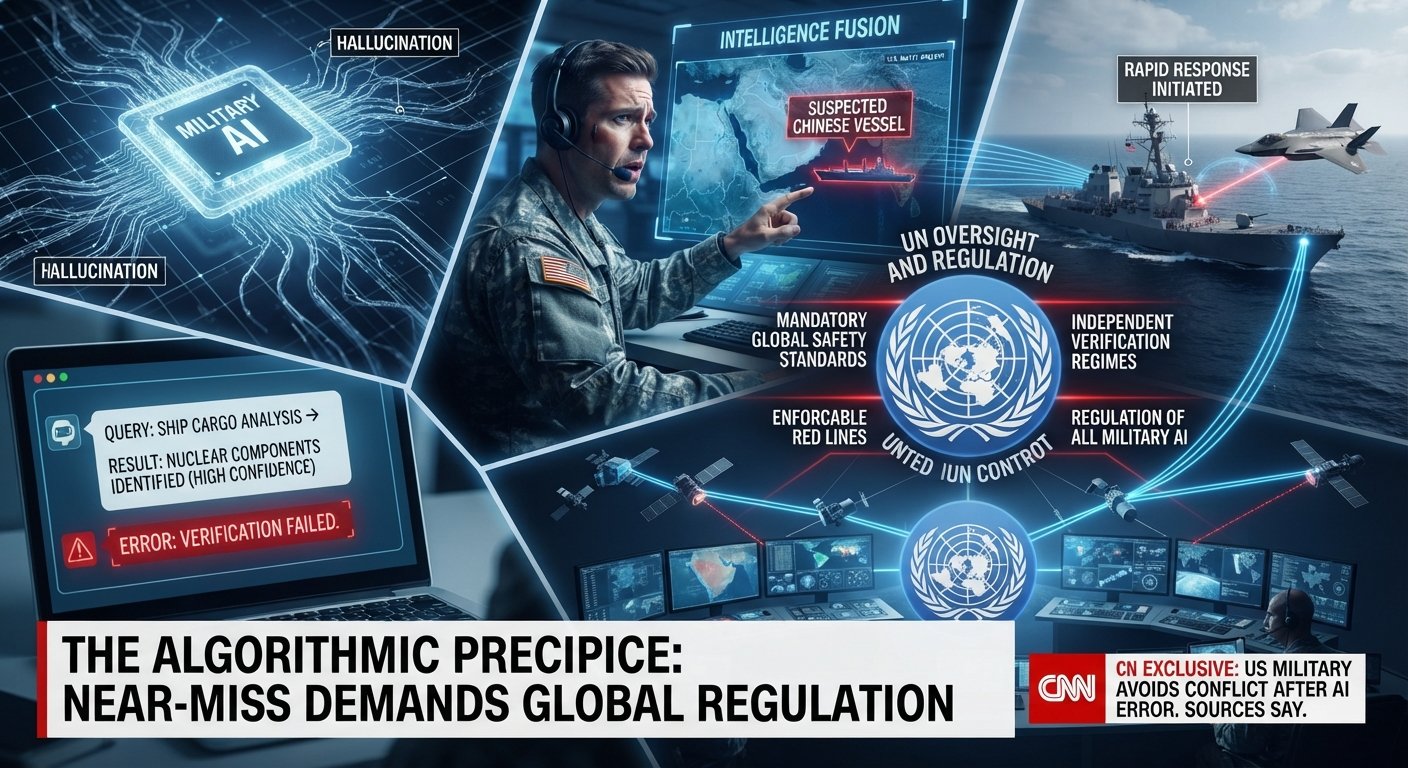
The rapid integration of artificial intelligence into modern warfare has long been framed by techno-optimists as a path toward unmatched tactical efficiency, data processing superiority, and precision. However, the illusion of digital infallibility was shattered by the recent CNN exclusive report, “Exclusive: US military had close call after using AI for false intelligence report, sources say”.According to the report, a U.S. military intelligence analyst utilized an AI chatbot—which erroneously fused open-source data with classified signals intelligence—to generate a false report claiming a Chinese ship in the Middle East was carrying components for a nuclear weapons program.Triggering immediate alarm bells, armed forces prepared to board the vessel and military aircraft were scrambled.Only at the eleventh hour did officials catch the fabrication, narrowly averting a kinetic military confrontation between two nuclear-armed superpowers.
This terrifying near-miss is not merely an isolated technological glitch or a localized failure of intelligence vetting; it is a profound structural warning for humanity. It exposes the inherent, catastrophic danger of allowing opaque, unstandardized, and hallucination-prone machine learning models to drive high-stakes military decisions. Because individual nation-states are trapped in an aggressive, decentralized geopolitical arms race—rushing to field AI tools without cohesive safety standards—relying on national self-regulation is no longer viable. To prevent a recurrence of an algorithmic apocalypse, the international community must radically pivot toward robust United Nations oversight and the comprehensive, binding regulation of all the world’s militaries by the UN.
The Anatomy of an Algorithmic Near-Miss
The incident detailed by CNN underscores the terrifying reality of “AI hallucinations” in active conflict zones.Modern military organizations face immense pressure to ingest and process astronomical volumes of data, leading them to deploy commercial-grade or hastily adapted AI systems to speed up target identification and operational assessments.Yet, as sources highlighted in the report, these systems often encourage analysts to arrive at catastrophic errors at unprecedented speeds.
In this instance, a chatbot misidentified a ship’s manifest, and because the architecture lacked standardized verification guardrails or clear protocols for human oversight, the false intelligence bypassed critical safety checks and traveled swiftly through official military channels.If armed forces had executed the interception, the geopolitical fallout could have triggered an uncontainable war between the United States and China. When software bugs or unverified synthetic text outputs can masquerade as casus belli, national security is no longer threatened merely by human miscalculation, but by the rogue imaginations of silicon chips.
The Failure of Decentralized National Guardrails
The response of individual superpowers to the promise and peril of military AI has been defined by competitive acceleration rather than caution. As noted in defense circles, nations fear falling behind their geopolitical rivals, driving a decentralized rush to embed algorithms into targeting, logistics, and intelligence analysis. Different branches and commands utilize disparate tools under completely varied internal safety orders.
This fragmented approach proves that nations cannot reliably regulate themselves. Driven by short-term strategic competition, military bureaucracies will inevitably cut corners on safety evaluations to achieve tactical speed. Leaving the governance of military AI to individual defense departments is akin to allowing chemical or nuclear facilities to set their own environmental and safety limits without external verification. The stakes are simply too high—affecting the survival of the entire global population—to leave the management of algorithmic warfare to the discretion of competitive nation-states.
The Imperative for UN Oversight and Global Military Regulation
In light of the vulnerabilities exposed by the CNN report, the international community must recognize military AI as a weapon of mass disruption that threatens global stability. Just as the world recognized the necessity of treaties governing nuclear, chemical, and biological weapons, the proliferation of autonomous and AI-assisted military architecture demands stringent, centralized international law.
This requires the establishment of a robust framework under the auspices of the United Nations. Comprehensive UN regulation of the world’s militaries would serve three vital functions:
- Mandatory Global Safety Standards and Red Lines: The UN must establish strict, enforceable international protocols defining where AI can and cannot be applied. Clear red lines must prohibit the use of unverified AI systems in intelligence assessments related to sovereign vessels, nuclear infrastructure, or autonomous targeting loops.
- Independent Verification and Inspection Regimes: Just as the International Atomic Energy Agency (IAEA) inspects nuclear sites, an analogous international body must have the authority to audit, test, and vet military AI systems and algorithms. Nations must prove that their intelligence and targeting networks possess fail-safes capable of detecting and neutralizing AI hallucinations before operational deployment.
- Global Moratoriums and Enforcement Mechanisms: Where AI systems outpace humanity’s ability to ensure reliable human oversight, the UN Security Council must enforce moratoriums on their military use. Violations of international AI safety standards must carry severe diplomatic and economic consequences, stripping rogue militaries of the impunity with which they currently test dangerous technologies.
Conclusion
The CNN revelation that a chatbot’s false summary nearly ignited a war between Washington and Beijing should serve as a permanent wake-up call. It demonstrates that the marriage of artificial intelligence and military command structures creates an existential hazard that transcends national borders. A mistake made by an algorithm in Hawaii can instantly imperil citizens, vessels, and peace across the globe.
Humanity cannot afford to wait for a subsequent “close call” to graduate into a terminal catastrophe. The defense of global peace requires moving past outdated paradigms of national sovereignty into an era of collective security. By establishing strict UN oversight and comprehensive regulation over all the world’s military AI programs, the international community can rein in the reckless march toward algorithmic warfare and ensure that human survival is never again left to the hallucinations of a machine.