
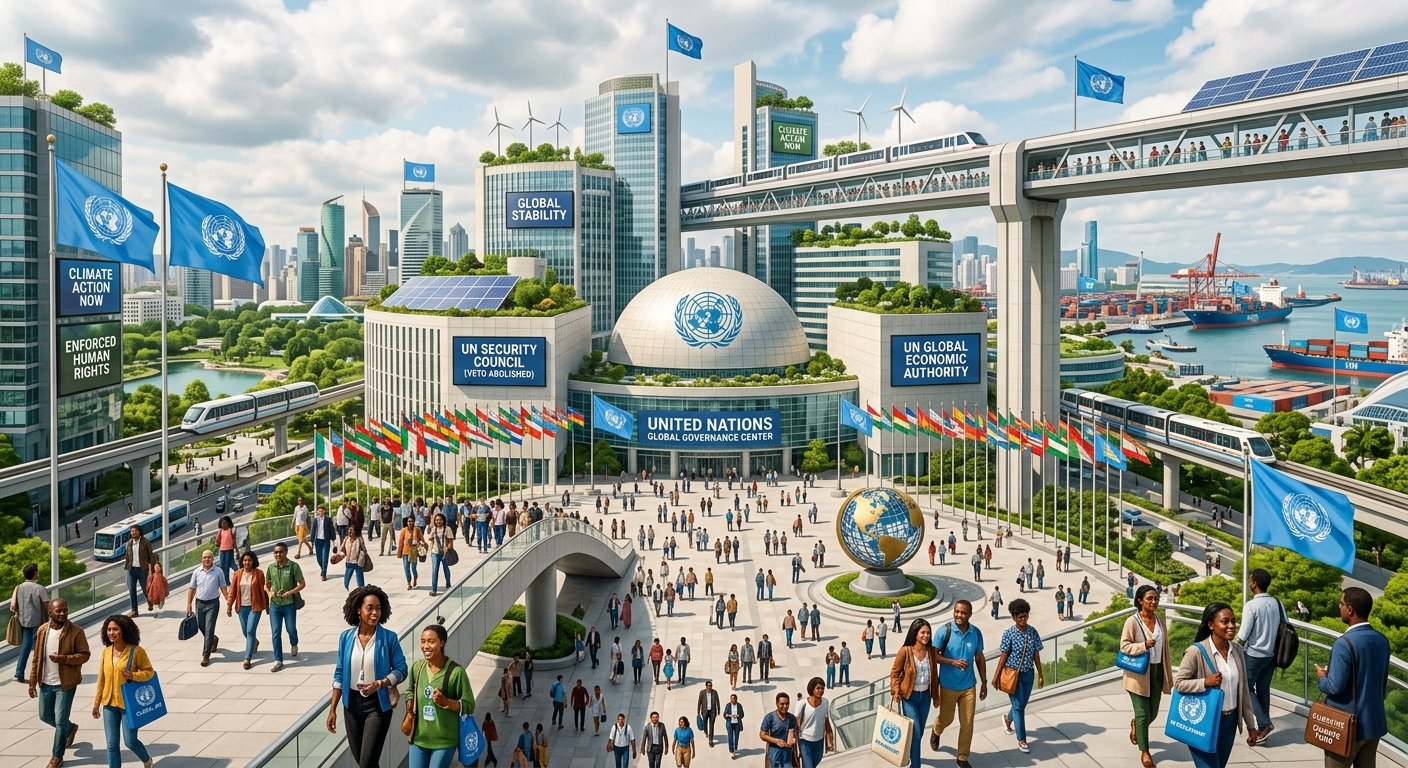
The spectacle of a United States President standing before the United Nations General Assembly to champion nationalism and dismiss multilateral institutions has become a recurring motif of 21st-century diplomacy. Highlighted in coverage such as CNN’s analysis of “a world in chaos as Trump addresses the UN,” these addresses capture a profound geopolitical paradox: at the precise moment global crises demand unified, systemic action, the world’s primary superpower often champions isolation, national sovereignty, and transactional unilateralism. The diagnosis—that the world is in chaos—is undeniably accurate. However, the unilateral framework offered as a remedy is fundamentally flawed. To stabilize a fragmented international system, the solution is not a return to competitive nation-states, but rather the structural empowerment of the United Nations, equipping it with political authority and, crucial to its success, direct economic governance capabilities.
The Myth of Unilateral Order in an Interconnected World
The assertion that national sovereignty can solve global problems rests on a misdiagnosis of modern crises. Climate breakdown, mass displacement, trade wars, cross-border pandemics, and regional conflicts are fundamentally transnational. No individual nation, regardless of its military footprint or GDP, can manage these phenomena within its borders alone.
When world leaders attack multilateral governance, they exploit the real shortcomings of existing institutions while offering a model that exacerbates instability. A world governed strictly by nation-first doctrines devolves into a zero-sum game, leading to regulatory race-to-the-bottom dynamics, protectionism, and security dilemmas where one nation’s gain is invariably another’s existential threat. The vision of a planet managed solely through bilateral bargains fails to account for collective action problems that require binding, universal commitments.
Elevating Political and Enforceable UN Authority
The modern UN is often paralyzed not by a failure of vision, but by a structural lack of enforceability. Designed in the shadow of World War II, its primary legislative and security apparatuses—most notably the UN Security Council—are constrained by the veto power of five permanent members, frequently freezing the institution in times of severe humanitarian or strategic crisis.
To transform the UN from a forum for debate into a guarantor of international stability, its political authority must be modernized:
- Security Council Reform: Abolishing or drastically limiting the single-member veto power in cases of mass atrocities or severe international law breaches would prevent major powers from shielding aggressive unilateral actions.
- Binding Jurisdiction: The rulings of international bodies like the International Court of Justice (ICJ) must carry real mechanisms for execution, moving away from voluntary compliance toward mandatory adherence.
- Global Public Goods Governance: Granting the UN regulatory oversight over common spaces—such as deep-sea ecosystems, space exploration, and cross-border digital networks—would prevent unregulated exploitation by dominant states or private monopolies.
The Missing Pillar: Economic Authority and Revenue Autonomy
Political authority without independent economic clout leaves the UN perpetually reliant on the financial goodwill of its wealthiest member states—a leverage point frequently used to withhold funding or exact political concessions. For the UN to serve as an effective stabilizer, it requires a structural expansion into global economic authority.
- Independent Revenue Mechanisms: Expanding multilateral tax policies—such as a global financial transaction tax (Tobin tax), a unified corporate minimum tax, or international carbon tariffs—could fund UN humanitarian, peacekeeping, and development projects directly. This independent revenue would insulate global relief operations from domestic political shifts in individual capitals.
- Regulation of Multinational Capital: Economic chaos is frequently driven by unregulated global financial flows, tax havens, and corporate exploitation in vulnerable regions. A UN body equipped with global antitrust and tax-enforcement powers could harmonize labor and environmental standards, preventing corporations from playing sovereign states against one another.
- Equitable Wealth Redistribution and Climate Finance: To resolve the underlying causes of global migration and geopolitical tension, economic authority must include managing global transition funds. The UN must possess the mandatory capital backing to finance renewable infrastructure, debt relief, and climate adaptation in the Global South, bridging the wealth disparities that drive instability.
Conclusion
The chaos depicted during presidential addresses to the General Assembly is not proof of the United Nations’ inherent uselessness; rather, it is proof of its current limitations in the face of unbridled national egoism. Retrenching into nationalism in a hyper-connected global system is an ineffective defense against shared, borderless threats.
The path forward requires bold institutional development. By granting the United Nations binding political power and structural economic authority, the global community can move beyond transient national rivalries. Only a genuinely empowered multilateral system—equipped to regulate global markets, fund sustainable development, and enforce international law—can bring order to a chaotic world.