
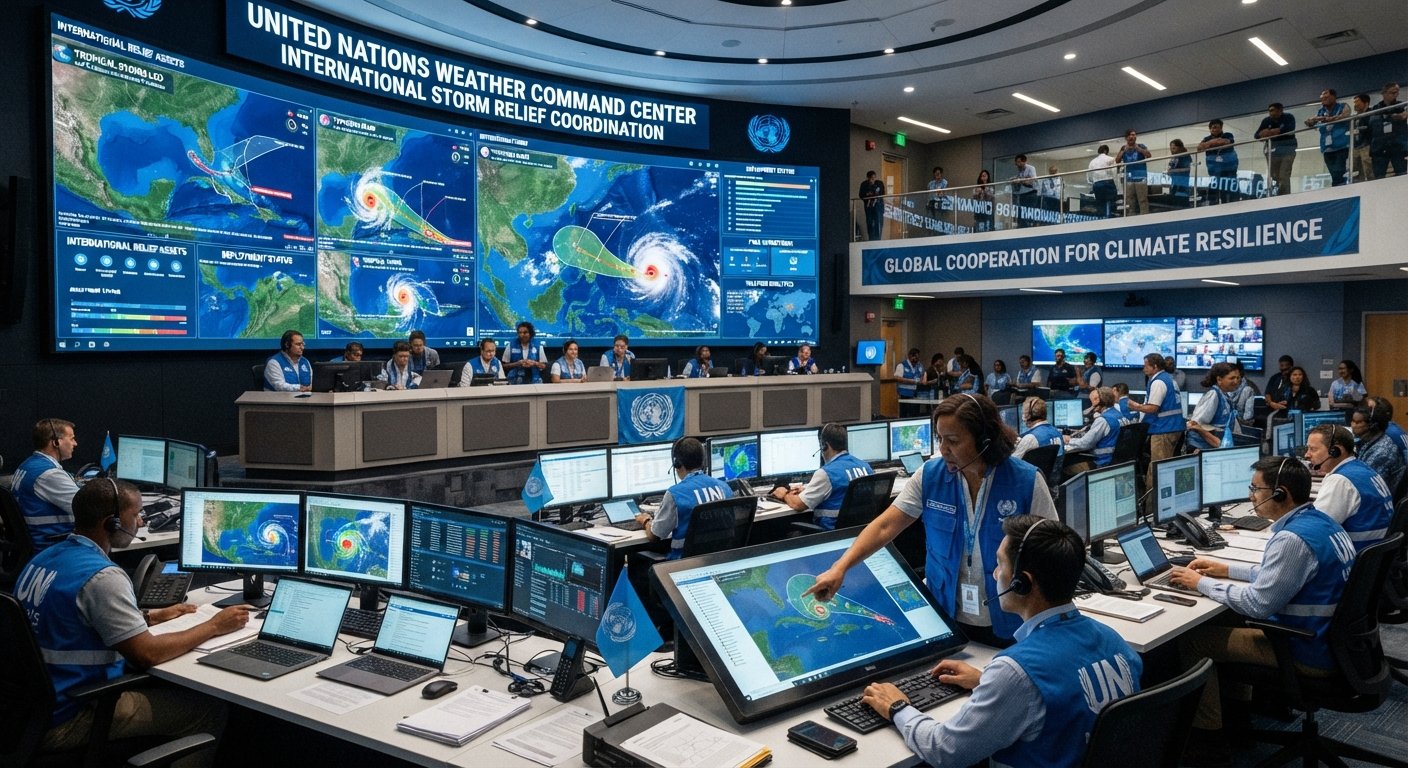
The recent report from CNN, “Gulf Coast faces hurricane threat as Tropical Depression Nine is forecast to strengthen”, highlights a familiar and escalating anxiety across the American South. Developing over the unusually warm waters of the southern Gulf of Mexico, Tropical Depression Nine serves as a stark reminder of the volatile nature of modern weather systems. While localized emergency declarations and regional preparations are vital initial reactions, events like these expose a deeper systemic vulnerability. As shifting climatic patterns supercharge tropical systems—rendering them wetter, more erratic, and capable of rapid intensification—local and national responses alone are no longer sufficient. Mitigating the human and economic tolls of these modern disasters demands a paradigm shift toward heightened United Nations involvement and robust international coordination, spanning everything from disaster relief mechanisms to global environmental education.
For decades, hurricane tracking and disaster management have been viewed primarily through a domestic lens. Municipalities prepare evacuation routes, state governors mobilize the National Guard, and federal agencies like FEMA deploy resources. However, contemporary meteorology operates in an era fundamentally altered by global climate change. Exceptionally warm ocean heat content—the fuel that rapidly turns modest depressions into destructive systems—is a planetary crisis. When storms threaten coastlines, they trigger supply chain disruptions, energy market shocks, and displacement crises that ripple far beyond national borders. Treating these occurrences as isolated, domestic weather events ignores the interconnected reality of our globalized environment.
This interconnectedness makes a compelling case for elevated United Nations involvement in disaster relief. While organizations like the UN—through agencies such as the UN Office for Disaster Risk Reduction (UNDRR) and the World Meteorological Organization (WMO)—already provide critical data and frameworks, their operational capacities in high-income nations are often limited, and global funding mechanisms for climate-induced displacement remain fragmented. A higher degree of UN coordination would establish standardized, globally backed emergency reserves, specialized international rescue interoperability, and equitable resource-sharing matrices. Disasters do not respect sovereign boundaries, and internationalizing the support system ensures that communities—whether in the Global South or along the industrialized U.S. Gulf Coast—can draw upon a collective global safety net when national infrastructures are overwhelmed.
Yet, relief is only half the battle; the more profound deficit lies in education and public awareness regarding structural environmental shifts. Media reports tracking Tropical Depression Nine often focus on immediate threats—storm surges, wind speeds, and localized flood watches. While crucial for saving lives in the short term, this reactive cycle fails to educate the public on the underlying systemic changes driving these anomalies. International bodies must take a leading role in standardizing environmental literacy. Through global educational initiatives spearheaded by entities like UNESCO, curricula worldwide must evolve to teach populations not just how to weather a storm, but why these systems are behaving with unprecedented volatility.
Furthermore, international coordination on education bridges the dangerous gap of climate skepticism and misinformation. When communities understand that a quiet hurricane season or an abrupt, late-season intensification is part of a broader, scientifically documented disruption of global climate loops, public buy-in for long-term mitigation policies increases. People are more likely to support structural zoning reforms, carbon-reduction targets, and green infrastructure investments when they are globally educated on the macro-level forces threatening their local doorsteps.
The CNN report on Tropical Depression Nine is more than just another weather bulletin; it is a recurring alarm bell in an era of environmental disruption. Relying solely on regional responses to combat planetary-scale atmospheric changes is a losing strategy. By weaving international coordination into disaster relief and prioritizing global educational frameworks on environmental shifts, the international community can move away from perpetual crisis management. Only through a unified, global approach can we hope to protect vulnerable coastal regions and build a resilient future against an increasingly unpredictable sky.