
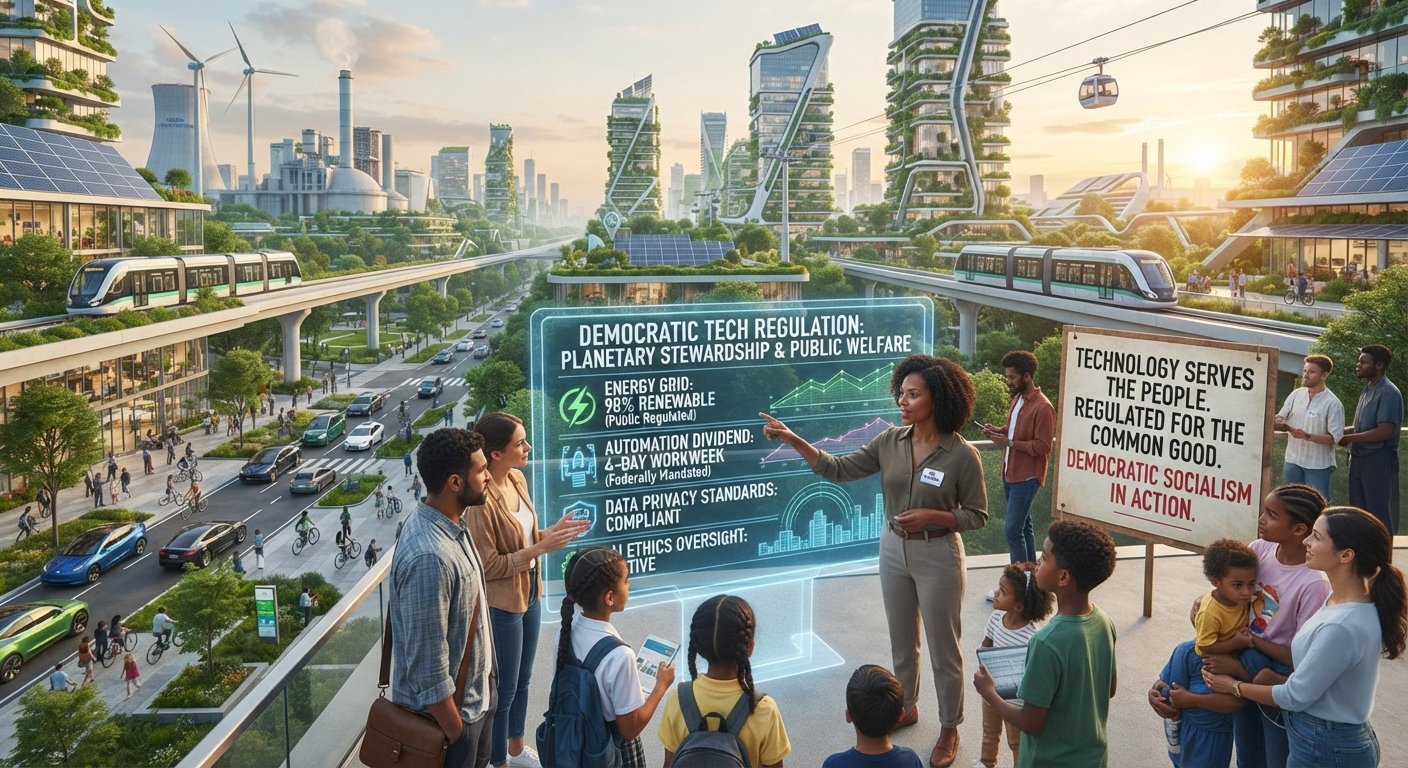
The romanticized longing for a return to a pre-industrial, “back-to-nature” existence is a powerful siren song. In an era marked by climate anxiety, algorithmic alienation, and corporate surveillance, the impulse to strip away modern machinery and retreat to the woods is entirely understandable. However, this primitivist philosophy fundamentally misdiagnoses our civilizational crisis. Technology itself is not the enemy of humanity or the earth; rather, it is a neutral tool whose current destructiveness stems from the profit-driven motives of unregulated capitalism. To abandon technology is to abandon billions to preventable suffering. Instead of retreating backward into the woods, our best path forward lies in embracing technological acceleration, guided, constrained, and directed by heavy government regulation through a democratic socialist framework.
The Fallacy of Primitivism
To advocate for a return to nature as a systemic solution is to ignore both history and the stark realities of human biology. A “back-to-nature” model is neither ecologically viable for a global population of eight billion people nor socially just. Pre-industrial life, romanticized as harmonious and simple, was largely defined by backbreaking labor, high infant mortality, vulnerability to fickle weather patterns, and the absence of modern medicine.
Moreover, primitivism relies on a false binary: the belief that humans and technology exist in permanent opposition to nature. In reality, human beings are tool-making animals. Technology—ranging from agricultural irrigation to modern renewable energy grids—is the very mechanism through which we interact with and survive within our environment. The ecological crises we face today are not the result of having too much technology, but rather the result of deploying extractive, polluting technologies designed to maximize short-term capital accumulation rather than public well-being.
Technology as an Engine of Liberation
When liberated from the narrow pursuit of profit, technology is our most potent instrument for human flourishing and environmental stewardship. Consider the existential threat of climate change. We cannot plant trees fast enough or simply lifestyle-change our way out of carbon saturation. Mitigating climate catastrophe requires state-of-the-art geoengineering, massive carbon capture infrastructure, next-generation solar and nuclear power, and globally integrated smart grids—all of which are triumphs of high technology.
Furthermore, automation and artificial intelligence possess the potential to eradicate forced, alienated labor. In a rational society, machines should do the heavy lifting, freeing humanity from the tyranny of the forty-hour workweek. Technology can democratize education through open-access digital libraries, revolutionize healthcare through advanced diagnostics and biotechnology, and connect communities across vast distances. The problem is never the innovation itself; it is the absence of public boundaries placed upon how it is deployed.
Democratic Socialism via Heavy Government Regulation
Under democratic socialism, managing technology does not necessarily require the clumsy mechanics of wholesale state ownership of every enterprise. Instead, democratic socialism frequently operates through robust, proactive, and heavy government regulation of private industry. By maintaining a framework of strong democratic oversight, the state can harness the innovation and dynamism of decentralized markets while strictly subordinating them to human need and ecological survival.
Rather than nationalizing every tech firm or laboratory, heavy democratic regulation achieves the public good through enforceable constraints and directives:
- Strict Environmental and Safety Mandates: Imposing rigorous carbon caps, zero-waste requirements, and rigorous algorithmic safety standards that private firms must legally meet to operate. If a technology fails to protect public health or the planet, its deployment is barred.
- Publicly Directed Research and Development Subsidies: Using government funding and tax policy to steer private sector innovation toward socially vital areas—such as clean energy, public transit, and affordable medicine—while starving destructive industries of capital.
- Data Rights, Antitrust, and Labor Protections: Enforcing stringent antitrust laws to break up monopolies, establishing absolute data privacy rights for citizens, and mandating that the productivity gains of automation translate into shorter workweeks, high wages, and robust social safety nets funded by progressive taxation.
In this model, corporations may retain their operational structures, but they answer to a sovereign public. The fundamental question of technological development is forcibly shifted from “Will this maximize shareholder return?” to “Does this serve the democratic public interest?”
Conclusion
The choice before humanity is not between a pristine, low-tech pastoral utopia and a dystopian corporate technocracy. The former is a logistical and humanitarian impossibility, while the latter is a dystopian dead end. By combining an enthusiastic embrace of innovation with a framework of heavy, democratic government regulation, we can harness technology to heal the planet, eliminate scarcity, and liberate human potential. We must look forward, not backward, building a future where technology is strictly governed to serve the many, not the few.