
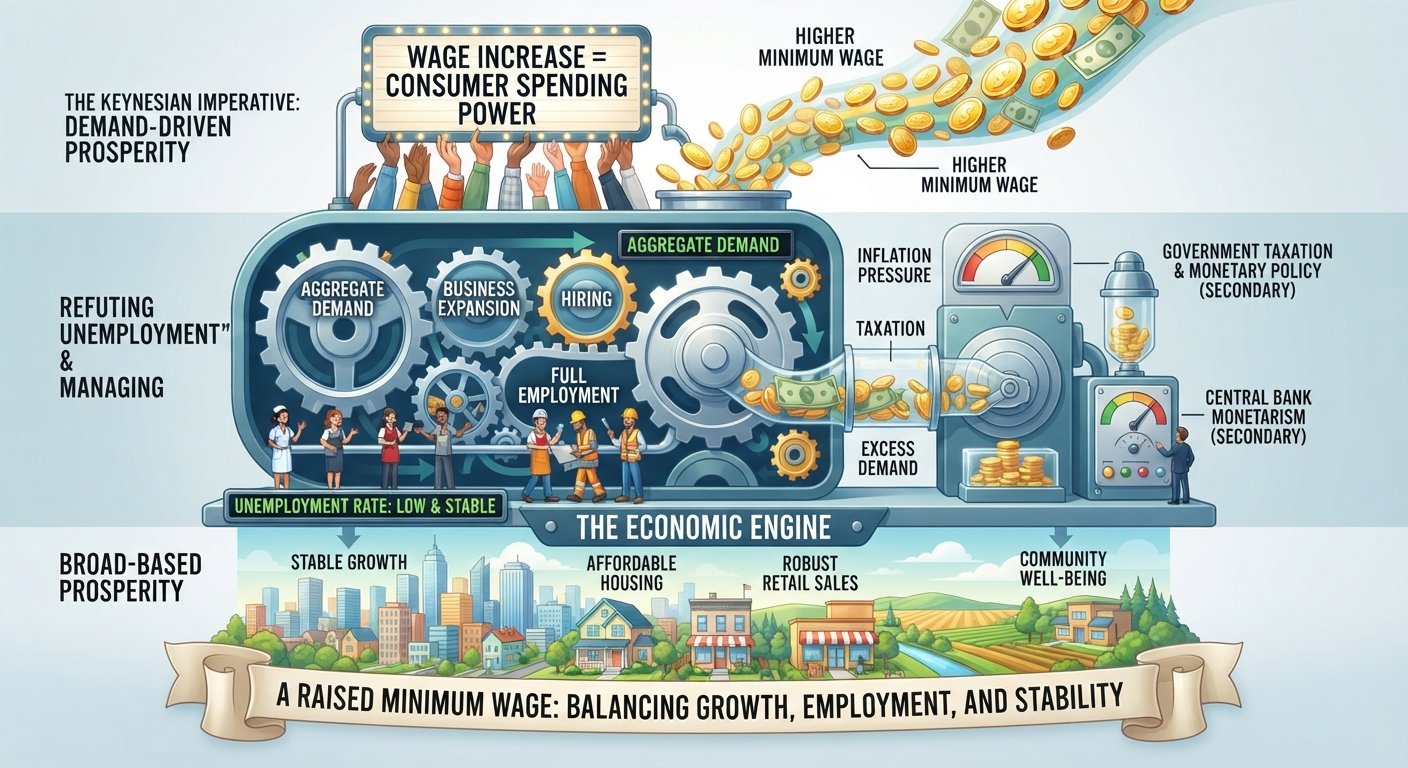
For decades, the debate surrounding the minimum wage has remained deadlocked between ethical appeals for a living wage and orthodox economic warnings of ruinous job losses and inflationary spirals. Critics of minimum wage increases often rely on static, neoclassical supply-and-demand models, arguing that artificially raising the price of labor inevitably reduces its quantity demanded. However, this view overlooks the dynamic realities of aggregate demand, consumer purchasing power, and modern macroeconomic policy. By examining the issue through a Keynesian framework—supported by targeted taxation and secondary monetarist controls—we can see that raising the minimum wage is not only a moral necessity but a sound economic strategy for achieving full employment and sustainable growth.
The Keynesian Imperative: Demand-Driven Prosperity
At the core of John Maynard Keynes’s economic philosophy is the principle of effective demand. In a consumer-driven economy, businesses do not hire workers simply because labor is cheap; they hire workers because there is robust consumer demand for their goods and services.
Low-income earners possess a high marginal propensity to consume. Unlike high-income earners, who save a significant portion of incremental income, low-wage workers immediately spend additional earnings on essential goods and services such as housing, food, transportation, and healthcare.
When the minimum wage is raised, billions of dollars are instantly injected back into the local economy. This surge in consumer spending boosts aggregate demand, prompting businesses to expand operations and hire more personnel to meet rising sales volumes. Rather than causing unemployment, higher wages frequently reduce it by generating the very market demand that justifies business expansion.
Refuting the Myth of Wage-Driven Unemployment
Critics frequently argue that increasing labor costs prices marginal workers out of the market, leading to widespread layoffs. This argument assumes a perfectly competitive market in dynamic stasis, ignoring the phenomenon of monopsony power in low-wage labor markets. In reality, large employers often exert significant control over wage rates, holding them artificially below the equilibrium value of workers’ marginal productivity.
Furthermore, higher wages yield substantial offsetting efficiencies for employers:
- Reduced Turnover: Better compensation drastically cuts the high costs associated with hiring, onboarding, and training replacement staff.
- Enhanced Productivity: Well-compensated workers experience lower stress, better health, and higher morale, leading to measurable gains in output per hour.
- Market Equilibrium: Modest, well-designed wage floors absorb these operational efficiencies without triggering widespread structural unemployment, a reality repeatedly supported by empirical labor market studies.
Managing Inflation: Taxation and Monetary Tools
A common counterargument is that higher labor costs will spark runaway inflation as businesses pass increased expenses onto consumers. While wage increases can exert mild upward pressure on the price level, this risk is manageable and can be effectively neutralized through established macroeconomic levers.
1. Fiscal Policy and Taxation as the Primary Anchor
Keynesian economics relies heavily on fiscal policy to manage aggregate demand and curb excess inflation. If a wage increase threatens to overheat the economy, progressive taxation serves as the primary stabilizing tool. By adjusting tax structures—such as increasing progressive income taxes or implementing targeted corporate levies on excessive profit margins—governments can cool consumer demand and temper price pressures without depressing the baseline purchasing power of working-class households.
2. The Secondary Role of Monetarism
While fiscal policy and taxation lead the charge in economic stabilization, monetarist principles play a valuable supporting role. Controlling the money supply and managing interest rates through central bank operations provide a secondary safeguard against speculative inflation. However, strict monetarism alone is inadequate for addressing income distribution or supply-side dynamics. Treating monetarism as a secondary instrument ensures that monetary policy acts as a fine-tuning mechanism rather than a blunt instrument that chimes growth.
Conclusion
Raising the minimum wage is a vital policy instrument for modern economic health. By moving past static neoclassical fears of unemployment and embracing a dynamic Keynesian framework, policymakers can recognize that wages are not merely a cost of production, but the lifeblood of consumer demand. Paired with intelligent fiscal taxation and supportive monetary guardrails, a higher minimum wage fosters an economy capable of balancing full employment, price stability, and broad-based prosperity.