
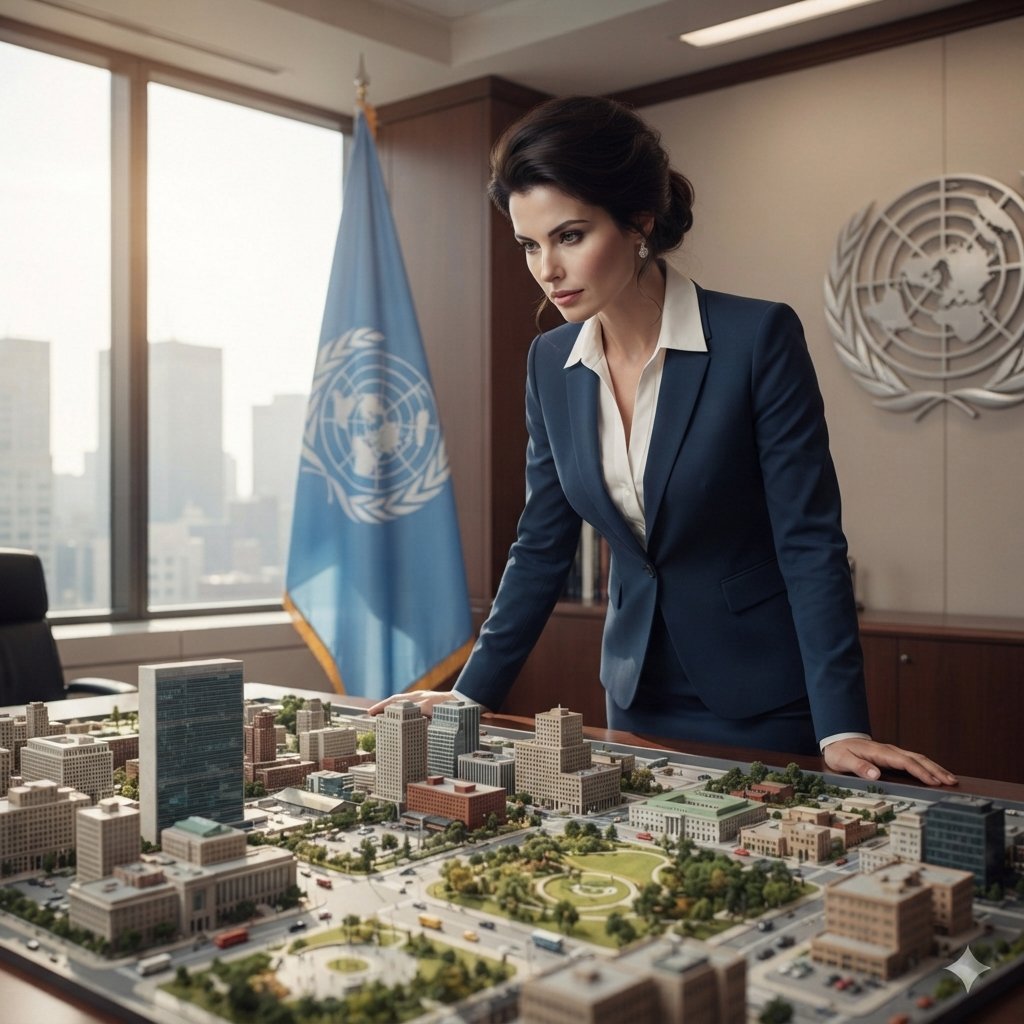
In Thomas Hobbes’s seminal political treatise, Leviathan, the frontispiece famously illustrates a towering monarch composed of thousands of individual citizens, standing omnipotent above the lands he governs. Centuries later, Jean-Jacques Rousseau refined this concept of collective sovereignty with his doctrine of the volonté générale—the “general will.” Rousseau posited that true legitimacy arises when individuals surrender their private egoism to a singular collective consciousness that acts relentlessly for the common good. In the image of the Secretary-General leaning over a meticulously crafted architectural model of a metropolis, we witness the modern, globalized iteration of this philosophical construct: the United Nations not merely as a forum for diplomacy, but as the supreme sovereign body on Earth, and its leader as the ultimate embodiment of humanity’s unified desire for order and peace.
The physical composition of the image serves as an ideal metaphor for this supreme authority. The Secretary-General stands tall, framing the frame with an aura of total power and cool resolve. Beneath her hands lies a sprawling urban expanse reduced to a miniature grid—a microcosm of human civilization, complete with towers, parks, avenues, and civic infrastructure. From her elevated vantage point, entire cities seem tiny, rendered as modest components of a much grander global calculus. The skyscrapers that usually overwhelm the individual human experience are here subverted; they are reduced to mere blocks on a table, subject to her oversight and direction. This visual reduction of the metropolis captures the sheer scale of the United Nations’ authority—a power that transcends individual municipal boundaries, national borders, and local self-interests to view human civilization as a singular, interconnected whole.
In Rousseau’s framework, the general will is distinct from the “will of all.” While the latter is merely a sum of selfish, individual desires, the general will represents the transcendent, rational interest of the entire collective. The image captures this philosophical nuance through the Secretary-General’s posture and gaze. Flanked by the official flag of the United Nations and the silver emblem of the world map enclosed in olive branches, she does not look upon the miniature city with tyrannical disdain, but with the solemn, totalizing gaze of ultimate stewardship. She is the living proxy of planetary sovereignty. Beneath her purview, the petty conflicts, local rivalries, and fractional interests of individual states fade into insignificance. The world’s sprawling urban centers, with all their chaos and complexity, become legible and manageable under a unified command.
Furthermore, the backdrop of real skyscrapers gleaming outside her window establishes a compelling duality. It signifies that the physical world outside reflects the vision held within the executive chamber. The United Nations emerges in this vision as the most powerful organization in human history—an institution where political fragmentation gives way to absolute consensus. The Secretary-General does not merely govern; she orchestrates. By embodying the collective sovereignty ceded by all nations to prevent self-destruction, her authority towers over the world’s cities, guiding humanity from a position of absolute oversight toward an ordered, harmonious future.