
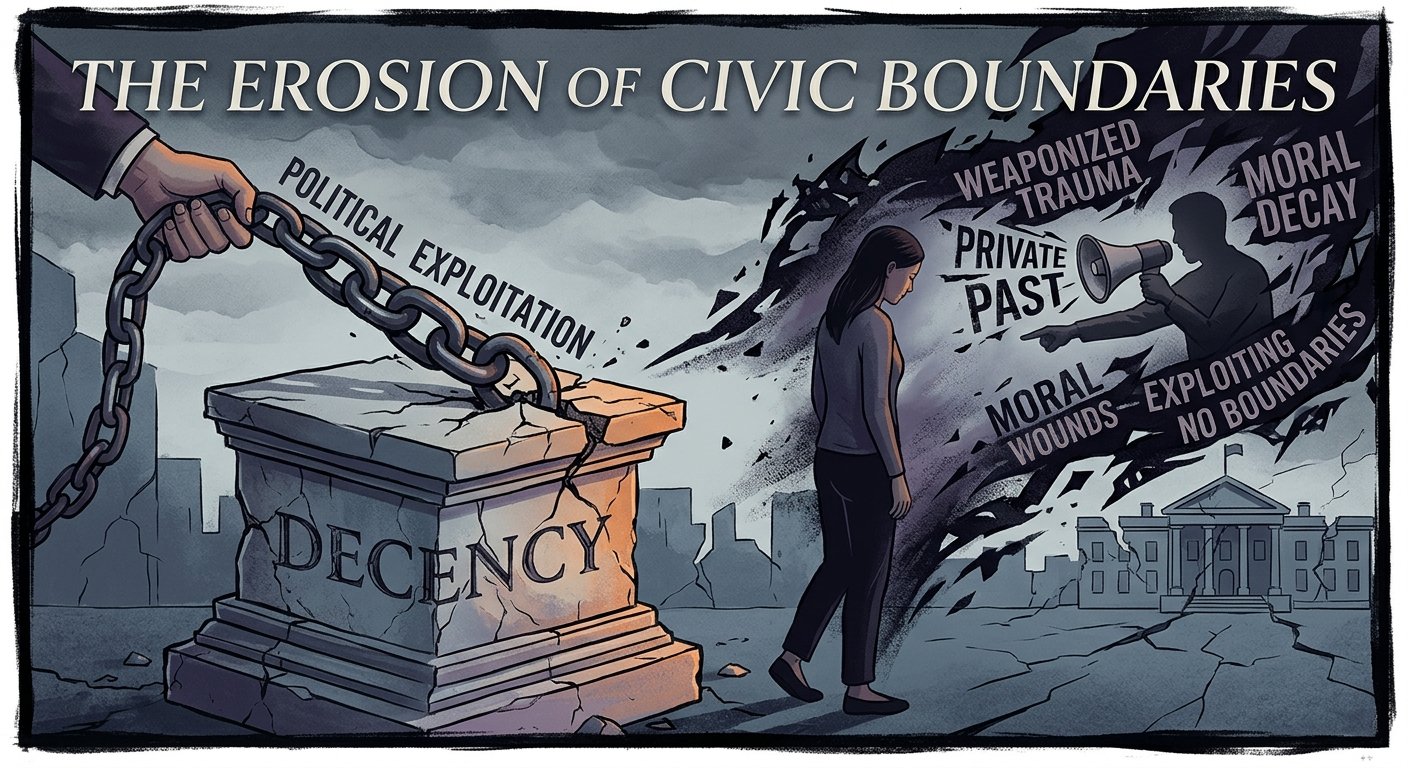
Modern American politics has long been characterized by sharp rhetoric and negative campaigning, but every so often a line is crossed that resets our collective understanding of political decency. The political attack ads fielded by Republican gubernatorial candidate Vivek Ramaswamy targeting Democratic opponent Dr. Amy Acton—specifically those leveraging her estranged mother to undermine her accounts of severe childhood sexual abuse—mark such a boundary. By turning a candidate’s documented childhood trauma into a political talking point, the campaign reflects a deeper social and moral decay in public discourse, where no personal boundary remains sacred in the pursuit of political power.
The Attack and Its Context
Dr. Amy Acton, former director of the Ohio Department of Health, built her public platform on transparency and public service. Throughout her career, she has spoken openly about her upbringing, which involved severe neglect and child sexual abuse at the hands of her birth mother’s husband in the late 1970s—a matter corroborated by historical court records, including grand jury indictments. Acton and her brother were eventually removed from the household by state authorities, while her birth mother chose to stay with the abuser until his death.
Despite these documented facts, Ramaswamy’s campaign released multi-million-dollar ad buys featuring Acton’s estranged birth mother, who labeled her daughter a “liar” regarding her childhood history. Although the campaign defended the ad by claiming it focused on credibility rather than childhood trauma, the practical effect was to weaponize an abuser-adjacent relative against a survivor of childhood sexual violence.
The Erosion of Moral Boundaries
The decision to elevate an estranged parent—who stood by a court-indicted child abuser—to delegitimize a survivor represents a qualitative shift in political strategy. Traditionally, political attacks aimed at policy decisions, voting records, or professional conduct. When personal lives entered the arena, they typically revolved around a candidate’s own adult choices.
Weaponizing childhood trauma, however, violates a fundamental moral norm: children are victims of their environments, and survivors should not be forced to re-litigate childhood abuse in the court of public opinion for political expediency. To exploit an estranged, abusive familial relationship is to strip away the basic empathy required to sustain a healthy civic society.
A Reflection of Broader Social Decay
This episode is not an isolated political misstep; it is a symptom of a broader culture that increasingly prioritizes sensation and dominance over empathy and truth. Several key trends underline this shift:
- The Normalization of Hyper-Personal Cruelty: Public discourse has drifted toward tactics that intentionally inflict maximum personal pain. When political strategists view a candidate’s deepest trauma not as off-limits, but as “pay dirt” or a tactical leverage point, it signals that cruelty has been mainstreamed as a viable political strategy.
- The Disregard for Fact and Nuance: By pitting an estranged relative’s narrative against established legal and state records of child removal, the ad relies on a post-truth framework where objective reality matters less than the emotional chaos generated by the accusation.
- Bipartisan Concern and Moral Fatigue: While the ad drew condemnation from across the political spectrum—including several prominent Republican figures who called it uncalled-for and harmful—the fact that millions of dollars were spent to broadcast it highlights how financial capital in politics often rewards shock value over civic responsibility.
Conclusion
A society’s moral health can be measured by how it treats its most vulnerable, including survivors of childhood violence. When political campaigns cross from challenging a candidate’s policies into exploiting their childhood trauma, it diminishes not just the candidate, but the electorate itself. Rebuilding civic decency requires recognizing these tactics for what they are: a reflection of social decay that undermines the integrity of public life.
Source List
- The 19th News: Amy Acton survived childhood abuse. Ramaswamy is using it to attack her.
- Associated Press / PBS NewsHour: Ramaswamy campaign says it produced ad with Amy Acton’s mother and will spend millions to promote it
- Mother Jones: GOP Doubles Down on Ad Exploiting Ohio Democrat’s Childhood Rape and Abuse
- WKYC Studios: Vivek Ramaswamy again stands by campaign ad featuring Amy Acton’s estranged mother
- CBS News: Ramaswamy should drop ad featuring Acton’s mom, GOP governor says
Amy Acton calls Vivek Ramaswamy campaign ad featuring her estranged mother ‘despicable’
This video provides direct coverage and context regarding Dr. Amy Acton’s response to the campaign ad featuring her estranged mother.