
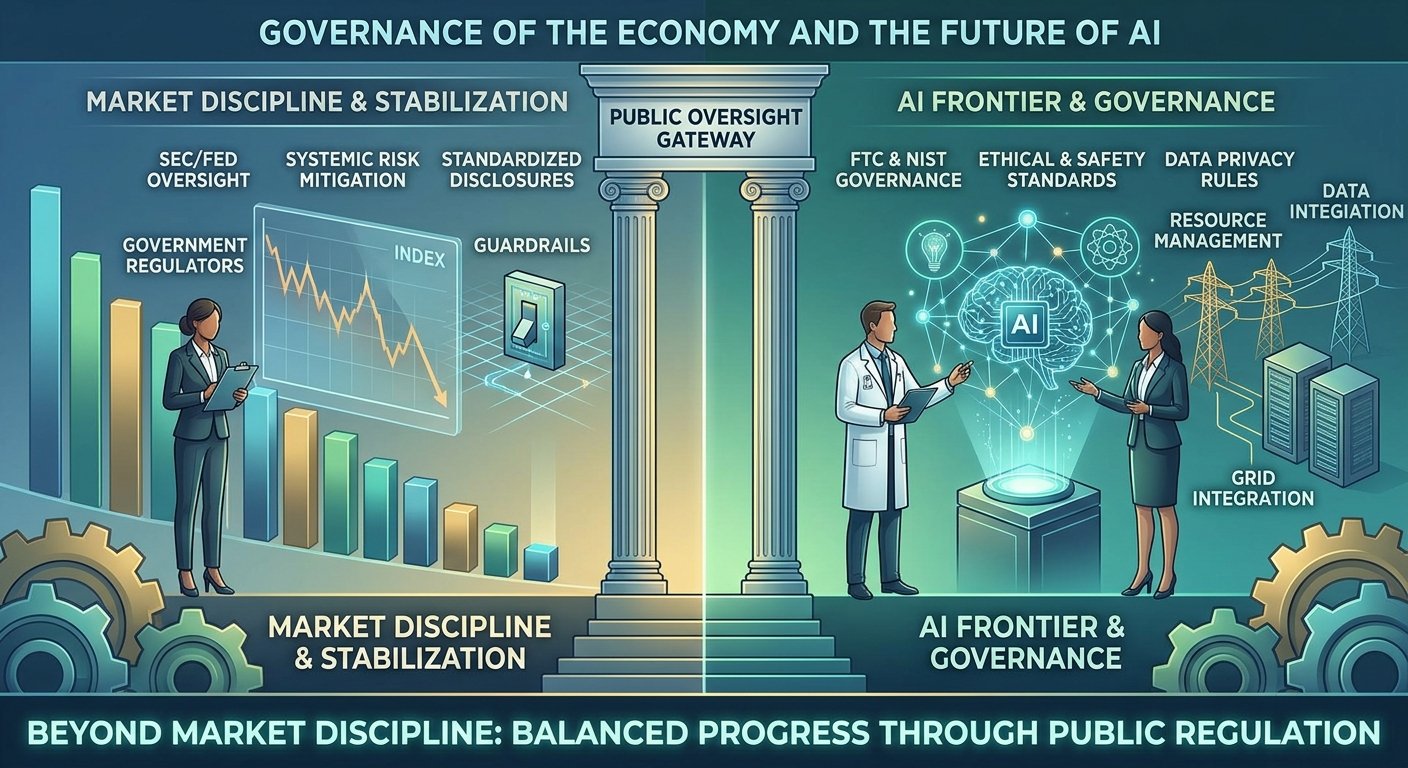
The sharp decline in the tech-heavy Nasdaq Composite—marking its worst single-month performance in over a year—sent a unambiguous warning shot across Silicon Valley and Wall Street. As analyzed by CNN, the market pull-back delivered a direct message to artificial intelligence infrastructure giants and software pioneers: the era of unchecked valuation, unbridled speculative spending, and unexamined capital deployment is meeting systemic friction.
While market commentary often frames sell-offs as routine self-correcting cycles of capitalism, this specific inflection point underscores a broader structural reality. The downturn of AI market darlings is not merely an isolated warning to corporate boardrooms; it serves as a compelling case for formal government regulation—both of capital markets broadly and of the emerging AI sector specifically. Relying solely on market forces to discipline economic bubbles and control transformational technologies introduces profound risks to macroeconomic stability and societal welfare.
1. Market Failures and the Mandate for Macroeconomic Regulation
The retreat of major tech indices illustrates why laissez-faire approaches to financial markets repeatedly fall short. Equity markets, left entirely to private incentives, are structurally susceptible to speculative mania, systemic herd behavior, and severe misallocations of capital.
During the rapid ascent of AI equities, private capital poured hundreds of billions of dollars into semiconductor manufacturing, data center expansion, and massive compute clusters. However, market prices frequently reflect short-term hype rather than fundamental long-term value, leading to severe volatility when underlying earnings fail to match elevated expectations immediately.
Government regulation of economic activity and stock markets serves as a necessary stabilizing counterweight to this cycle:
- Systemic Risk Mitigation: When index weighting becomes heavily concentrated in a handful of mega-cap technology firms, market downturns in one sector risk destabilizing wider consumer sentiment, pension holdings, and broader economic liquidity. Central banking oversight, capital reserve mandates, and transparent reporting requirements established by statutory bodies protect the public from system-wide fallout.
- Capital Allocation Discipline: Public regulators—such as the U.S. Securities and Exchange Commission (SEC)—mandate standardized accounting disclosures and material risk reporting. Without enforced disclosure rules, speculative bubbles inflate unchecked on opaque promises of technological dominance, ultimately harming retail and institutional investors when realities reset.
Economic regulation does not aim to stifle capital growth; rather, it establishes legal guardrails that prevent predatory financial practices, systemic leverage risks, and irrational panics.
2. The Unique Imperative for Public Regulation of AI Technology
While general market regulation addresses financial stability, the AI surge poses distinct technological and social risks that market pricing models are completely unequipped to manage. Financial markets evaluate companies based on projected cash flows, profit margins, and return on investment. They do not naturally price in systemic externalities such as data privacy erosion, algorithmic bias, labor disruption, deepfake-driven disinformation, or critical infrastructure security vulnerabilities.
Allowing private commercial incentives to unilaterally dictate the trajectory of general-purpose artificial intelligence creates compounding structural challenges:
- Monopolistic Infrastructure Bottlenecks: The staggering capital expenditures required to train frontier models restrict real market participation to a small oligopoly of tech behemoths and cloud providers. Public antitrust enforcement—coordinated by entities like the Federal Trade Commission (FTC)—is critical to ensuring open competition and preventing single points of failure across digital infrastructure.
- Resource and Energy Demands: The exponential expansion of AI data centers places extreme pressure on regional power grids and municipal water systems. Statutory bodies like the U.S. Department of Energy (DOE) must step in to govern grid integration, energy efficiency standards, and environmental impact reporting.
- Safety and Governance Standards: As artificial intelligence systems are deployed in high-stakes domain settings—healthcare, loan underwriting, defense, and power distribution—leaving technical safety to voluntary corporate self-regulation creates moral hazards. Binding safety protocols, such as those developed by the National Institute of Standards and Technology (NIST), establish vital public-interest standards.
3. Synthesis: Coordinating Financial and Technological Oversight
The market correction signaled by the Nasdaq’s sharp decline demonstrates that private financial markets are reactive rather than proactive. Wall Street penalizes tech firms only after capital expenditure metrics outpace near-term returns. However, by the time financial markets react to structural problems in technological deployment, significant systemic damage—ranging from misallocated public resources to unmitigated safety risks—has already occurred.
A comprehensive regulatory regime must operate along two reinforcing axes:
Public oversight ensures that technical innovation is grounded in societal need, moral responsibility, and macroeconomic health, rather than being driven entirely by quarterly earnings pressures and speculative investment waves.
Conclusion
The clear message delivered by the Nasdaq’s downturn is that market forces alone cannot serve as the primary regulator of transformational technologies. Financial markets are vital mechanisms for price discovery, but their inherent volatility, short-term focus, and vulnerability to speculative bubbles prove that robust government regulation remains indispensable.
By maintaining strong statutory oversight of capital markets while simultaneously establishing clear legal and safety frameworks for artificial intelligence development, policymakers can guard against economic instability while steering breakthrough innovations toward the broader public good.
Sources & References
- U.S. Securities and Exchange Commission (SEC): Enforces federal securities laws, mandates corporate financial disclosures, and maintains market integrity.
https://www.sec.gov - Federal Trade Commission (FTC): Enforces consumer protection laws and prevents anti-competitive business practices and market consolidation.
https://www.ftc.gov - National Institute of Standards and Technology (NIST): Develops technical standards, metrics, and risk management frameworks for emerging technologies and AI governance.
https://www.nist.gov - U.S. Department of Energy (DOE): Oversees national energy infrastructure, grid reliability, and clean energy standards applicable to high-compute data centers.
https://www.energy.gov - Nasdaq Market Insights & Indexes: Tracks performance metrics, sector concentration risks, and financial returns across technology benchmarks.
https://www.nasdaq.com - CNN Business: Provides financial news coverage and structural analysis regarding market trends and technology valuation metrics.
https://www.cnn.com/business