
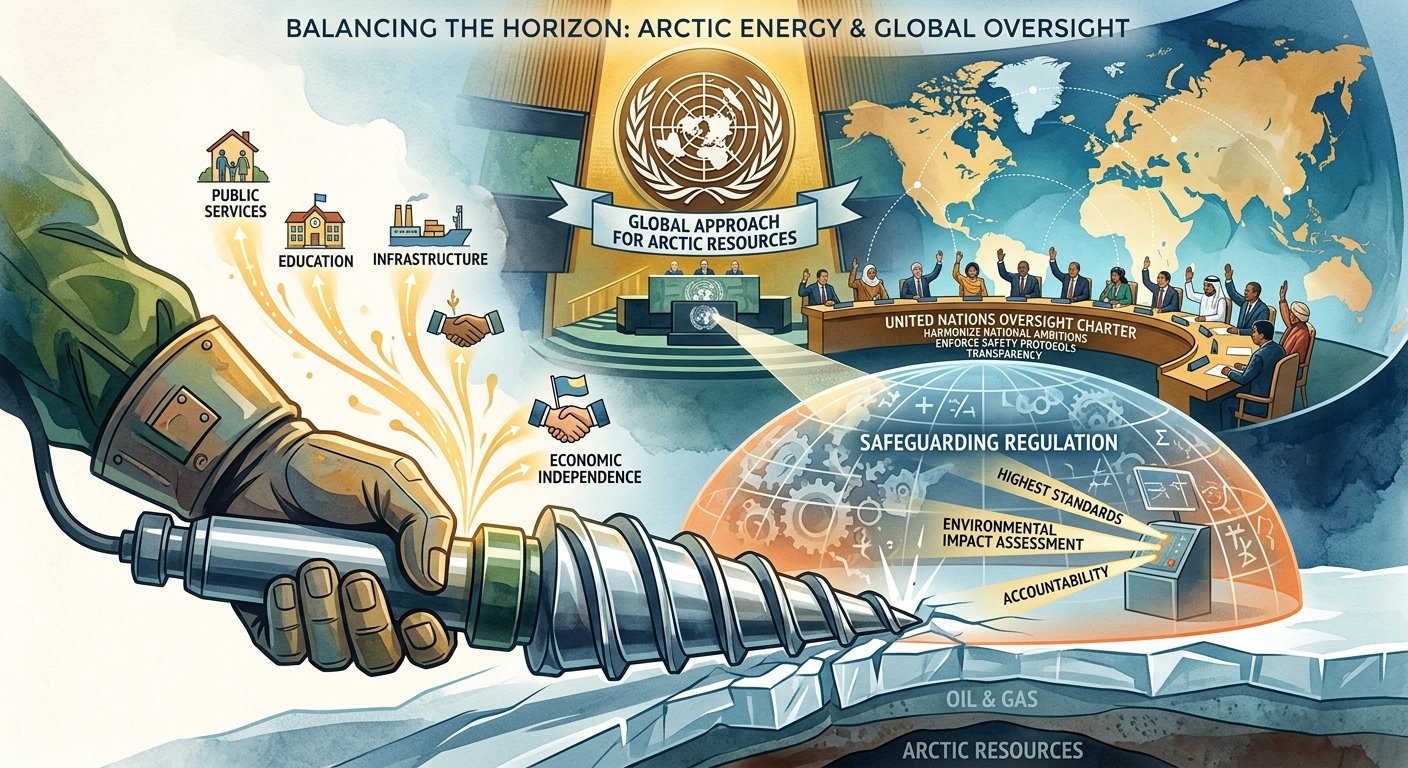
Recent headlines highlighting statements from Washington regarding “massive” oil, gas, and mineral exploration in Greenland have reignited a fierce global debate. The prospect of tapping into the untouched energy reserves of the Arctic carries profound implications for geopolitics, economic security, and environmental stewardship. While the immediate reaction from purist environmental corners is often outright condemnation, a more nuanced perspective reveals that Arctic resource extraction can be a positive and necessary endeavor—provided it is tightly constrained by rigorous regulation. However, given the borderless nature of our climate and oceans, managing this new frontier cannot be left to individual superpowers or corporate interests alone; it demands a comprehensive, global approach spearheaded by the United Nations.
The Pragmatic Case for Arctic Resource Development
To dismiss oil and gas development entirely is to ignore the current realities of the global economy. Despite ongoing transitions toward renewable energy, fossil fuels remain the baseline engine powering modern infrastructure, manufacturing, and transportation worldwide. Disruptions in energy supplies frequently trigger economic hardship, inflation, and instability that disproportionately affect vulnerable populations.
Opening regions like Greenland to resource exploration can yield substantial economic benefits. For Greenland itself—an autonomous territory striving for greater financial independence—revenues from energy and mineral development could fund vital public services, infrastructure, and education, transforming its economy. From a broader strategic standpoint, diversified energy supplies can enhance market stability and prevent geopolitical leverage from concentrating exclusively in the hands of volatile or adversarial regimes. Done responsibly, tapping these resources can act as a pragmatic bridge, fueling current global needs while economies slowly and securely scale up alternative technologies.
The Imperative of Strict Regulation for the Common Good
Yet, the remote and pristine nature of the Arctic ecosystem means that the margin for error is razor-thin. An oil spill or unmitigated industrial footprint in the Arctic would not just remain a local tragedy; it would cause catastrophic, long-lasting damage to fragile polar habitats, marine life, and indigenous livelihoods that have endured for generations.
Therefore, extracting oil and gas cannot be treated as a traditional land-grab or a corporate free-for-all. It must be subjected to the highest standards of ecological and operational regulation. Regulatory frameworks must mandate state-of-the-art containment technology, strict environmental impact assessments, and absolute accountability for corporations. Drilling must be conditioned on the “common good”—meaning that the wealth generated must directly benefit local populations while safeguarding the biosphere. Profit can no longer be allowed to eclipse preservation; environmental safety must be baked into the foundational license to operate.
The Role of the United Nations: A Global Approach
Because the environmental consequences of Arctic drilling—ranging from localized marine disruption to global carbon contributions—transcend national borders, unilateral control by any single nation is fundamentally inadequate. The United States, Denmark, and Greenlandic authorities hold primary jurisdiction, but the stakes belong to the entire planet.
This is where the United Nations must step in to establish an overarching global framework. The UN is uniquely positioned to harmonize competing national ambitions, prevent a chaotic Arctic “gold rush,” and ensure that strict, enforceable environmental baselines are applied uniformly. A UN-led initiative could create an international Arctic oversight charter, bringing together indigenous leaders, scientists, and member states to monitor extraction rates, enforce environmental safety protocols, and mandate transparency. By anchoring Arctic development within a multilateral structure, the international community can ensure that resource extraction respects ecological limits and aligns with collective global stability.
Conclusion
The conversation surrounding oil and gas exploration in Greenland is a defining test for the 21st century. It forces humanity to walk a delicate tightrope between meeting undeniable energy needs and protecting the planet. Drilling for oil and gas can be a positive catalyst for economic security and regional development, but only if stripped of reckless ambition and subjected to rigorous, uncompromising regulation. By elevating this issue to the global stage and empowering the United Nations to oversee a coordinated, international approach, we can pursue necessary resources without sacrificing the health of our natural world for future generations.