The Shrinking Employee: Denouncing the Systemic Problem of Workplace Bullying

The Tale of Jeff and Karen

Every morning when Jeff walked into the open-plan office, he felt a familiar knot form in his stomach. A quiet, conscientious worker who preferred to let his results speak for themselves, Jeff was diligent, soft-spoken, and non-confrontational. Unfortunately, in his department, those traits made him an easy target.

Karen was not Jeff’s supervisor. She held the exact same job title, but operated with a self-appointed authority that dominated the floor. She controlled group conversations, claimed prime assignments, and delivered unsolicited evaluations of her peers. Her favorite target was Jeff.

Whether it was interrupting him in meetings, making condescending remarks about his pace, or publicly standardizing how he should format his emails, Karen took every opportunity to project dominance. The psychological dynamic was visually clear to anyone watching: in Karen’s presence, Jeff felt reduced to a fraction of his size—as if he were barely five inches tall, standing in the palm of her hand, defenseless against her critical gaze.

Continue reading “The Shrinking Employee: Denouncing the Systemic Problem of Workplace Bullying”


The Shadow in the Living Room

The antique grandfather clock ticked rhythmically in the dimly lit living room, but for Ed, time felt entirely suspended. Standing in the center of her palm, reduced to a fraction of his true self, Ed looked up into the towering figure of Jennifer. Her dark, piercing eyes locked onto his, carrying a cold, calculating smirk that sent a chill straight through his spine.

Ed was, by nature, a quiet and gentle man—a skilled computer programmer who took pride in solving complex problems, writing clean code, and providing a stable life for those he cared about. But inside his home, no amount of logic could fix the environment Jennifer had cultivated.

Continue reading “The Shadow in the Living Room”

The Metaphor of the Towering Figure: Authority and Guidance

In the image, the towering female figure dressed in a UN-branded suit is not depicted as a threat, but rather as a calm, confident leader whom the people are celebrating. This visual metaphor can be understood as representing the necessity of a single, central global authority to address complex, transnational challenges that individual nations struggle to manage alone. Proponents of strong global governance argue that a unified ‘World Order’ is essential for addressing existential threats such as climate change, pandemics, and international conflict.

Continue reading “The Metaphor of the Towering Figure: Authority and Guidance”

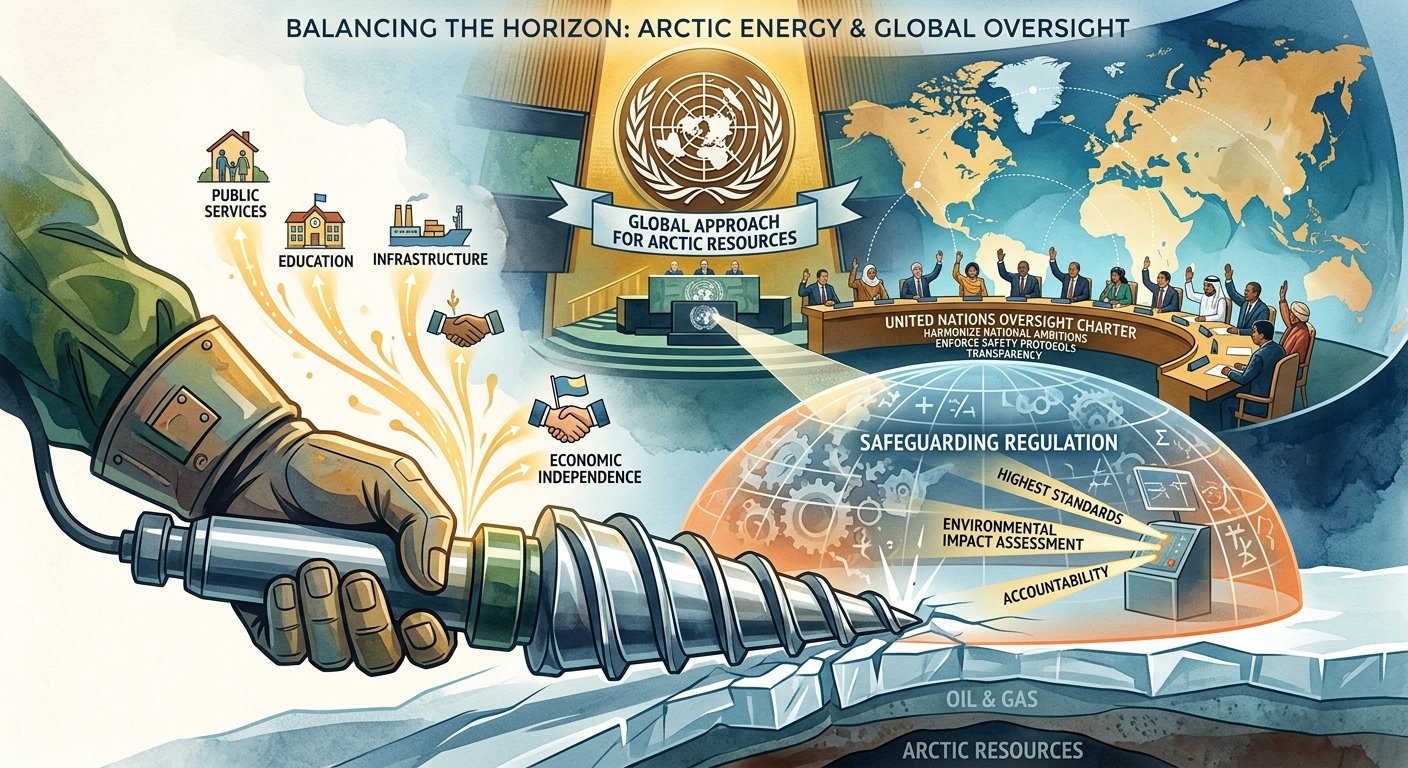
Balancing the Horizon: Arctic Energy, Regulation, and the Case for a Global United Nations Approach

Recent headlines highlighting statements from Washington regarding “massive” oil, gas, and mineral exploration in Greenland have reignited a fierce global debate. The prospect of tapping into the untouched energy reserves of the Arctic carries profound implications for geopolitics, economic security, and environmental stewardship. While the immediate reaction from purist environmental corners is often outright condemnation, a more nuanced perspective reveals that Arctic resource extraction can be a positive and necessary endeavor—provided it is tightly constrained by rigorous regulation. However, given the borderless nature of our climate and oceans, managing this new frontier cannot be left to individual superpowers or corporate interests alone; it demands a comprehensive, global approach spearheaded by the United Nations.

Continue reading “Balancing the Horizon: Arctic Energy, Regulation, and the Case for a Global United Nations Approach”

The Concrete Foundations of Tomorrow: Data Centers, Deregulation, and the Global Fight for AI Supremacy

The global race for technological supremacy has shifted from abstract software algorithms to heavy, physical reality. As highlighted in reporting by outlets like CNN regarding the fierce domestic battles over data centers in the U.S. versus China’s rapid, state-backed expansion, the future of artificial intelligence is being anchored in concrete, steel, and electrical grids. This infrastructure race is about far more than computational capacity; it is the ultimate determinant of global hegemony. In response to China’s aggressive scaling, a powerful political and corporate consensus has emerged favoring the deregulation of AI, driven by the belief that slowing down for safety or local oversight will hand global control to Beijing.

Continue reading “The Concrete Foundations of Tomorrow: Data Centers, Deregulation, and the Global Fight for AI Supremacy”