Bridging Compassion and Contribution: A Work-Anchored Vision for Social Support

Helping the vulnerable is a moral imperative of any civilized society. True community strength is measured by how we treat our most disadvantaged members. However, the method by which we deliver support matters just as much as the intention behind it.

While democratic socialism correctly identifies the need for economic security and a robust social safety net, tying those benefits directly to work creates a sustainable, dignified, and culturally sound framework.

Continue reading “Bridging Compassion and Contribution: A Work-Anchored Vision for Social Support”

The Architecture of Order: Global Governance and the Common Good

The modern era faces a profound paradox: while humanity possesses unprecedented technological and economic power, it struggles with fragmentation, systemic volatility, and a crisis of collective purpose. From transnational market instabilities to social dissolution, unchecked individualism and unrestrained economic competition have repeatedly proven incapable of safeguarding human well-being. To navigate an increasingly complex world, society must embrace a comprehensive framework of order—one that extends from international diplomacy down to individual conduct, anchored by a centralized global authority.

Continue reading “The Architecture of Order: Global Governance and the Common Good”

Driving Forward: The Environmental, Economic, and Independent Evolution of the Electric Vehicle

The conversation surrounding modern transportation is inextricably linked to the future of electric vehicles (EVs). Among the pioneers of this shift, Tesla has played a foundational role in dragging the automotive industry out of a century-long reliance on the internal combustion engine. To secure a sustainable future, the continuous development of Tesla’s vehicle technology remains a vital endeavor. Supporting this evolution is not merely a preference for modern engineering; it is an environmental necessity and, increasingly, an economic one. Crucially, evaluating this technology requires a clear separation between the machinery itself and the polarizing political persona of its chief executive officer.

Continue reading “Driving Forward: The Environmental, Economic, and Independent Evolution of the Electric Vehicle”

The Executive Palm: A Parable of Capitalism and the Need for a Mixed Economy

The Glass Tower and the Power of Capital

Paul, a dedicated stock clerk in the massive fulfillment center of OmniCorp, smoothed the front of his sweater. He was about to meet with Helen, the company’s CEO. For weeks, he and his colleagues had tried to form a union to negotiate for a living wage—a living wage that would lift them out of poverty and allow them to afford the very goods they handled every day. As Paul entered the executive boardroom, a space gleaming with glass and chrome, he felt small. He felt insignificant. At the far end of the vast room, bathed in the cool light of floor-to-ceiling windows, sat Helen. Her tailored suit spoke of unimaginable wealth, and a faint, knowing smile played on her lips.

To Paul, she didn’t just look wealthy; she looked monumental. She was a figure of unassailable power, like an executive giant. When she raised her hand, Paul almost instinctively took a step back. But then, a surreal scene unfolded. As Paul stepped onto the conference table, Helen extended her hand, palm upward. In a moment that blurred the line between the metaphorical and the physical, Paul found himself standing in the literal palm of her hand. He was, quite literally, one of the “little people” she controlled.

Continue reading “The Executive Palm: A Parable of Capitalism and the Need for a Mixed Economy”

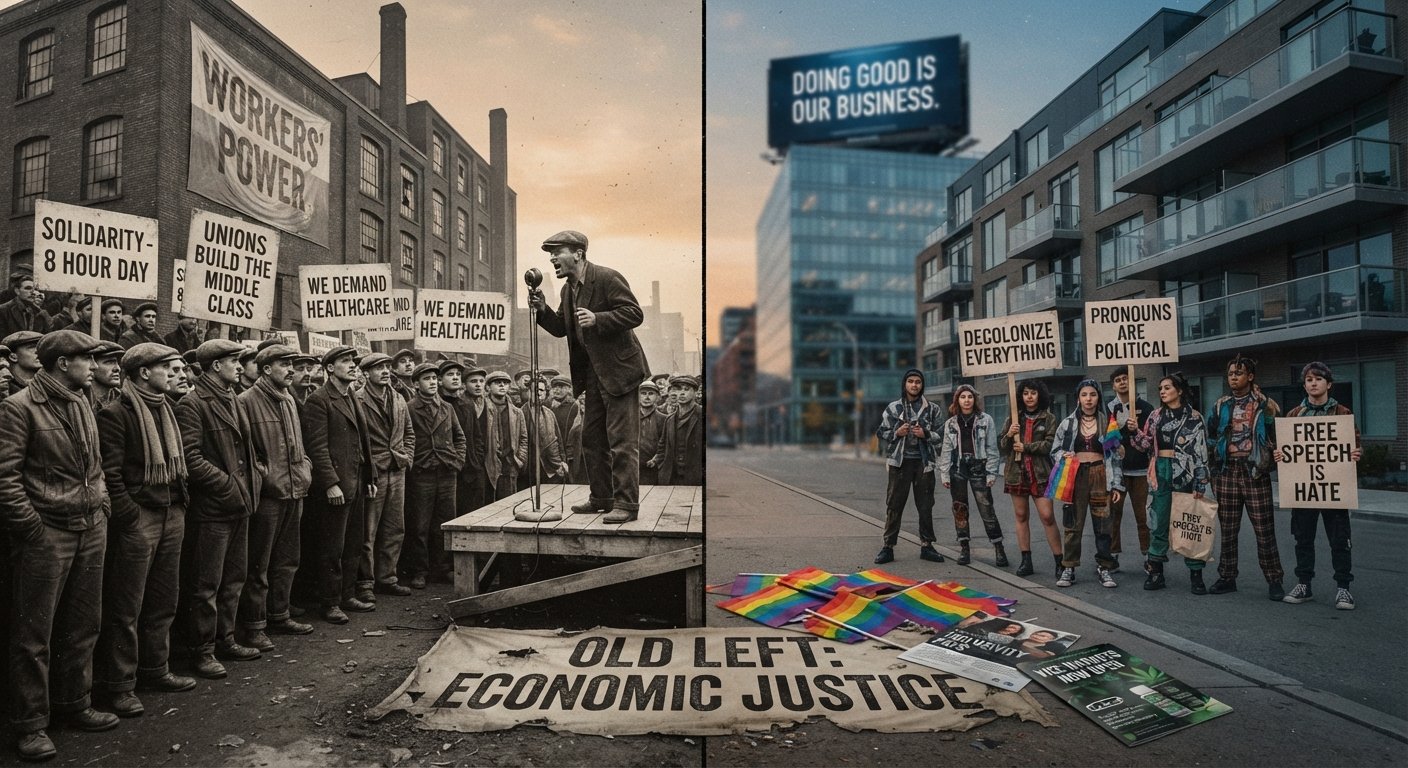
We Must Return to the Wisdom of the “Old Left”

The political evolution of the Western left over the past century represents a fundamental shift in focus—from material economic security to cultural individualism. While the “Old Left” of the mid-20th century prioritized labor, wages, and social welfare, the “New Left” that emerged post-1960 pivoted toward cultural identity, permissive lifestyles, and symbolic politics. For the lower and working classes, this transition has been a disaster, trading tangible material gains for symbolic gestures that ultimately strengthen corporate power and hand political victories to the right.

Continue reading “We Must Return to the Wisdom of the “Old Left””