
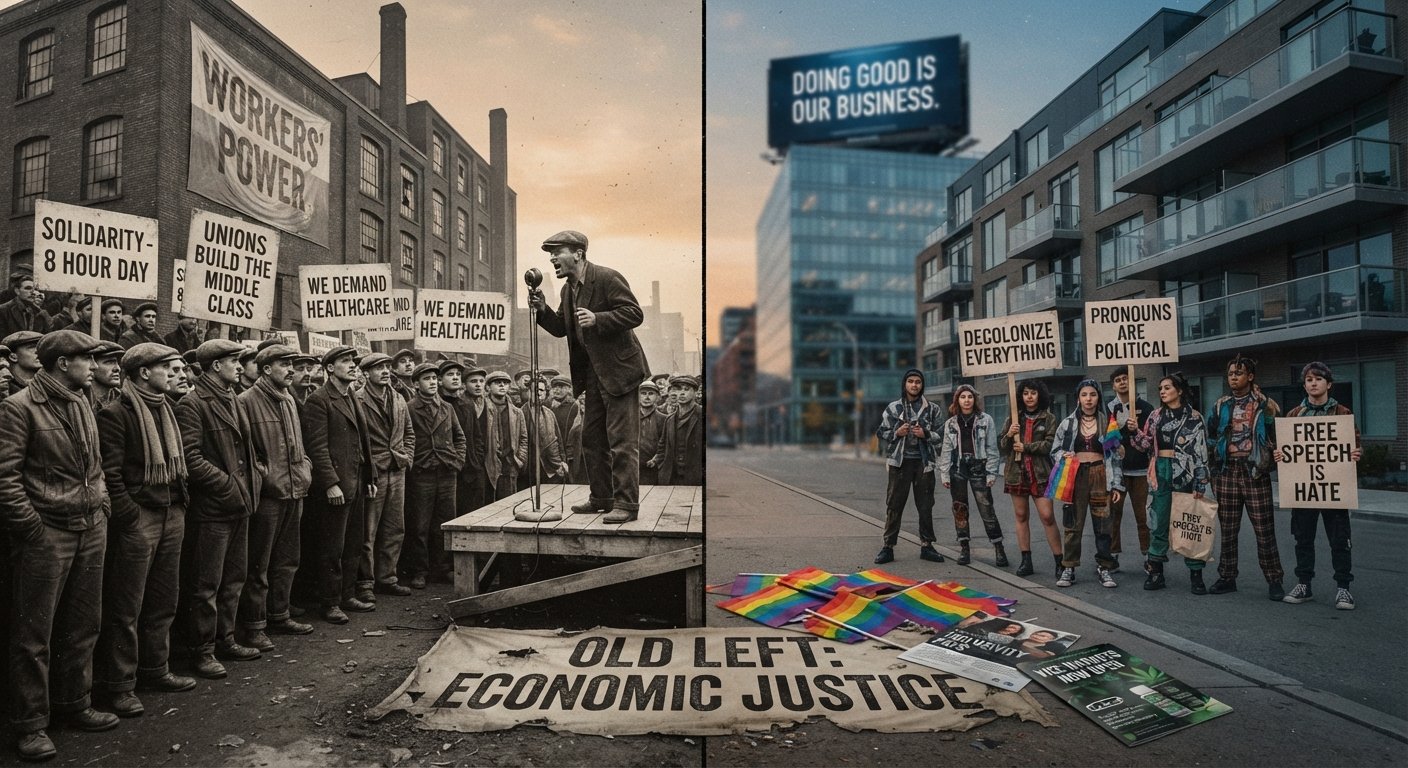
The political evolution of the Western left over the past century represents a fundamental shift in focus—from material economic security to cultural individualism. While the “Old Left” of the mid-20th century prioritized labor, wages, and social welfare, the “New Left” that emerged post-1960 pivoted toward cultural identity, permissive lifestyles, and symbolic politics. For the lower and working classes, this transition has been a disaster, trading tangible material gains for symbolic gestures that ultimately strengthen corporate power and hand political victories to the right.
The Material Focus of the Old Left
The strength of the Old Left lay in its unwavering focus on the structural mechanics of capitalism. Grounded in trade unions, working-class solidarity, and social democratic parties, its primary objective was the redistribution of wealth and power.
- Economic Centeredness: Even when ideological factions, such as orthodox communists, pursued flawed or authoritarian strategies, their diagnosis of the core problem remained correct: the exploitation of labor by capital.
- Tangible Policies: The Old Left fought for and secured monumental improvements in the standard of living, including the 40-hour work week, workplace safety regulations, minimum wage laws, and the foundation of universal health care systems across the developed world.
By keeping its eyes fixed on the economic ledger, the Old Left directly addressed the material vulnerabilities of ordinary people.
The Cultural Pivot and the Lower Classes
The post-sixties New Left fundamentally changed the political vocabulary. Academic and cultural elites co-opted leftist thought, replacing the language of class struggle with the language of lifestyle, identity, and personal liberation.
- Abandonment of the Worker: As politics shifted toward cultural battles, the working class was largely abandoned. Issues vital to lower-income families—such as industrial jobs, affordable housing, and robust social safety nets—took a backseat to abstract academic theories.
- The Cost of Permissiveness: The cultural revolution’s promotion of permissive lifestyles regarding sex and drugs disproportionately harmed vulnerable communities. Lacking the insulation of wealth and social capital, lower-income neighborhoods bore the brunt of family breakdown, addiction, and social atomization.
- Diversion from Redistribution: Today’s progressive movements often champion a socially “woke” or politically correct agenda. While these movements claim to promote social justice, they cost huge corporations virtually nothing to adopt. A multinational corporation can proudly fly a pride flag or issue corporate statements on diversity without surrendering a single percentage point of profit or raising its workers’ wages. Cultural tokenism has become a cheap substitute for economic justice.
Complicity with Capitalism and the Right
Far from challenging the capitalist system, the cultural turn of the New Left has inadvertently served its interests in two critical ways:
- Market Expansion: The celebration of personal liberation and unbridled self-expression opened up lucrative new vice markets. Corporate America successfully commercialized rebellion, transforming countercultural aesthetics and substances into multi-billion-dollar profit engines.
- Fueling Reactionary Politics: The hyper-focus on cultural grievances provided conservatives and right-wing populists with a permanent reservoir of winning electoral issues. By framing the left as hostile to traditional values, common sense, and local communities, the right built winning coalitions. Once in power, these conservative politicians systematically dismantled the very policies that genuinely helped working people—weakening unions, cutting health care access, and suppressing wages.
Even environmentalism, a genuinely vital concern, has frequently been distorted by cultural elites into elitist, punitive “tree-hugging” policies. By focusing on lifestyle restrictions rather than holding major industrial polluters accountable, these movements alienate working-class voters and hand political leverage back to right-wing opponents of environmental regulation.
Conclusion
The shift from the Old Left to the New Left represents a tragic misdirection of progressive energy. By trading the hard, unglamorous work of economic redistribution for cultural posturing, the modern left has weakened the lower classes, enriched major corporations through expanded vice markets, and gifted consecutive victories to conservative opponents. Until the left returns to its foundational mission—material security, labor power, and economic equality—it will remain incapable of offering genuine relief to those who need it most.