
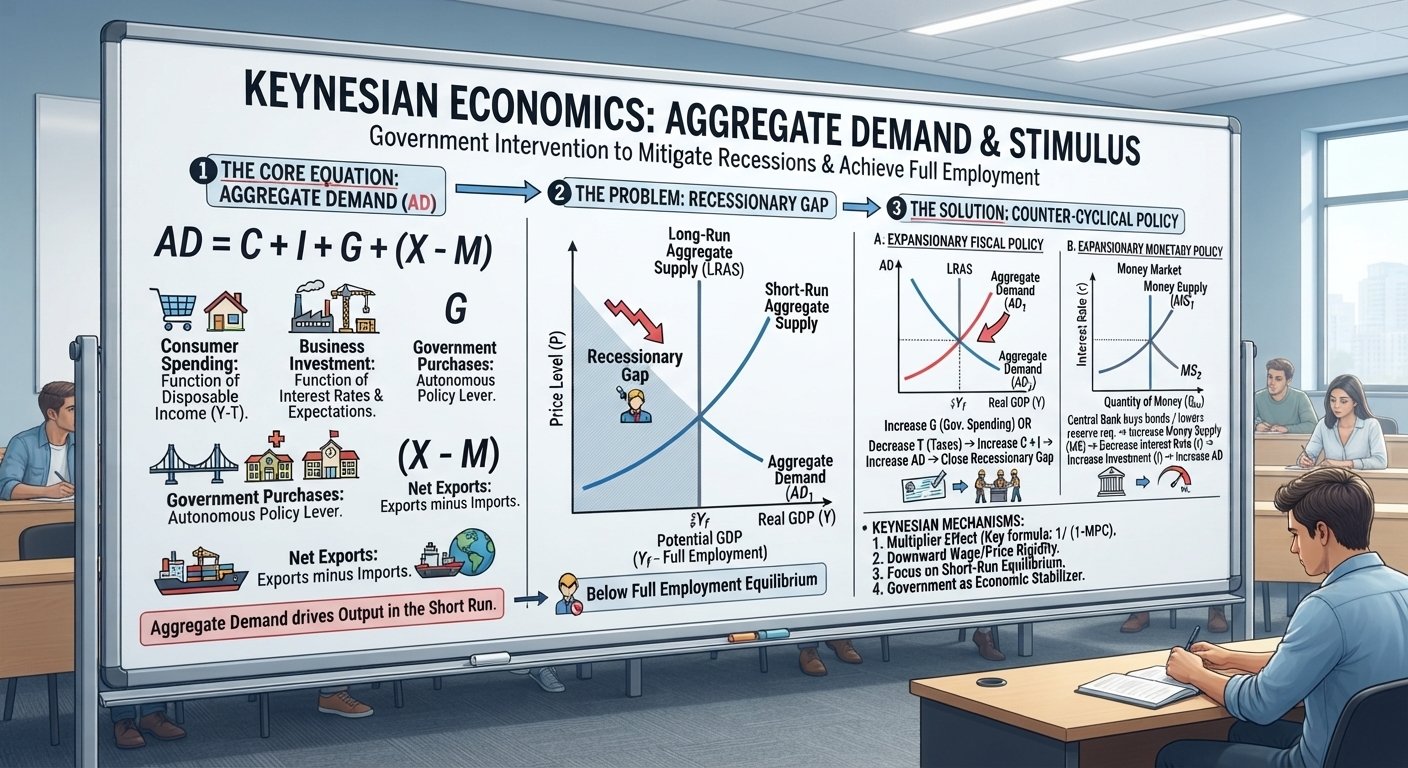
Keynesian economics, developed by British economist John Maynard Keynes during the Great Depression, fundamentally reshaped macroeconomic theory by challenging classical economic assumptions. Classical economists believed that free markets naturally self-corrected over the long run, ensuring full employment. Keynes countered this complacency with his famous observation that “in the long run we are all dead,” emphasizing that immediate, active government intervention is necessary during economic downturns. The foundational principles of this framework focus on aggregate demand, market rigidities, and counter-cyclical policy.
Aggregate Demand and Its Components
At the heart of Keynesian theory is the concept that economic activity is driven primarily by total spending—known as Aggregate Demand (AD). Keynes argued that output and employment are unstable because aggregate demand fluctuates independently of the economy’s productive capacity. The core identity governing this is expressed as:
$$AD = C + I + G + (X – M)$$
- Consumer Spending ($C$): Represents household consumption, which is largely determined by disposable income.
- Investment ($I$): Refers to business expenditures on capital and equipment, driven heavily by business expectations and interest rates.
- Government Purchases ($G$): Acts as an autonomous policy lever controlled directly by the state to stimulate economic activity.
- Net Exports ($X – M$): Accounts for the difference between a nation’s exports and imports, linking domestic output to the global economy.
The Role of Government and Counter-Cyclical Policy
Keynesians assert that during recessions, private sector spending collapses due to pessimism and uncertainty, creating a recessionary gap where real GDP falls below potential full-employment output. Because prices and wages are often “sticky” or downwardly rigid in the short run—meaning they do not drop quickly enough to clear markets—unemployment rises sharply. To combat this, Keynesian economics advocates for expansionary fiscal policy. By increasing government spending ($G$) or decreasing taxes ($T$), the state injects vital liquidity into the system, shifting the aggregate demand curve outward to restore full employment.
The Multiplier Effect
A crucial mechanism within this school of thought is the multiplier effect, which dictates that an initial injection of government or investment spending triggers a chain reaction of increased income and consumer spending, amplifying the final economic impact. The magnitude of this effect is determined by the Marginal Propensity to Consume (MPC), represented by the multiplier formula:
$$\text{Multiplier} = \frac{1}{1 – \text{MPC}}$$
Through strategic fiscal and monetary management, Keynesian economics provides a roadmap for smoothing out the volatile boom-and-bust cycles of capitalist economies, utilizing public power to stabilize private instability.