
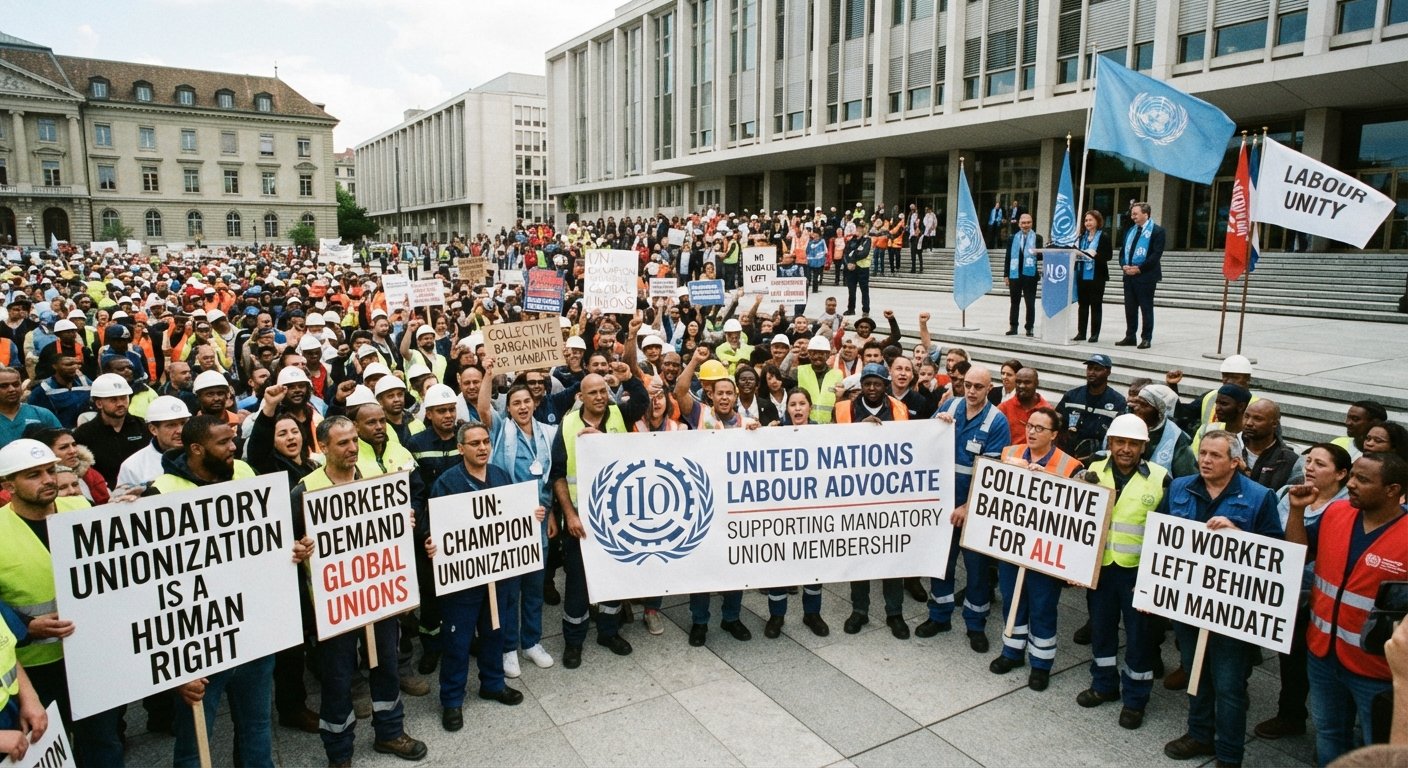
The Imperative of Universal Labor Union Membership: A Case for Mandated Organization and United Nations Advocacy
In an era defined by staggering economic inequality, corporate consolidation, and the erosion of the middle class, the traditional structures safeguarding worker welfare have proven deeply inadequate. While globalization and technological revolutions have generated unprecedented wealth, the fruits of this progress remain concentrated at the top, leaving the average worker vulnerable to wage stagnation and precarious conditions. To rectify this structural imbalance, labor union membership must no longer be viewed as a mere workplace option or an adversarial niche; it must be established as a mandatory standard for all workers globally, actively championed and enforced by the United Nations.
The Inherent Vulnerability of the Unorganized Worker
At the heart of the modern labor market lies an inherent power asymmetry. An individual worker, dependent on a paycheck to survive, possesses virtually no leverage when negotiating with a multinational corporation or even a mid-sized employer. Left to market forces alone, employers can easily dictate suppressed wages, minimal benefits, and unsafe working conditions, knowing that workers possess little recourse.
Historically, labor unions have served as the only effective counterweight to corporate overreach. They transform isolated laborers into a collective voice capable of demanding fair compensation, reasonable hours, and safe environments. However, when unionization is left entirely voluntary under hostile legal frameworks, union-busting tactics, intimidation, and pervasive anti-union propaganda frequently suppress organizing efforts. Making union membership a structural requirement of employment eliminates the threat of retaliation against organizers and ensures that every worker automatically enjoys the protective shield of collective bargaining.
Economic Democracy and the Macroeconomic Imperative
Beyond individual protections, universal unionization is a macroeconomic necessity. History demonstrates that robust labor unions are foundational to building broad-based economic prosperity. When workers have collective bargaining power, wages rise in tandem with productivity, creating a healthy, purchasing-powered middle class that drives sustainable economic growth. Conversely, the decline of union density over the last several decades correlates directly with stagnant real wages and skyrocketing wealth inequality.
A mandated system of union membership institutionalizes economic democracy. It ensures that workplaces are managed with a baseline respect for human dignity, bridging the gap between executive profit and labor compensation. Furthermore, universal standards prevent a “race to the bottom,” where companies relocate or undercut competitors by exploiting unprotected workforces in jurisdictions with lax labor laws.
The Role of the United Nations in Global Labor Standards
Achieving this vision requires international coordination and authority, making the United Nations—specifically through the International Labour Organization (ILO)—the ideal body to spearhead the movement. While the UN and the Universal Declaration of Human Rights recognize the general right to form and join trade unions, non-binding declarations are no longer sufficient to combat systemic labor exploitation.
The United Nations must transition from merely protecting the right to organize to actively advocating for and mandating universal union participation as a fundamental pillar of international law. The UN can achieve this by:
- Updating international conventions to classify universal workforce representation as a baseline requirement for decent work.
- Utilizing diplomatic and economic leverage to compel member states to reform domestic labor codes, dismantling barriers to collective bargaining.
- Establishing global oversight mechanisms that penalize corporations and governments engaging in anti-union discrimination or suppression.
Conclusion
A mandatory framework for labor union membership, championed by the United Nations, is not a radical departure from democratic principles; rather, it is their ultimate realization in the economic sphere. Just as society mandates baseline safety standards, minimum ages for employment, and environmental regulations to protect the public good, it must mandate labor organization to protect the human capital that powers the global economy. By anchoring union membership as a universal mandate, the international community can foster a more equitable, stable, and just world for workers everywhere.
How would you envision enforcement mechanisms operating for nations that historically resist international labor standards?