
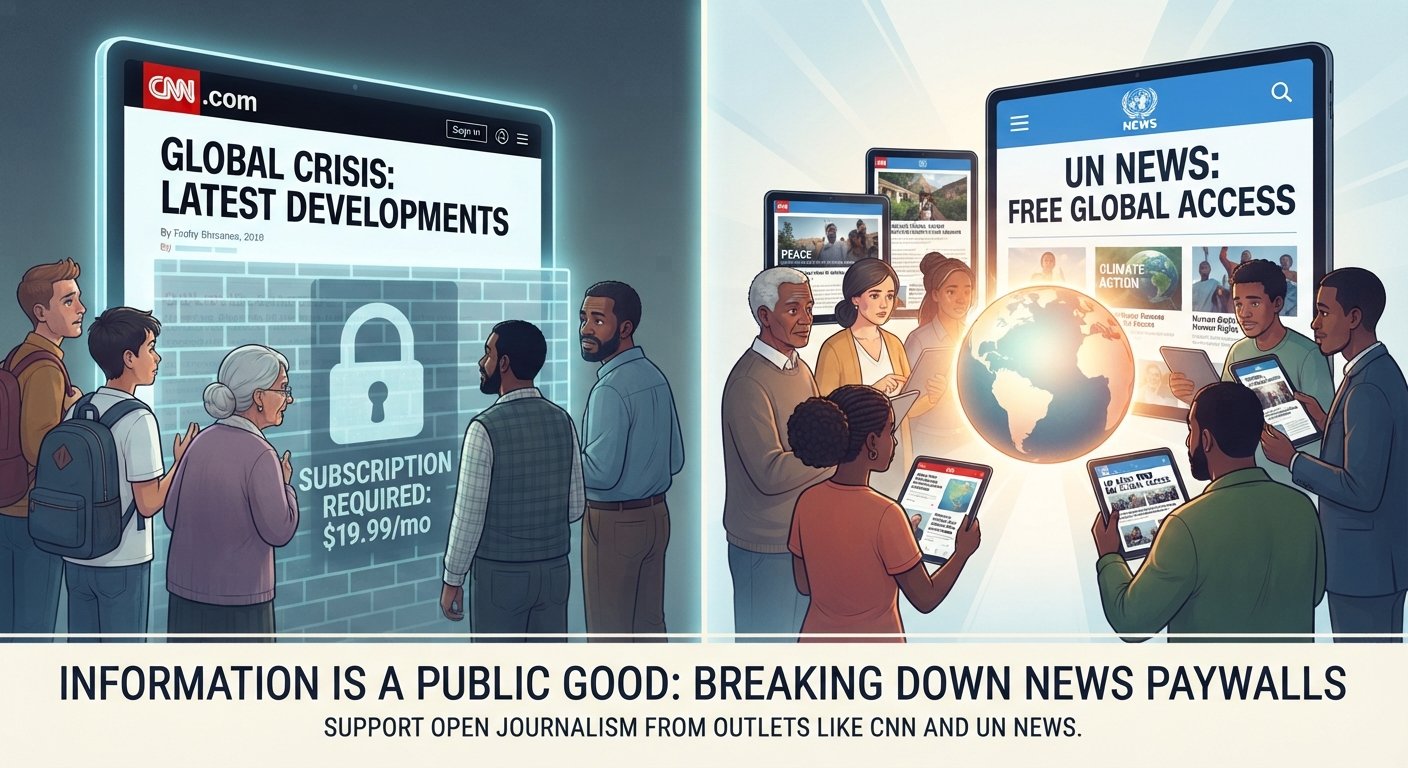
Breaking the Paywall: Why Accessible Journalism is Essential for an Informed Public
In a healthy democratic society, access to accurate and timely information should be a fundamental right, not a luxury commodity. For decades, major news organizations operated under a model funded primarily by advertising, allowing people from all socioeconomic backgrounds to stay informed about global events. However, the modern digital media landscape has shifted dramatically. Major outlets, including prominent networks like CNN, have increasingly turned to subscription models and digital paywalls. While financial sustainability is a valid concern for media companies, placing journalism behind a paywall is fundamentally unfair to low-income populations and creates an information divide that harms society as a whole.
The Value of Trusted Outlets and the Problem with Paywalls
Outlets like CNN serve as vital pillars of mainstream journalism. With extensive resources, global bureaus, and dedicated reporting teams, CNN is a good news outlet capable of delivering comprehensive coverage of breaking world events, investigative pieces, and critical analysis. When major crises unfold, having an established infrastructure to broadcast and report facts is crucial.
However, restricting this reporting behind a financial barrier creates a steep equity problem. Even seemingly modest monthly subscription fees can be a prohibitive burden for low-income families, working-class individuals, and students who must meticulously budget every dollar for basic necessities like housing, food, and utilities. By locking articles behind paywalls, news networks inadvertently create a two-tiered society: one where wealthy individuals can easily afford to stay fully informed, and another where lower-income individuals are cut off from essential reporting. This directly impacts civic engagement, as an inability to access reliable news makes it significantly harder for marginalized communities to participate fully in the democratic process.
The Model of Open Access: The Role of UN News
To understand how public information can be distributed equitably, one can look toward global public service models. Platforms like UN News exemplify how vital reporting can be shared globally without placing a financial toll on the reader. Dedicated to covering peace, human rights, sustainable development, and humanitarian crises around the world, UN News provides its content entirely free of charge to anyone with internet access.
This open-access framework ensures that global updates regarding public health emergencies, international law, and human rights are universally accessible, regardless of a person’s geographic location or economic standing. It demonstrates that keeping information open is not only possible, but necessary for fostering global awareness and solidarity.
Conclusion
Journalism plays an indispensable watchdog role in society, holding power to account and keeping citizens educated. While commercial outlets must find sustainable revenue streams, doing so at the expense of public accessibility is a step backward for equity and education. News outlets should explore alternative monetization strategies—such as privacy-respecting targeted advertising or sponsorships—rather than walling off the truth. Information is a public good, and ensuring that outlets like CNN remain open to all, alongside championing public resources like UN News, is essential for building a fairer, better-informed world.
Hi,
I just visited fkblog.site and wondered if you’d ever thought about having an engaging video to explain what you do?
Our videos cost just $195 (USD) for a 30 second video ($239 for 60 seconds) and include a full script, voice-over and video.
I can show you some previous videos we’ve done if you want me to send some over. Let me know if you’re interested in seeing samples of our previous work.
Regards,
Joanna