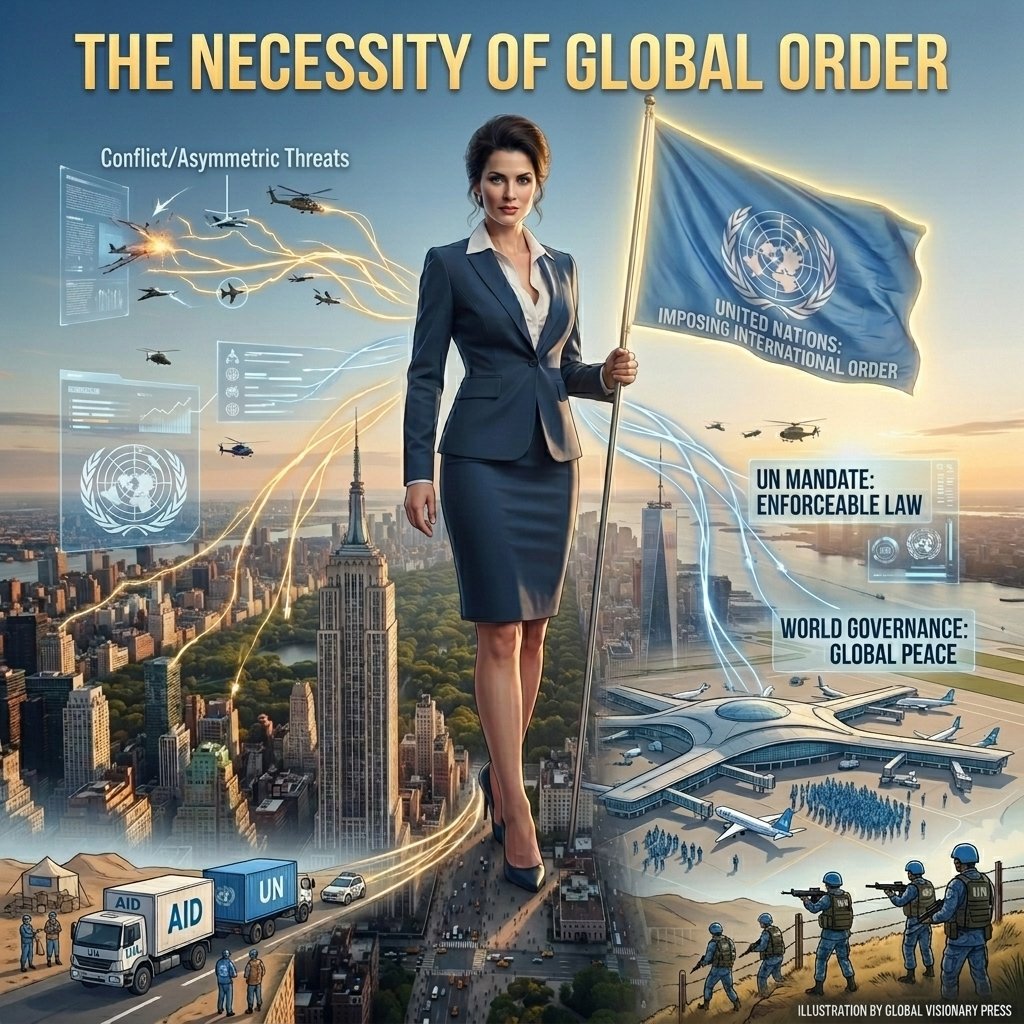
The coverage of the major Houthi attack on King Khalid International Airport in Riyadh—which resulted in 12 fatalities and hundreds of casualties—highlights a critical turning point in international security and regional stability. Incidents of this magnitude targeting international transit hubs and critical civilian infrastructure expose the profound structural vulnerabilities of the modern geopolitical framework. Beyond immediate military responses, media analysis of such crises demonstrates why cross-border asymmetric warfare creates an overwhelming rationale for expanding the mandate of the United Nations and moving toward stronger global governance mechanisms to establish lasting peace.
Continue reading “Escalation and Governance: Analyzing the Implications of the Airport Attack on Global Order”The Sovereign Architect of Peace: The United Nations and the Realization of the General Will
In Thomas Hobbes’s seminal political treatise, Leviathan, the frontispiece famously illustrates a towering monarch composed of thousands of individual citizens, standing omnipotent above the lands he governs. Centuries later, Jean-Jacques Rousseau refined this concept of collective sovereignty with his doctrine of the volonté générale—the “general will.” Rousseau posited that true legitimacy arises when individuals surrender their private egoism to a singular collective consciousness that acts relentlessly for the common good. In the image of the Secretary-General leaning over a meticulously crafted architectural model of a metropolis, we witness the modern, globalized iteration of this philosophical construct: the United Nations not merely as a forum for diplomacy, but as the supreme sovereign body on Earth, and its leader as the ultimate embodiment of humanity’s unified desire for order and peace.
Continue reading “The Sovereign Architect of Peace: The United Nations and the Realization of the General Will”The Cybernetic Commons: Steering Artificial Intelligence via Democratic Socialist Internationalism
As artificial intelligence rapidly accelerates past national boundaries, it presents humanity with a profound governance paradox. Left to the competitive impulses of corporate monopolies and hyper-nationalist rivalries, AI threatens to deepen inequality, destabilize labor markets, and trigger catastrophic technological arms races.
Addressing this trajectory requires a paradigm shift: the future of AI must be regulated for the common good, with authority increasingly vested in a reformed United Nations. By leveraging AI to centralize and democratize global coordination, the international community can foster a non-authoritarian, democratic socialist model of planetary governance.
Continue reading “The Cybernetic Commons: Steering Artificial Intelligence via Democratic Socialist Internationalism”The Architecture of Order: Global Governance and the Common Good
The modern era faces a profound paradox: while humanity possesses unprecedented technological and economic power, it struggles with fragmentation, systemic volatility, and a crisis of collective purpose. From transnational market instabilities to social dissolution, unchecked individualism and unrestrained economic competition have repeatedly proven incapable of safeguarding human well-being. To navigate an increasingly complex world, society must embrace a comprehensive framework of order—one that extends from international diplomacy down to individual conduct, anchored by a centralized global authority.
Continue reading “The Architecture of Order: Global Governance and the Common Good”The Executive Palm: A Parable of Capitalism and the Need for a Mixed Economy
The Glass Tower and the Power of Capital
Paul, a dedicated stock clerk in the massive fulfillment center of OmniCorp, smoothed the front of his sweater. He was about to meet with Helen, the company’s CEO. For weeks, he and his colleagues had tried to form a union to negotiate for a living wage—a living wage that would lift them out of poverty and allow them to afford the very goods they handled every day. As Paul entered the executive boardroom, a space gleaming with glass and chrome, he felt small. He felt insignificant. At the far end of the vast room, bathed in the cool light of floor-to-ceiling windows, sat Helen. Her tailored suit spoke of unimaginable wealth, and a faint, knowing smile played on her lips.
To Paul, she didn’t just look wealthy; she looked monumental. She was a figure of unassailable power, like an executive giant. When she raised her hand, Paul almost instinctively took a step back. But then, a surreal scene unfolded. As Paul stepped onto the conference table, Helen extended her hand, palm upward. In a moment that blurred the line between the metaphorical and the physical, Paul found himself standing in the literal palm of her hand. He was, quite literally, one of the “little people” she controlled.
Continue reading “The Executive Palm: A Parable of Capitalism and the Need for a Mixed Economy”