
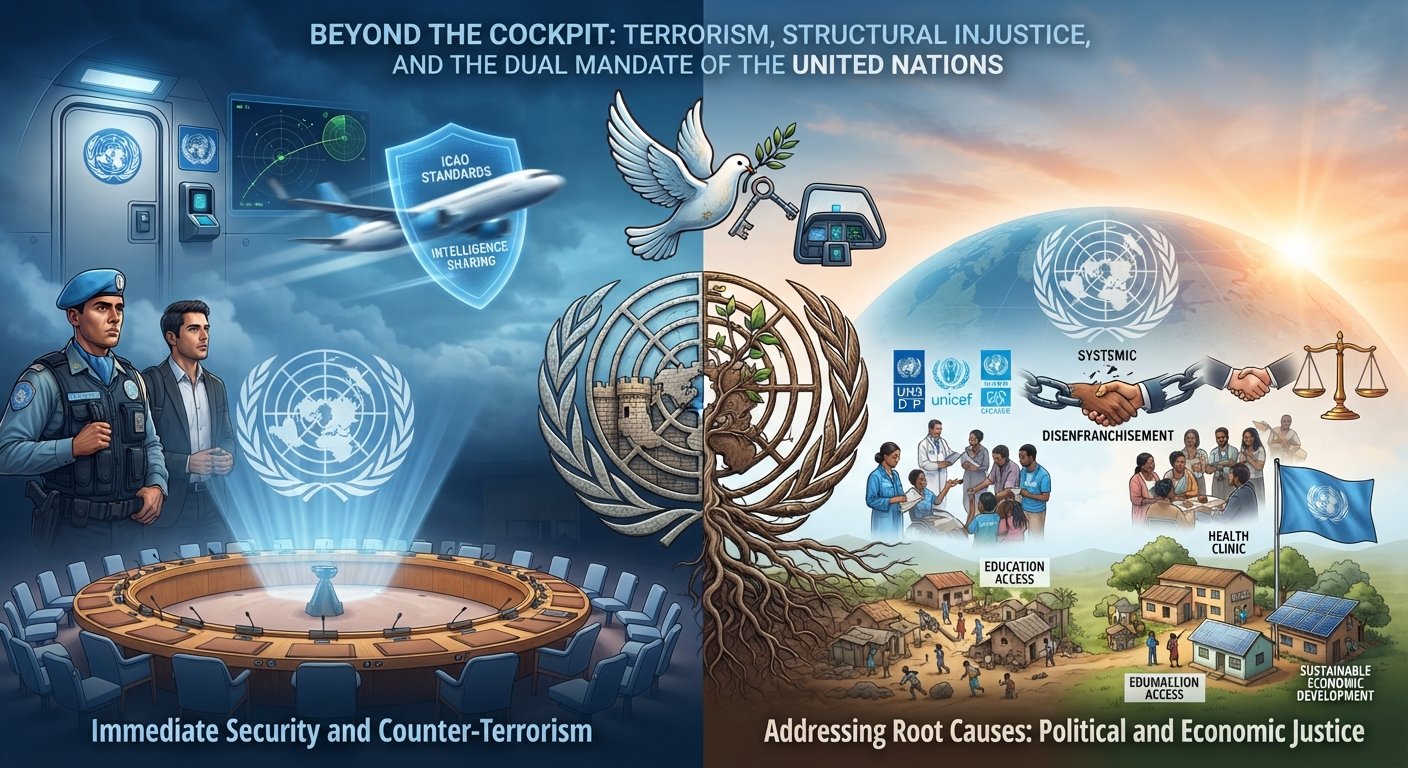
Beyond the Cockpit: Terrorism, Structural Injustice, and the Dual Mandate of the United Nations
The terrifying ordeal aboard Flydubai Flight 1073—in which a routine commercial journey from Dubai to Tel Aviv transformed into a desperate struggle against an attempted cockpit takeover and targeted crash—serves as a stark reminder of the persistent vulnerability of global civil aviation. As national leaders categorized the incident as a deliberate act of terror averted only by extraordinary passenger intervention, the international community was once again forced to confront the mechanics of modern violence.
Incidents of this magnitude immediately galvanize calls for enhanced security protocols, intelligence sharing, and defensive preparedness. Yet, focusing exclusively on tactical countermeasures treats only the symptoms of a deeper global pathology. To effectively safeguard international stability, multilateral institutions like the United Nations must embrace a dual mandate: fighting terrorism through robust operational security while aggressively pursuing global political and economic justice to eradicate the root causes from which extremism springs.
The Imperative of Security: Countering Immediate Threats
At its foundational level, the United Nations and its specialized agencies, such as the International Civil Aviation Organization (ICAO), bear an undeniable responsibility to maintain the physical security of global infrastructure. Aviation has long served as a high-profile stage for ideological conflict, where civilian lives are leveraged for maximum psychological impact.
- Operational Standards: Multilateral frameworks must continuously update and enforce stringent global safety directives, ranging from cockpit access controls to real-time flight telemetry monitoring.
- Intelligence Coordination: Cross-border threats require seamless intelligence cooperation among nations, ensuring that extremist infiltration within sensitive transport sectors is detected long before an aircraft leaves the tarmac.
- Accountability: International law must unambiguously penalize state and non-state actors who sponsor, harbor, or inspire violence against civilian transit, reinforcing norms through binding Security Council resolutions and targeted sanctions.
Without these defensive mechanisms, international commerce and travel would fracture under the weight of constant fear. Security is the indispensable shield that preserves order and protects innocent lives in real-time.
The Root Causes: Political and Economic Injustice
Yet, history demonstrates that a purely punitive or defensive security paradigm is inherently limited. Walls, air marshals, and enhanced cockpit barriers can intercept a specific attack, but they cannot permanently exhaust the well of radicalization. Terrorism rarely emerges in a vacuum; it is frequently fueled by chronic despair, systemic disenfranchisement, extreme economic inequality, and unresolved geopolitical grievances.
When populations are subjected to protracted conflict, systemic deprivation, and a lack of meaningful political self-determination, extremist networks find fertile ground for recruitment. Ideologues exploit these vulnerabilities, channeling legitimate grievances or deep-seated regional trauma into destructive fanaticism.
Consequently, true security cannot be achieved solely through the barrel of a gun or the vigilance of a passenger cabin. It requires addressing the underlying conditions that make individuals susceptible to extremist recruitment in the first place.
The Dual Mandate of the United Nations
This brings into sharp focus the comprehensive role envisioned for the United Nations under its Charter. The UN is not merely a global police force designed to react to crises; it is a framework meant to engineer enduring peace through structural equity.
“Peace is not merely the absence of visible conflict, but the presence of justice, equity, and opportunity for all peoples.”
To fulfill this vision, the UN must balance its security architecture with developmental and diplomatic initiatives:
- Economic Development: Through agencies like the UNDP, the UN must champion programs that alleviate acute poverty, expand educational access, and create sustainable economic futures for marginalized youth globally.
- Diplomatic Resolution: The organization must aggressively mediate protracted regional conflicts, ensuring that international law and human rights are applied universally, leaving no group feeling permanently abandoned by the international community.
- Inclusive Governance: Promoting transparent, accountable institutions helps drain the swamp of political corruption and disenfranchisement that authoritarian and extremist groups exploit.
Conclusion
The terrifying events surrounding Flight 1073 underscore that the international community can never lower its guard against acts of terror. Protecting the global commons requires unyielding vigilance, rigorous aviation security, and the decisive neutralization of immediate threats. However, stopping there is a grave mistake. Security and justice are two sides of the same coin. By pairing robust counter-terrorism measures with a dedicated, structural commitment to global political and economic equity, the United Nations can move beyond merely surviving the next crisis—and begin dismantling the conditions that created it.
How do you view the balance between immediate security measures and long-term economic development in preventing modern acts of terrorism?