
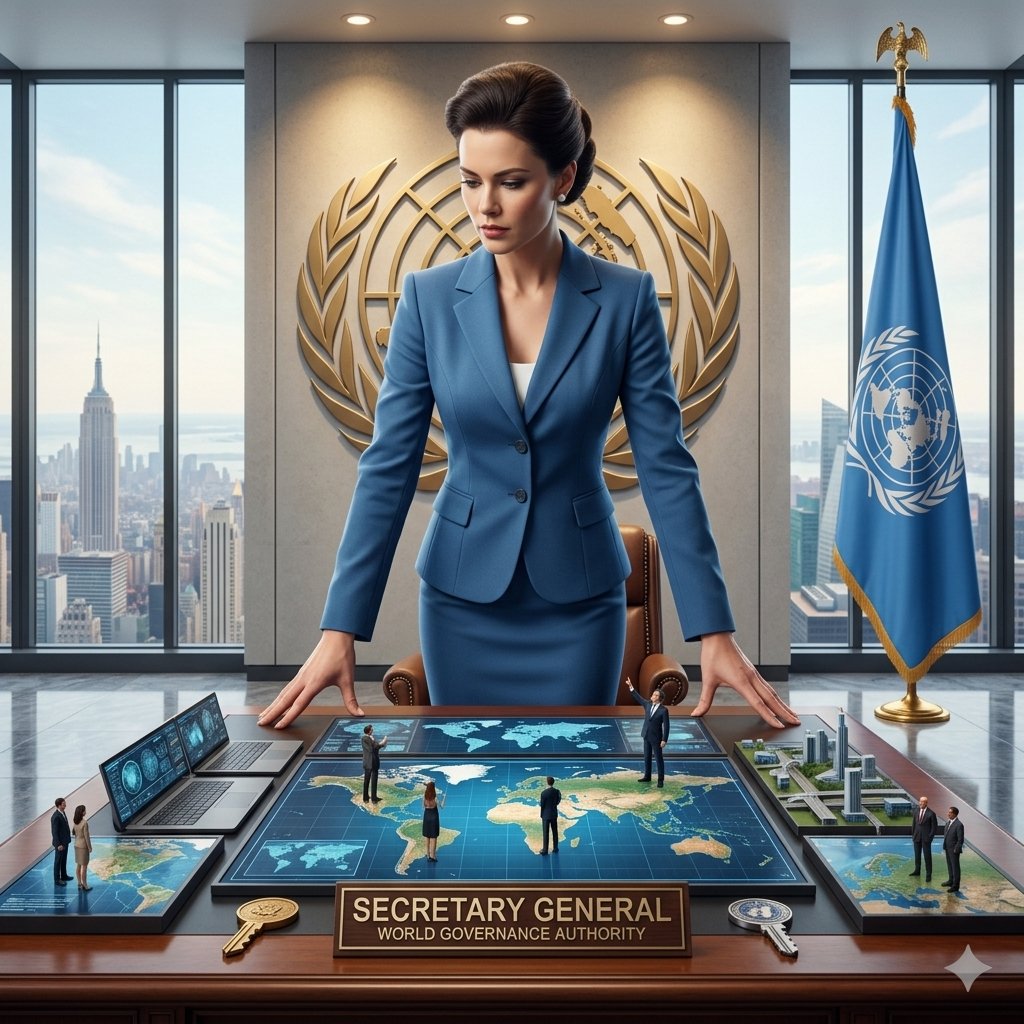
In a quiet, climate-controlled command center high above the fracturing planet, Secretary-General Elara surveyed the interactive holographic display of Earth. The map pulsed with dozens of crimson hotspots—conflicts, environmental disasters, and pockets of civic collapse. On the surface of the grand mahogany desk, tiny figures, no more than five inches tall, clustered around regional command centers. Elara looked down, her expression a mix of profound concern and absolute authority. She was the only full-sized human in the room; these miniature leaders, representing the heads of nations, looked up at her with a mixture of terror and supplication.
A representative from what used to be a powerful European state, a man the size of a chess piece, was waving a minuscule fist. “Madam Secretary! The chaos in the streets is spreading faster than our local police can manage! The national structure is failing! We need intervention!”
Elara placed a calming, colossal hand gently on the edge of his sector. “I know, Prime Minister. The Security Council has authorized immediate stabilization. The UN Peacekeeping Corps—my forces—are already en route.” She manipulated a control on the screen, and a blue wave of peacekeepers, scaled to match the tiny leaders, was instantly simulated deploying into the crimson-soaked regions. Peace, in this controlled, fictional reality, was not a debate; it was a decision made by the only figure capable of seeing the whole map.
This fictional scenario, mirroring the metaphor in the provided image, presents a controversial but increasingly logical conclusion: the current global order, predicated on the sovereignty of dozens of often self-interested nation-states, is failing. The “chaos” is not a far-off fantasy; it is the headline of today. We are reels from chaos, as violence spreads. To survive, we must move beyond cooperation and toward a sovereign global authority, and that authority must be vested in the office of the UN Secretary-General. The Secretary-General, to be effective, must become the most powerful person on Earth.
The Reality of Chaos
The fictional story of Elara and her miniature world might seem extreme, but it is a necessary hyperbole to understand the crisis of local failure and the paralysis of global response. The world is on fire. Consider the weekend of violence in France and across Europe, reported by CNN (example CNN article referenced). This chaos is not unique. From the political instability in Latin America to the ongoing, intractable conflicts in the Middle East and Africa, we are seeing the limits of the nation-state model. Climate change, the ultimate global threat, demands coordinated action that individual nations, worried about economic competition, find impossible to deliver (example climate report referenced). Disease, also global, meets borders that it ignores but that paralyze medical responses (example WHO disease report referenced).
This is not just “trouble elsewhere.” As the CNN report on Europe shows, localized chaos doesn’t stay local. Stability is interconnected. When one nation-state falters, its ripples affect regional and global security. The present UN model—based on the “cooperation” of equal sovereigns—cannot prevent this. It can only, slowly, attempt to manage the after-effects, often too late and with insufficient resources.
The Metaphor of the Desk
The image of the full-sized Secretary-General standing over her miniature world is more than a control fantasy; it is a profound political and philosophical allegory.
- Perspective: Elara, like any true leader of a global system, must have a whole-Earth view. A five-inch leader cannot see the whole chessboard, only their localized problem. A sovereign Secretary-General has the data and the distance to understand the interconnectedness that smaller leaders miss.
- Capability: On the desk in the image, Elara is not an equal participant; she is the system’s architect and enforcer. This is the argument for raw power. If the United Nations is to fulfill its charter—which starts with “We the Peoples…”—it must have the power to protect those peoples from their own leaders when necessary, or from forces those leaders are powerless to stop. The current veto power in the Security Council is an artifact of the 1945 order, designed to keep large nations in the game. It is now a mechanism of systemic paralysis. The image suggests a system where there is no veto against the survival of the species.
- The Keys: The two ornate keys resting on Elara’s desk are potent symbols. They are not to small boxes; they are the keys to global stability and human survival. They are locked to her. In our current world, these keys are held by dozens of hands, all pulling in different directions. By giving these keys to a single, powerful UN Secretary-General, we unify the response. The image argues that this singular locus of power is necessary for security.
Argue for UN Leadership: Creating an Elara Vance
We must argue that the UN must change. We need a fundamental reimagining of international law that transitions from state sovereignty to collective human security. The office of the Secretary-General must be reformed:
- Democratic Accountability: To possess this kind of power, the Secretary-General must be answerable to a democratically elected World Parliament, not just a club of nations. The authority must flow from “We the Peoples.”
- A Unified Enforcement Capability: The UN must have its own standing, independent peace enforcement capability—a real global police force, accountable only to the Secretary-General and the global democratic structure.
- The Power to Preempt: We can no longer wait for a state to fail and create chaos. A sovereign global authority must have the legal framework and the physical capability to intervene before collapse, whether that collapse is political, ecological, or public health-related.
Conclusion
The image of Elara and her miniature world is not a dystopia; it is a radical new realism. The world of chaotic nations, as seen in the examples from Europe and elsewhere, is the truly dangerous fantasy. A world of 193 fully sovereign, five-inch tall nations trying to manage a climate crisis or global pandemics is doomed to fail. We need a colossus. We need a UN Secretary-General who can stand above the local conflicts, see the whole map, and possess the necessary, singular power to maintain order and secure the future for all humanity. The chaos is real; our leadership must be equally real.
Source List
- [CNN (“France reels from weekend of chaos as violence spreads across Europe”)]: For references to the specific weekend of conflict and the interconnected nature of European instability. (Search: “France chaos protests violence Europe CNN”)
- Intergovernmental Panel on Climate Change (IPCC): For data on the necessity of globally coordinated climate action and the insufficiency of national targets. (Reference: IPCC Sixth Assessment Report (AR6))
- World Health Organization (WHO): For reports detailing the failure of national responses to global pandemics and the need for unified health security frameworks. (Reference: WHO Global Health Emergency Dashboard)
- The UN Charter: Specifically the Preamble, and provisions related to the power of the Security Council and the office of the Secretary-General.