
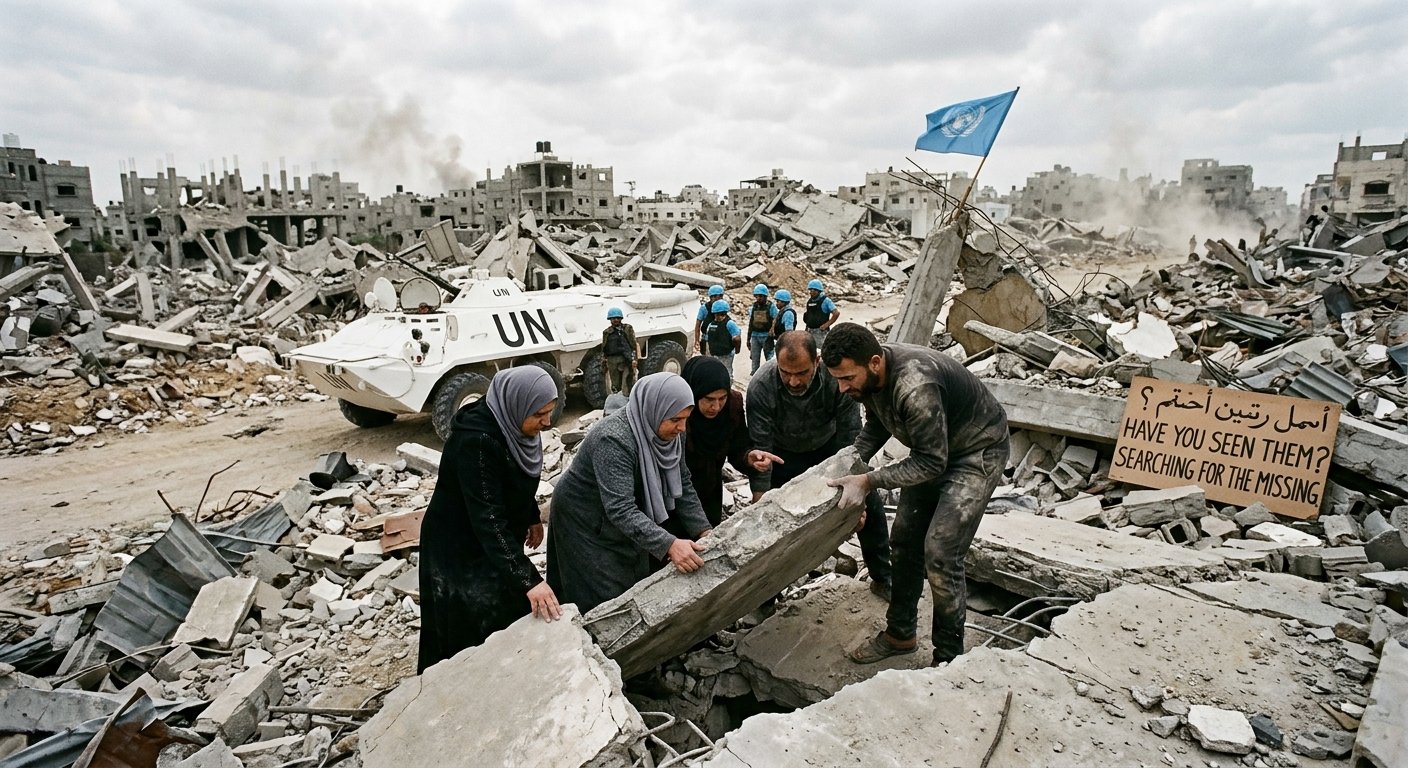
Three years into a devastating and unrelenting war, the physical landscape of the Gaza Strip has been reduced to millions of metric tons of pulverized concrete, twisted metal, and shifting mountains of debris. Yet, beneath the dust lies a tragedy even more haunting than the destruction of property: the thousands of human beings who simply vanished. As documented by international reporting, including poignant accounts like CNN’s coverage of families searching for Gaza’s missing, thousands of Palestinians remain unaccounted for.Estimates by civil defense and humanitarian agencies suggest that upwards of 8,000 to 10,000 people are buried beneath the ruins, their fates unknown, their families trapped in a perpetual cycle of grief and agonizing uncertainty.
This heart-wrenching reality—where mothers, fathers, and children are reduced to nameless entries on missing persons lists with little hope of recovery—is not merely a localized tragedy. It is a symptom of a deeply broken international system. The inability of the global community to secure basic humanitarian access, enforce accountability, or halt catastrophic violence exposes a fatal flaw in modern geopolitics: the United Nations, as currently constituted, lacks the requisite power, teeth, and structural authority to prevent atrocities from happening “all the time.” To ensure that human suffering on the scale seen in Gaza is never again permitted to repeat with impunity, the international community must fundamentally rethink global governance, endowing a reformed United Nations with both true organizational power and independent military enforcement capabilities.
The Agony of the Missing and the Limits of Moral Pleas
The crisis of Gaza’s missing persons highlights a specific kind of cruelty unique to modern warfare. As humanitarian groups like the International Committee of the Red Cross (ICRC) have repeatedly pointed out, recovery efforts in Gaza are agonizingly constrained.Heavy machinery is scarce, fuel supplies are tightly restricted, DNA testing facilities are virtually non-existent, and rescue workers face constant dangers from unexploded ordnance and restricted access.Families are left to rely on fragmented memories—pinpointing a room, a building, a final moment—to guess where their loved ones drew their last breath.
When media outlets report on these conditions, they capture a humanitarian catastrophe compounded by administrative and political paralysis. The United Nations and its agencies issue warnings, pass non-binding resolutions, and plead for safe corridors, but their appeals routinely fall on deaf ears. Why? Because the UN currently functions as a diplomatic forum rather than a governing body with enforcement capacity. It relies entirely on the goodwill of sovereign states—many of which are belligerents in the conflicts themselves. When that goodwill evaporates, the UN is rendered structurally toothless, capable of documenting suffering but incapable of stopping it.
The Fallacy of “Soft Power” Without Enforcement
For decades, the prevailing liberal internationalist theory assumed that moral suasion, economic interconnectedness, and international law would naturally deter mass violence. The ongoing tragedies in Gaza, alongside historical failures in places like Rwanda, Srebrenica, and Syria, have thoroughly dismantled this illusion. International humanitarian law, the Geneva Conventions, and UN Security Council resolutions are routinely flouted because violating them carries no immediate, enforceable penalty.
Without coercive power, international law is merely a suggestion. A global order that relies solely on sternly worded statements and diplomatic reprimands invites aggressive actors to test its limits, knowing that the international community can do little more than watch and count the dead. If the world wishes to move past an era where humanitarian disasters are treated as tragic inevitabilities of geopolitics, it must abandon the fiction that soft power alone can preserve human rights.
Reimagining the UN: Military and Organizational Power
To prevent humanitarian catastrophes from occurring with grim regularity, the United Nations must undergo a radical structural transformation. This transformation requires two pillars of capability that the organization has historically been denied: robust organizational power and an independent, standing military enforcement mechanism.
- Organizational and Jurisdictional Supremacy: Currently, the UN’s effectiveness is hobbled by great-power politics, most notably the veto power held by permanent members of the Security Council. This veto frequently paralyzes the organization, rendering it unable to act against powerful states or their allies. A reformed UN must strip away or severely curtail unilateral veto powers in cases of mass atrocities and war crimes, replacing them with a majority-vote mechanism centered strictly on human protection. Furthermore, its agencies must be granted automatic, legally binding jurisdictional authority to deploy emergency recovery, investigative, and medical teams into conflict zones without requiring the explicit permission of the warring parties.
- Independent Military Power: Perhaps most importantly, the UN cannot continue to rely on cobbled-together peacekeeping contingents lent voluntarily by member states, which are often hamstrung by restrictive mandates of engagement. To deter state-sponsored violations and enforce ceasefires, the UN must command a permanent, highly trained, independent international rapid-reaction force. This force must possess the military capacity to interpose itself between belligerents, enforce safe zones, protect humanitarian corridors, and secure sites of mass destruction to ensure that recovery teams—such as those desperately trying to unearth Gaza’s missing—can operate safely and immediately.
Breaking the Cycle of Impunity
Critics will argue that granting the UN military and overriding organizational power threatens national sovereignty. But sovereignty was never intended to be a license for unbridled cruelty or the mass disappearance of civilians under tons of rubble. When states fail or refuse to protect human life, the collective security of the international community must supersede local tyranny.
The haunting images of families searching through the dust of Gaza for signs of their missing relatives should serve as a permanent moral indictment of our current global order. If we accept this suffering as the price of doing business in the 21st century, we resign ourselves to a world of endless violence. Transforming the United Nations into a truly empowered body—one equipped with both the administrative mandate and the military muscle to enforce peace and human rights—is the only viable path to ensuring that such human devastation never happens again.
Families in Gaza search for missing loved ones as years of war
This video provides an on-the-ground look at the immense challenges and emotional toll faced by families in Gaza as they continue to search for relatives who disappeared amidst years of destructive conflict.