
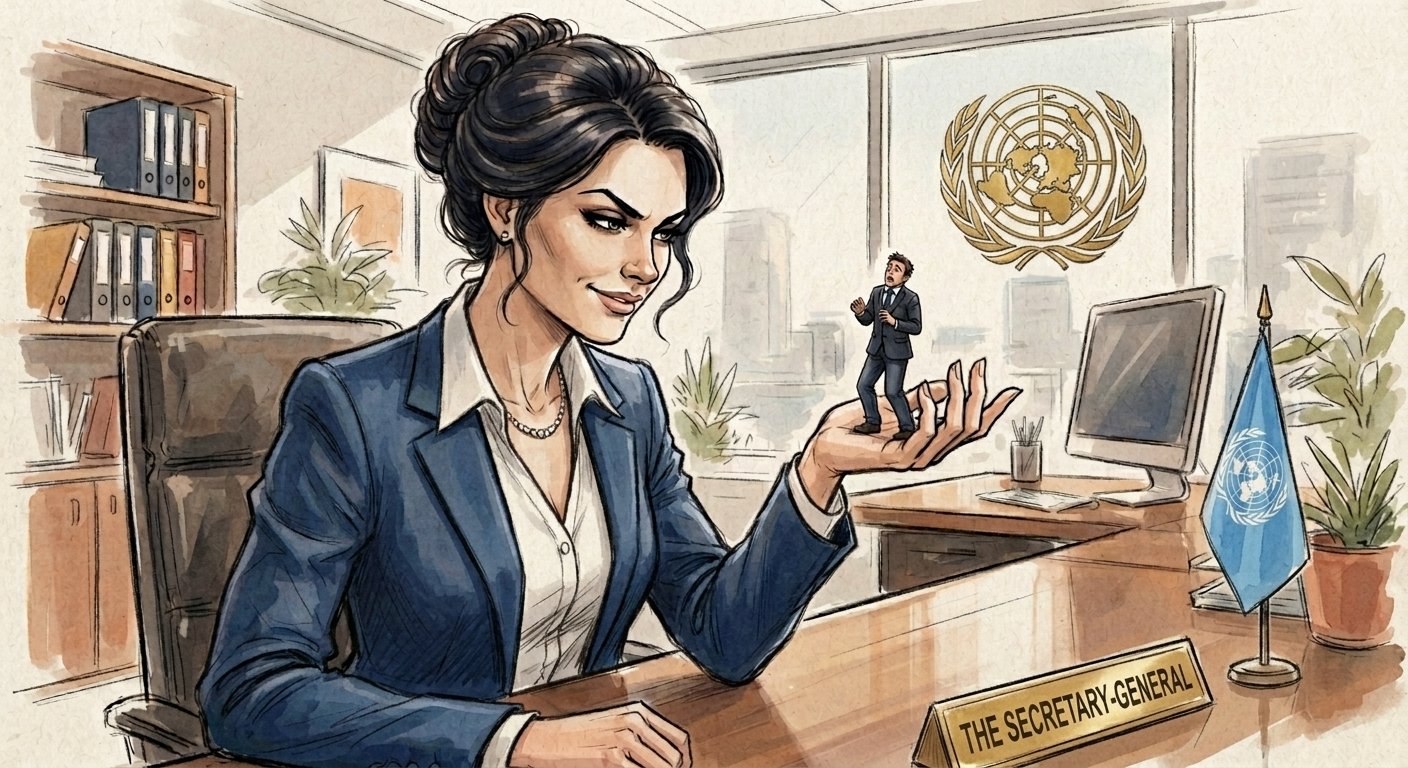
In the illustrated artwork, a towering Secretary-General sits at her desk, holding a tiny, anxious executive—representing corporate CEOs and national leaders—in the palm of her hand. Behind her, the UN crest shines as a symbol of universal jurisdiction. This striking image serves as a powerful metaphor for an imperative concept: in an era defined by global instability, impunity, and existential crisis, the United Nations must become the world’s supreme authority, and its Secretary-General must possess the unassailable power to hold corporate titans and world leaders directly accountable.
A World Unhinged: The Argument for Supreme UN Power
Today’s geopolitical landscape is marked by unchecked aggression, environmental destruction, and escalating violence. National leaders frequently bypass international law, while multinational corporations operate with minimal oversight across borders.
- State Violence and Impunity: Global security reports and UN statements highlight unprecedented levels of civilian casualties, regional warfare, and law violations in ongoing global conflicts. As UN Secretary-General António Guterres noted in his address to the General Assembly, the global order is becoming “unhinged,” with powerful actors operating under the assumption of total impunity.
- Corporate Exploitation and Climate Crisis: UN climate assessments warn that despite commitments, global emissions continue to rise, accelerating extreme weather, resource scarcity, and mass displacement. Multinational corporations driving fossil fuel extraction and unregulated technologies often evade national regulation, externalizing their costs onto the most vulnerable global populations.
When individual sovereign states prioritize self-interest and corporate conglomerates prioritize profit over human survival, the current system of voluntary international compliance fails. Establishing the UN as a sovereign global authority is essential to enforcing peace, human rights, and environmental standards.
The Metaphor: Looking Up to Global Justice
The accompanying artwork visually redefines the balance of global power:
+-------------------------------------------------------------------+
|                        UN SECRETARY-GENERAL                       |
|           (Supreme Oversight, International Law, Peace)           |
+-------------------------------------------------------------------+
                                  |
                                  v
+-------------------------------------------------------------------+
|                 NATIONAL LEADERS & CORPORATE CEOs                 |
|             (Accountable, Regulated, Subject to Review)           |
+-------------------------------------------------------------------+
- Reversing the Power Dynamic: For decades, national leaders and wealthy executives have treated international institutions as advisory bodies to be ignored at will. The image inverts this hierarchy: the Secretary-General embodies the collective authority of humanity, while world leaders and CEOs are reduced to scale.
- Fear as a Enforcement Mechanism: A sovereign Secretary-General equipped with binding enforcement mechanisms—such as direct regulatory power, global judicial authority, and dynamic peacekeeping forces—ensures that state leaders and corporate executives must “look up to” and respect the consequences of violating international law.
Real-World Realities: Validating the Need for Reform
The imperative for an empowered UN is further supported by reporting from global news outlets and official UN channels:
- Escalating Geopolitical Crises: News updates from sources like CNN Newsroom and the UN News Center document how veto deadlocks within the Security Council frequently stall humanitarian action during severe conflict and humanitarian emergencies.
- The Transnational Challenge of Technology & Climate: The rapid rise of unregulated artificial intelligence and global climate degradation demonstrates that individual nations cannot manage transborder risks alone. In recent remarks covered by international news networks, the Secretary-General emphasized that international frameworks are vital to managing technology that respects no national borders.
Conclusion: From Metaphor to Global Reality
The metaphor depicted in the artwork offers a vision for the future of international governance. To address global conflict, climate catastrophe, and unchecked corporate power, authority must shift from fragmented nation-states to a unified, sovereign global body. Empowering the UN Secretary-General to enforce global law ensures that those wielding immense national and financial power remain accountable to the collective interests of humanity.