
Taming the Tool: Why AI Demands Global Regulation and a Focus on Labor, Not Sci-Fi
The public discourse surrounding artificial intelligence is frequently pulled in two opposing, unhelpful directions. On one side, tech evangelists promote an uncritical utopianism, promising a frictionless future of boundless productivity. On the other, popular media and speculative commentary lean heavily into science-fiction tropes, fixating on existential threats, sentient algorithms, and dystopian scenarios of AI “taking over” the world. Both narratives obscure the reality of the technology. Artificial intelligence is neither a conscious overlord nor a magical panacea; it is a powerful, highly scalable general-purpose technology. Like the steam engine, the assembly line, or the internet before it, its societal impact will be determined entirely by how it is governed, owned, and deployed. To ensure that the dividends of this technology serve society broadly rather than concentrating wealth in a few hands, AI must be systematically regulated for the common good, with the United Nations playing a central coordinating role.
Dispelling the Sci-Fi Distraction
The obsession with science-fiction dystopias—where rogue machines outwit humanity—does a profound disservice to current policy discussions. These narratives frame the challenges of AI as technical problems of alignment or control over an autonomous entity, when they are, at their core, political and economic problems regarding human choices. Algorithms do not act with intent; they optimize for metrics defined by their creators and owners.
When we worry about AI, we are not worrying about a Terminator scenario. We are worrying about concentrated corporate power, opaque decision-making systems deployed in healthcare, criminal justice, and finance, and the speed at which automation is reshaping the economic landscape. By treating AI as an impending sci-fi crisis, policymakers risk missing the immediate, terrestrial disruptions happening right now in workplaces across the globe.
The Real Crisis: Work, Jobs, and Economic Distribution
The defining challenge of the artificial intelligence era is labor displacement and wealth concentration. Previous technological revolutions automated manual labor or routine cognitive tasks, eventually creating new industries and higher-value jobs. However, generative AI and advanced machine learning are compressing this transition timeline and encroaching directly upon professional, creative, administrative, and analytical work.
As corporations race to substitute human labor with algorithms to drive down overhead and maximize shareholder value, the risk of structural unemployment and underemployment grows sharply. The fundamental problem is not that machines are thinking; it is that capital is substituting for labor at an unprecedented scale.
When productivity rises while labor’s share of income shrinks, wealth concentrates rapidly among the owners of capital—the tech conglomerates and asset holders who control the proprietary models and infrastructure. Left unaddressed, this dynamic will exacerbate wealth inequality to unsustainable levels, hollowing out the middle class and destabilizing consumer-driven economies. If AI drives productivity sky-high while mass populations lose secure livelihoods, the economic system fails its primary purpose: providing for the well-being of its people.
Controlling Technology for the Common Good
Technology is not an exogenous force of nature; it is a human construct subject to democratic governance. Throughout history, societies have established guardrails around powerful technologies—such as pharmaceuticals, aviation, and financial markets—to protect public health, safety, and economic stability. AI requires the same pragmatic, institutional approach.
Regulating AI for the common good means shifting the regulatory paradigm from reactive damage control to proactive social stewardship. This involves several critical steps:
- Labor Protections and Transitions: Implementing policies that safeguard workers, provide robust safety nets, and manage the transition of displaced labor through public investment in education and re-skilling.
- Fair Distribution Mechanisms: Exploring economic frameworks—such as productivity taxes, data dividends, or broadened ownership models—to ensure that the immense wealth generated by automation is shared widely across society rather than funneled exclusively to a corporate elite.
- Transparency and Accountability: Enforcing strict standards for algorithmic transparency, data sourcing, and bias mitigation, ensuring that deployment serves public interest metrics rather than purely commercial exploitation.
The Role of Global Governance and the United Nations
Because digital networks, data flows, and multinational tech firms operate across national borders, localized regulation alone is insufficient. A patchwork of national rules will allow capital and technology to migrate to jurisdictions with the weakest oversight, sparking a regulatory “race to the bottom.”
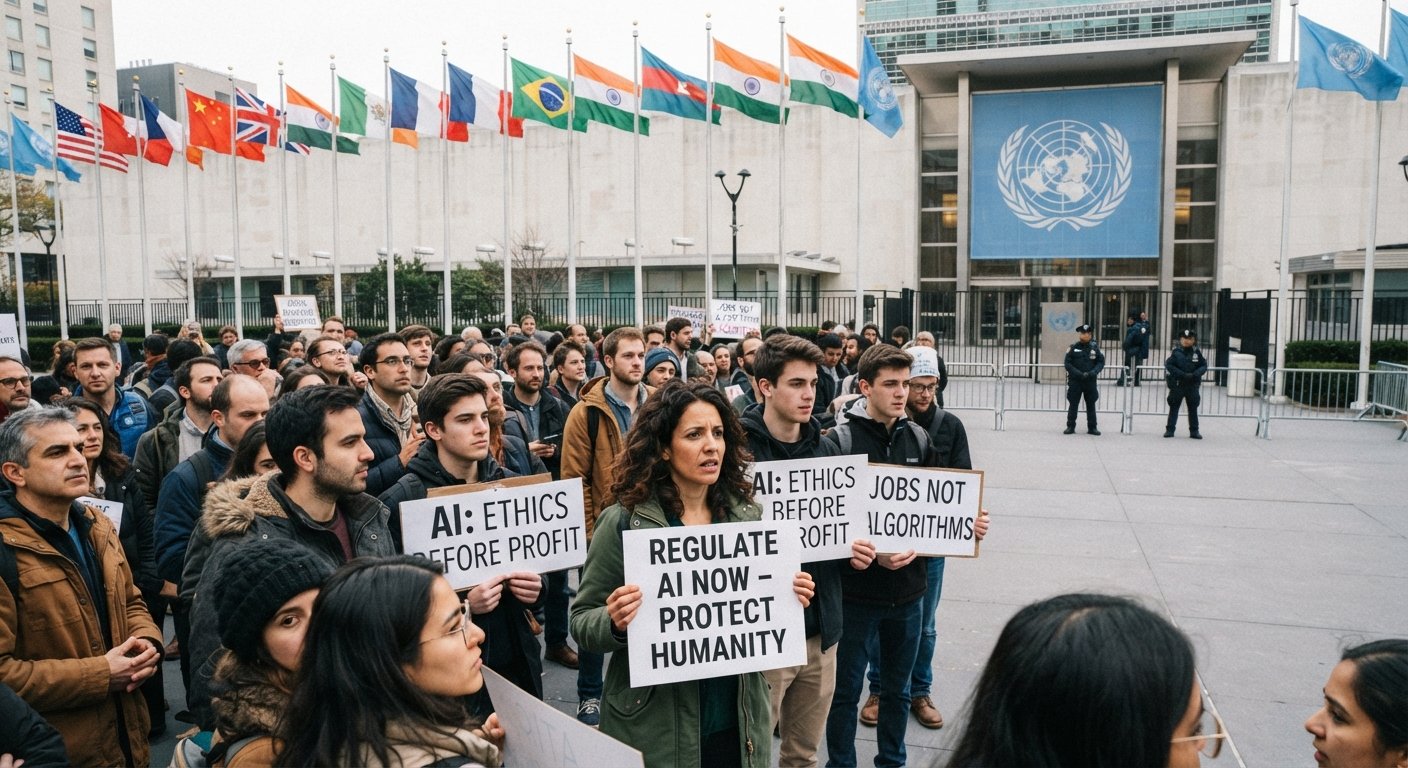
This is where the United Nations must step in. As the premier global forum for multilateral cooperation, the UN is uniquely positioned to establish baseline international standards and norms for AI governance. Just as the global community has coordinated treaties on environmental protection, nuclear non-proliferation, and human rights, it must forge a cohesive international framework for artificial intelligence.
The UN can facilitate agreements on ethical deployment, foster technology transfer to ensure developing nations are not left behind in the digital economy, and provide a neutral ground to balance corporate ambitions against human rights. By anchoring AI oversight within an institution dedicated to global welfare, humanity can treat artificial intelligence for what it truly is: a powerful tool that must be harnessed collectively, fairly, and deliberately for the benefit of all.